
CHAPTER 2
LITERATURE REVIEW
2.0 INTRODUCTION
The review of relevant literature as seen in some academic publications is not a mere formality. The purpose is to broaden understanding of past and present studies, including intellectual debates, theories, concepts and relevant data in the field or area of study. A good literature review should be coherent, critical, and have a storyline. This implies that a substantive, thorough and sophisticated research can be qualitative or quantitative. However, any information collected from books, journals, or articles, including contributions from the researcher, are open for validation by other authors with proven knowledge and evidential experience on the subject area. The continuous search for answers helps authors to identity knowledge gaps in existing studies. Thus, literature reviews empower scholars find more effective solutions to their various research questions. But a literature review does not just evaluate how knowledge has changed within the field; it provides information on widely accepted facts, including current and emerging areas related to the research topic (Rowly & Slack, 2004; Wouters et al, 2016; Rana et al, 2022).
2.0.1 DEFINITION OF CONCEPTS
Business administration involves a cumbersome process of managing human and material resources to create sustainable value for the company. According to Frandsen et al (2017), business development activities are more likely to yield positive results if managers correctly apply proven strategies and continuously adjust people, process, and technology. These approaches do not only provide competitive advantage, but they are also necessary for creating sustainable value for key stakeholders and building strategic partnerships with investors, consumers, and industry players. The central role of marketing in business development cannot be overemphasized. Marketing is a coordinated activity such as content creation, branding and data-driven advertising undertaken to increase sales and sustain competitiveness (Koetz, 2019). The key roles of marketing are to: (a) create awareness for products and services (b) identify new customers (c) increase demand for goods and services, and (d) create a sense of urgency among consumers that drives them to pay for products or services. Marketing is often interchangeably used with brand awareness creation due to the blurry line between both concepts. While brand awareness creation focuses of increasing consumers’ knowledge about a company and its products, services or brand attributes, marketing is all about sales, profits, and market dominance. Brand marketing is therefore defined as an offline and internet-based communication strategy for improving consumers’ perception of a company, its products, services, market environment, business plan and brand value. Although brand marketing increases market share, brand marketers in the twenty-first century would make insignificant impact in their brand awareness creation efforts without cutting-edge technologies such as data analytics, artificial intelligence, cloud computing and related systems. For example, the future of social media, which is a major source of intent data, depends on technologies such as AI, augmented reality (AR), Blockchain and Internet of Things (IoT) that make it easy to create and share contents as well as integrate responsive systems in smart devices thereby making it easy for digital marketers to gain insights on real-time consumer details. But while digital marketers have maximized intent data to change brand marketing outcomes, some of the major challenges faced by digital marketers are: (a) cut-throat competition among big brands (b) unpredictability of consumers’ buying behaviour (c) limited budgets (d) high demands from consumer-centric markets (e) ability to constantly create unique, engaging and mobile-friendly contents (f) complexity of digital tools, and (g) fast-changing trends and updates that negatively affect search engine optimization (SEO) and social media marketing activities of companies.
Brands establish marketing and sales department to identify consumer needs, assist in product development, design marketing strategies, and highlight unique value proposition. In the marketing domain, value proposition means the benefits and economic value which companies and existing or future customers expect from offering/purchasing products or services. On this backdrop, digital marketing companies (e.g. Salesforce) provide services such as (a) generating workable business ideas (b) unlocking user-generated data from search engines (c) identifying high-impact factors in customer relationship management (CRM) (d) enhancing sales channels, and (e) converting leads into sales. While digital marketing is an important for achieving sales growth and business survivability, evidence-based research indicates that intent data-driven marketing is not just the solution to reaching more consumers but the unknown secret to strengthening competitive advantages (Vincent, 2016; Varadarajan, 2018).
2.0.2 INTENT DATA
Intent data is a dataset containing specific details of what consumers are searching or buying online. Digital marketers use intent data collected from internet-based devices to predict future buying behaviours. Thus, tech-savvy business managers use intent data to connect the missing dots between marketing and sales. Intent marketing therefore involves use of bots—e.g. Salesforce Marketing Cloud app—to deliver personalized messages for consumers in different market segments. For example, display ads are designed to be unique and highly engaging to increase chances that web users would click to learn more, ask questions or make purchase when contents are viewed from different touchpoints (e.g. smartphones, tablets, computers etc). For example, when an internet user visits a website and clicks on visual ads or backlinks, the marketing and sales department gets an automated notification showing details of a new.
At this point, a marketing and sales team using Salesforce AI-powered Sales Cloud system gathers important details about the new or old customers and advises key personnel on the best time to take specific actions that might convert leads to sales. Because the support team can see personal details of all customers (such as full names, age, gender, location, phone number, shopping preferences, complaints log etc), they can maximize the data to deliver surprise-and-happy moments, resolve issues faster, and consistently engage in cross-company meetings or discussions to sustain positive customer experience (CX) (Shiner, 1988; Steven & Griffith, 1997, Mutchler, 2019).
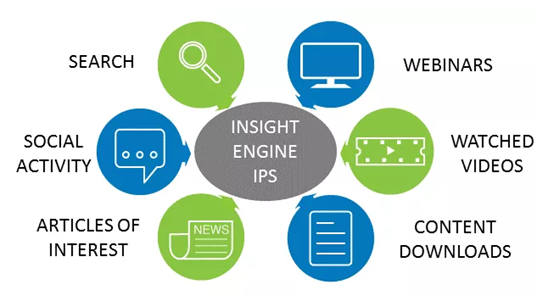
Figure 2.1: How Intent Data is Collected
Source: Saleschoice (2022)
As shown in Figure 2.1, businesses use intent data for the following:
- To identify which websites consumers are visiting.
- To record the length of time every customer spends on specific websites.
- To know every product or service consumer searched for, and
- To view their product reviews and online subscriptions.
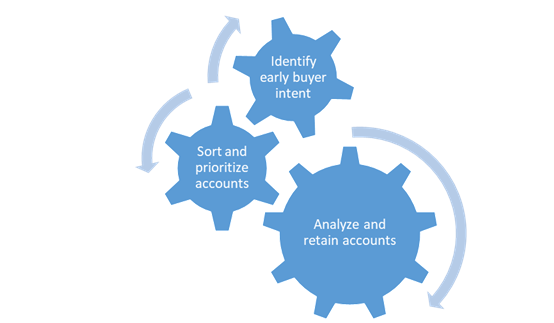
Business-to-business (B2B) marketers use intent data to efficiently manage customer journeys and close deals better. To achieve these purposes, they categorize intent data into two. First-party intent data is assessed by direct observation and interaction with target audience (that is, customers or prospects) via emails, social media platforms and company-owned websites. The second category, third-party intent data, issieved from websites owned by other companies such as publishing networks and product/service review websites—with a possibility of targeting their customers and prospects. Intent data helps marketing teams to focus on the right leads, enhance customer experience, and retarget lost leads. Over 70% of B2B marketing agencies are already leveraging intent data to increase brand awareness and profits. But while intent data has empowered digital marketers to easily identify and influence “invisible buyers” as shown in Figure 2.2, about 75 percent of companies are yet to maximize the huge benefits of intent data (Sharma, 2011; Ab Hamid et al, 2022; Arora et al, 2022; Radder & Huang, 2008; Ghorbanzadeh et al, 2022).
Figure 2.2: Intent Data and Use Cases
Source: The Author (2022)
Intent data is the future of B2B and B2C marketing and sales. It has become increasingly relevant as a reliable tool in digital marketing. Not only that, but intent data is also a lifeline to innovative brands that understand how AI-powered insights can be integrated in marketing to achieve profitability (Melewar et al, 2012; Park & Chang, 2022).
2.0.3 BRANDING
In marketing and management contexts, branding entails use of symbolic representations that helps consumers to identify and differentiate companies and products. Thus, branding involves choosing a corporate name, logo or slogan that provides unique—and somewhat legal—identity in a saturated global marketplace. The effectiveness of branding strategies determines whether a company will achieve competitiveness or not. Branding can be categorized as Online/Offline Branding, Personal Branding, Product Branding, Service Branding and Corporate Branding among others. Branding is an important business strategy in competitive markets because it leaves a memorable impression on consumers and constantly reminds both customers and staff of what is expected from the company (Koporcic et al, 2018; Saraniemi, 2011; Thottoli et al, 2022; Shtovba et al, 2020).
Brand perception is the holistic ideas about the products and services offered by a brand. It is a mental picture created by assessing if a brand/company is committed to fulfilling its CSR obligation, investing in global sustainability, and doing exactly what it promised to all stakeholders, especially the consumers. This impression is, however, influenced by consumers’ understanding of the brand’s corporate values and the shared experiences from people (consumers and competitors) who have used the product and/or service. Brand perception evaluates how well people know a brand and the value placed on it. Therefore, brand equity, which determines the profitability of a company, is a result of brand perception—and these can be strengthened when customers recommend a product or service to other people (Bibby, 2009). Brand perception can gain wider acceptance when people use and recommend the product/service by sharing individual experiences, highlighting their functionality, and affirming through social media platforms, face-to-face interactions or word-of-mouth that the brand is reputable and deserving of the vibe. (Aaker, 1991; Aaker, 1996; Basuroy et al, 2003)
Brand awareness means the extent of knowledge people have about a company, including its products, service, and attributes. Brand awareness is also an evaluation tool for understanding how a company measures against market competitors. Marketers develop brand awareness strategies to ensure that the company and its products or services are not easily forgotten. Social media platforms (e.g. Twitter, Facebook, WhatsApp, Instagram etc) have become an important tool for brand awareness marketing and this trend, in connection with intent data, will be fully discussed as the central themes of this research (Baumeister et al, 2001; Ab Hamid et al, 2022; Avery & Gupta, 2015).
2.1 THE BRAND MARKETING METRICS
Experts in the business domain are consistently highlighting the importance and benefits of sustainability, ethics, and Corporate Social Responsibility (CSR) in organizations (Romaniuk et al, 2017; Rosli et al, 2020). According to Henry Ford (the founder of Ford Motor Company), ‘You cannot build a reputation on what you are going to do.’ This implies that brand awareness creation requires decisive actions driven by reliable data and insights. Thus, brand marketing objectives must be consumer-centric, visionary, and purposeful to successfully build relationships, strengthen consumer loyalty and increase sales. There is also need for organizations to humanize their marketing strategies to deliver the authentic consumer experience (CX) that ensures profitability, boosts brand equity, and guarantees long-term survivability. In other words, “technology with human touch” has become a maxim for shrewd marketers who are keen on leveraging intent data to create lasting bond with consumers, drive sales, and regularly maximize user-generated content (UGC) (Balmer, 2017; Olanipekun & Adelekan, 2022).
AWARENESS, ATTITUDES AND USAGE (AAU)
To understand the brand awareness of a company, certain metrics such as the AAU model, which measures the hierarchy of effects, is highly effective (Casidy et al, 2022). The AAU framework is commonly used among marketers because it provides an empirical insight on the levels of customers’ knowledge about a brand, intentions to pay for certain products or services, as well as personal beliefs that influence behaviour (Lau et al, 2022). Results obtained from the AAU model are commonly described as “tracking data” due to their relevance in tracking consumer awareness, attitudes, and behaviour. But research on AAU often serves as a comparator, thus, results are more useful when juxtaposed against one or more variables in digital marketing (Balmer, 2017). The metrics may include data collected from various geographical markets, different competitors, or price timelines. Main purpose of the AAU model is to identify and keep real-time records of consumer attitudes and behaviour—especially on digital devices (Frandsen et al, 2017; Maar et al, 2022).
Scholars in the business domain use AAU metrics to elaborate Hierarchy of Effects theory, which claims that customers pass through continuous stages—starting from a period when they had no knowledge of a brand to other sequential stages when brand awareness inspires an initial purchase 9of products and services) and then leads them to the loyalty stage as shown below (Lavidge & Steiner, 1961).
Figure 2.3: Hierarchy of Effects Theory
Source: Adapted to Lavidge & Steiner (1961)
The AAU model is designed with metrics that enables marketers to identify and track changes in the knowledge and beliefs held by consumers, as well as their actions. Although the AAU framework may not provide detailed information about web users who are loyal customers to a brand, it categorizes customers as heavy or light based on their social media usage, demographics, geographical locations, psychographics, and purchase records. Information gathered from these metrics help marketers to understand why specific web users patronize or overlook certain products and services (Davcik & Sharma, 2015; Koporcic et al, 2018).
AAU studies usually involve use of questions that aid understanding of the relationship between consumers and brands—such as who are the acceptors and rejecters of a product? How do web users feel when they see pop-up advertisements about a brand?
Table 2.1: Typical AAU Questions
| Type | Metrics | Sample Question |
| AWARENESS | Awareness & Knowledge | Are you aware of Brand X? What comes to your mind when you hear “CRM” software? |
| ATTITUDE | Beliefs & Intentions to Buy a Product / Service | Do you use Brand X? Why would you repeat purchase of Brand X? What do you dislike about Brand X? On a scale of 1 to 5, is Brand X for young people? |
| USAGE | Purchase History & Loyalty | How often do you use Brand X? |
As shown in Table 2.1, marketers use consumers’ response to these questions to design comprehensive metrics that reliably indicate brand awareness performance—such as customers’ intention to buy, and their willingness to recommend a product or service to others. With intent data and other diagnostic metrics, digital marketers easily understand why specific consumers would most likely complete a purchase or recommend the brand to others, so it becomes easy to easily identify potential buyers and attach high priority to them. Although some consumers in the AAU model may have no prior knowledge of a brand, some of them have possibly heard or seen but never used the product or service and cannot lay claims to the key benefits (Jun & Park, 2017).
Figure 2.4 The AAU Model

Source: The Author (2022)
- Awareness and Knowledge
Under Awareness and knowledge, marketing experts ask questions about whether consumers in AAU research are attracted by a brand, product category, advertising, or usage experience. The awareness metrics concentrate on identifying the percentage of customers who can recognize a brand through its products, logo, slogan, or other visual attributes without assistance. Likewise, the top-of-mind question is used to understand what consumers first recall when an unprompted statement is made about a product category. Ad awareness measures the percentage of consumers who demonstrate knowledge of a brand’s advert with or without assistance. Lastly, brand/product knowledge focuses on identifying the number of consumers who have in-depth knowledge about a brand name, product category and attributes that influence individual belief about the company (Hankinson, 2005; Jun & Park, 2017).
- Attitudes
As a brand awareness metric, attitudes measure how consumers respond to a product or brand marketing efforts. Attitude in this context is a result of what consumers think and feel about a brand. Although the scope of this research does not allow a detailed review of attitudinal research, the author provides a brief analysis of selected metrics in the field (Radder & Huang, 2008; Maar et al, 2022).
Metrics such as attitudes, liking and image are used together (on a scale of 1 to 5) to rate consumers’ response and level of agreement with statements such as: “Brand X is not for people like me” or “Brand X is ideal for companies in need of aggressive social media advertising.” Metrics designed with data from qualitative surveys like this are found to be relevant in brand marketing. Perceived Value for Money is the second metric under attitudes. It prompts survey respondents (consumers) to rate their response or level of agreement (on a scale of 1 to 5) to propositions such as, “Brand X is reputable because it is consistent with value creation and consumer satisfaction” or “Brand X gives value for the money.” The Perceived Quality and Esteem metric gives study participants a chance to rate competing products in the same category on a scale of 1 to 5. On the same scale, Relative Perceived Quality metric is used to compare a brand product to other alternative products in the market or category. But Intentions metric analyses the willingness of consumers (research correspondents) to act in a certain way (Lau et al, 2022). Thus, intent data gathered from the AAU model comes from survey questions such as: “Would you consider buying similar product from another brand if your favourite is not available?” Intention to Purchase also investigates why people buy certain products. Data on consumers’ intention to buy is usually collated from responses or levels of agreement (on a scale of 1 to 5) with statements like “I strongly believe that I need this product” or “It is very likely that I will buy the product” (Kozielski et al, 2017; Maar et al, 2022)
- Usage
Usage is part of the AAU metrics. It measures self-reported behaviours collected from research surveys. Basically, measures of usage concentrate on individual activities such as how often a consumer buys certain products and the quantity purchased in each transaction. Usage data goes further to record the time and location of purchase. Marketers analysing usage metrics also aim at identifying the number of consumers who have tested the product(s), what percentage disliked the product(s), and what percentage willingly identifies with the brand to the extent of adding it to their daily portfolio of brands. Sample survey questions for measuring usage include: “How many Salesforce products are you conversant with? What level of Salesforce package is your company using? When was the last time your company upgraded or added new Salesforce systems? Do you have a personal subscription on Salesforce systems?”
Even when AAU studies are conducted with the most effective or widely accepted methodologies, there could be discrepancies in tracking data obtained at different times—and this makes the results less reliable. Therefore, users of AAU metrics must apply their experiences to correctly differentiate between seasonal buzz from actual trends and patters (Rachmawati & Suroso, 2022). Some of the data gathering techniques and data review process proven to be helpful in making this distinction are as follows:
- Managers should adjust for periodic changes while preparing or administering questionnaires. While decision on how participants should be contacted (via email or telephone) can be made based on whether they have a paid or free subscription, different data collation methods may require changes in norms and values used to determine “good/acceptable” or “bad/unacceptable” responses. Further, marketers should not ignore sudden changes in data collected at different times. If this occurs, an analysis should be conducted to ascertain whether the change was an outcome of change in methodology.
- Responses from participants should be categorized under “customer responses” and “non-customer responses” because causal links between the three AAU metrics are not always specific—despite claims by the Hierarchy of Effects theory that awareness, attitudes and usage follow a sequential process. For example, someone who does not have knowledge of a product may use it first before learning more about the brand or liking it (Lavidge & Steiner, 1961).
- Category dynamics between attitudes, retail/distributor sales and company shipments can be identified by triangulating directions of customer survey data and variables such as shipments, sales revenue, and overall business performance. For example, a toy manufacturer would first ship products to retailers before investing in advertisements that would increase awareness, boost purchase intentions, and drive sales (Maar et al, 2022; Lau et al, 2022).
2.2 HIERRACHY OF EFFECTS THEORY
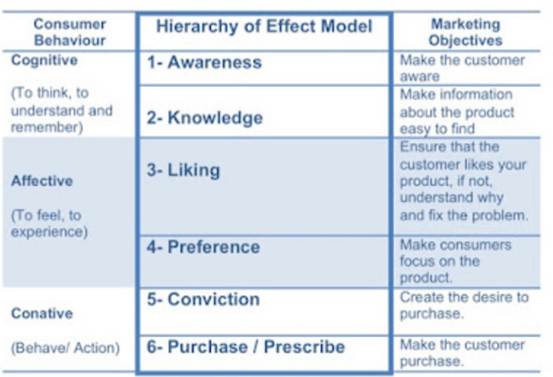
The Hierarchy of Effects theory was designed by Lavidge R. J. and adapted in studies by other authors in the 1960s. According to the original work published in 1961, Lavidge explained that consumers move through a six-stage cycle starting from brand awareness to knowledge, liking, preference, conviction and the purchase of a product (Lavidge & Steiner, 1961; Chakravarty & Sarma, 2022).
Table 2.2: The Hierarchy of Effects
Source: Adapted to Lavidge & Steiner (1961)
The “Hierarchical of Effects” theory has different models with slight variations from different authors. Although the theory was first designed and reviewed by St. Elmo Lewis in 1898 and 1900 respectively, the theory has maintained relevance among modern-day academicians and business managers (Cappo, 2003; Chakravarty & Sarma, 2022). But the basic sequence as outlined by Lavidge and Steiner (1961) is as follows:
Cognition (C) – Affect (A) – Behaviour (B)
The Hierarchy of Effects sequence shown above is sometimes known as the C-A-B framework. Other recent changes to the model were designed to accommodate technology diffusion in marketing and the influence of social media on consumers’ purchasing habits. Therefore, the adaptations as shown in Table 2.3 are specifically for the benefit of web users who prefer to shop online.
Table 2.3: Changes in the Hierarchy of Effects Model
| Basic AIDA model | Awareness → Interest → Desire→ Action |
| Modified AIDA model | Awareness→Interest→ Conviction → Desire → Action |
| AIDAS Model | Attention → Interest → Desire → Action → Satisfaction |
| AISDALSLove model | Awareness→ Interest→ Search →Desire→ Action → Like/dislike → Share → Love / Hate |
| Lavidge et al’s Hierarchy of Effects | Awareness → Knowledge → Liking → Preference → Conviction→ Purchase |
| DAGMAR Model | Awareness → Comprehension → Attitude/ Conviction → Action |
| Rossiter and Percy’s communications effects | Category Need → Brand Awareness → Brand Preference (Ab) → Purchase Intent → Purchase Facilitation |
2.3 THE Q SCORE
Because AAU metrics have great importance to marketers, and for the fact that there is no one-size-fits-all approach to evaluating the variables, many digital marketing companies like Salesforce, Microsoft, HubSpot, Oracle, Zendesk and others are investing more in Research and Development (R&D) to stay in tune with technology trends and changing consumer habits. One of the advanced proprietary systems for evaluating AAU variables in the United States, particularly likeability, is the Q Score (Kozielski et al, 2017; Uhm et al, 2022)
Q Score is a reliable tool for measuring the attractiveness and popularity of a brand (such as companies, products, TV shows, celebrities etc). It is widely used in the digital marketing, media, advertising, and public relations industries. Designed by Jack Landia in 1963, the Q Score 9also known as Q factor or simply Q) is owned by Marketing Evaluations (a New York-based company offering services such as opinion polls and market research for advertising agencies and marketers). Like Salesforce, Q Score provides real-time information, data-based analysis, and interpretations about the extent to which consumers like or dislike certain brands, products, celebrities and more (Williams & Koekpe, 2006). Both digital marketing companies—Salesforce and Q Score—are reputable for sieving complex data and presenting it in a single measurement with the following ratings:
A. One of my favourites
B. Very Good
C. Good
D. Fair
E. Poor, and
F. Never heard of
Among all metrics and concepts relating to AAU, “likeability” is preferred for various reasons. Q Scores function with direct responses from consumers. Although the Q Scores system is sophisticated, its popularity and success in the marketing domain are well earned because the model encourages use of research correspondents (consumers) who know the brand and are willing to share their preferences (Xue & Deng, 2012).
The formula for calculating positive Q Score is:
In quantitative evaluations, the Q Score is calculated by checking the number of research respondents who answered “A,” dividing the sum by the number of those who gave answers ranging from A to E (that is, A, B, C, D or E), and working out the percentage by multiplying the fraction by 100.
{\displaystyle Q_{+}={\frac {\text{favorites}}{\text{known}}}\times 100}The negative Q Score is also checked by adding the percentage of consumers (research participants) who answered D or E relative to others in the group who answered A to E as follows:
{\displaystyle Q_{-}={\frac {\text{disliked}}{\text{known}}}\times 100}
Numerous metrics (such as Nielsen ratings) have been used to check the likeability, popularity or appeal of brands, but Marketing Evaluations considers Q Score as the most effective tool for marketers seeking understanding of the link between brand awareness and intent data. The company has different categories of Q Scores vis-a-vis:
Table 2.4: Categories of Q Score Ratings
| Q Score Category | Description |
| Brand Attachment Q | Rates brand and company names |
| Cable Q | Rates cable television programs |
| Cartoon Q | Rates cartoon characters, video games, toys, and similar products |
| TVQ | Rates broadcast television programs |
| Performer Q | Rates living celebrities |
| Sports Q | Rates sports figures |
| Kids Product Q | Rates children’s responses to brand and company names |
| Dead Q | Rates the current popularity of deceased celebrities |
Source: Marketing Evaluations (2022)
2.4 CONCEPTUAL FRAMEWORK AND SUPPORTING THEORY
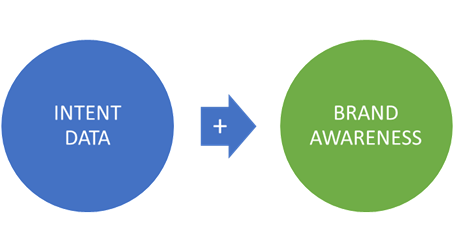
A conceptual framework is used in academic studies to explain the relationship between variables. It outlines the relevant objectives of a chosen research process and maps, and ultimately, illustrates how variables link up to make rational conclusions. This paper therefore explores the correlation between dependent and independent variables, which may be two or more and different in nature, form, pattern, direction, strength, or relationship. Basically, the conceptual framework for this study starts with the question: “Is there a relationship between brand awareness (X) and intent data (Y)” – where X is the independent variable and Y is the dependent variable.
Figure 2.5: Theoretical Concepts
Source: The Author (2022)
According to Aaker (1991), there is a positive relationship between brand awareness and consumers’ intention to pay for goods and services. Based on the empirical research supported by other relevant studies in the business domain, the first hypothesis for this research is:
Hypothesis 1: Brand awareness has a positive correlation with purchase intention.
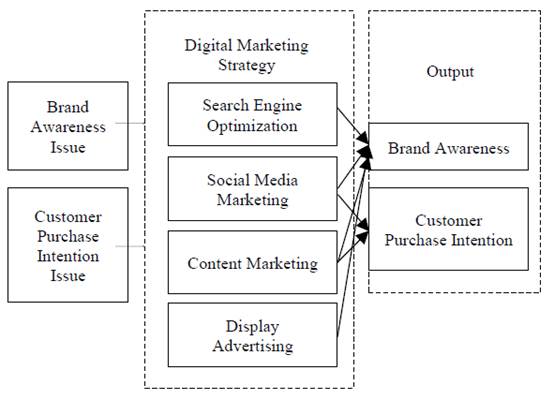
Brand awareness is strengthened by brand marketing, brand association and perceived quality—all of which combine to improve purchase intention, customer experience, brand equity and loyalty. Experts in sales and marketing management also agree that the success of modern-day brand awareness efforts largely depend on the effectiveness of digital marketing strategies. Thus, Search Engine Optimization (SEO), social media marketing, content marketing and display advertising are the bedrock of brand marketing as shown in Figure 3.2, customer purchase intention is measured through these metrics as dimensions. And central tenet of the research model is from Lavidge and Steiner’s Hierarchy of Effects theory, which states that advertising (or brand marketing) has a significant impact on consumers’ decision to purchase or not purchase a product or services.
Figure 2.6: Dimensions in Brand Awareness and Intent Data
Source: The Author (2022)
According to the Activation Theory by Anderson (1983), business owners should focus on building an emotional connection between brands and consumers to consistently deliver an interactive and immersive journey that leaves a positive perception of a brand in consumers’ minds. This memorable experience is necessary not just to connect with consumers but to showcase the company’s values and ultimately improve customer engagement. Hence the second proposition:
Hypothesis 2: Positive Brand Associations increases brand loyalty.
Through awareness, a consumer can compare two brands in the same product segment and decide on what factor or preference should a product or service gain better rating than others. Is its perceived quality, price, brand equity emotional attachment etc? Hence the third proposition:
Hypothesis 3: A consumer’s evaluation of a brand is an outcome of cognitive functioning.
The study goes further to analyse the impact of social media marketing and consumers’ purchase intention with focus on education, technology savviness and access to digital devices. The author observed that brand loyalty is connected to cognitive functioning because an individual’s preference (liking0 for a product is not dependent on the tangible or intangible attributes of a brand. Using these three hypotheses, the author considers “brand awareness” an independent variable for the structural equation (Hafez, 2018; Rachmawati & Suroso, 2022).
REFERENCES
Leave a Reply