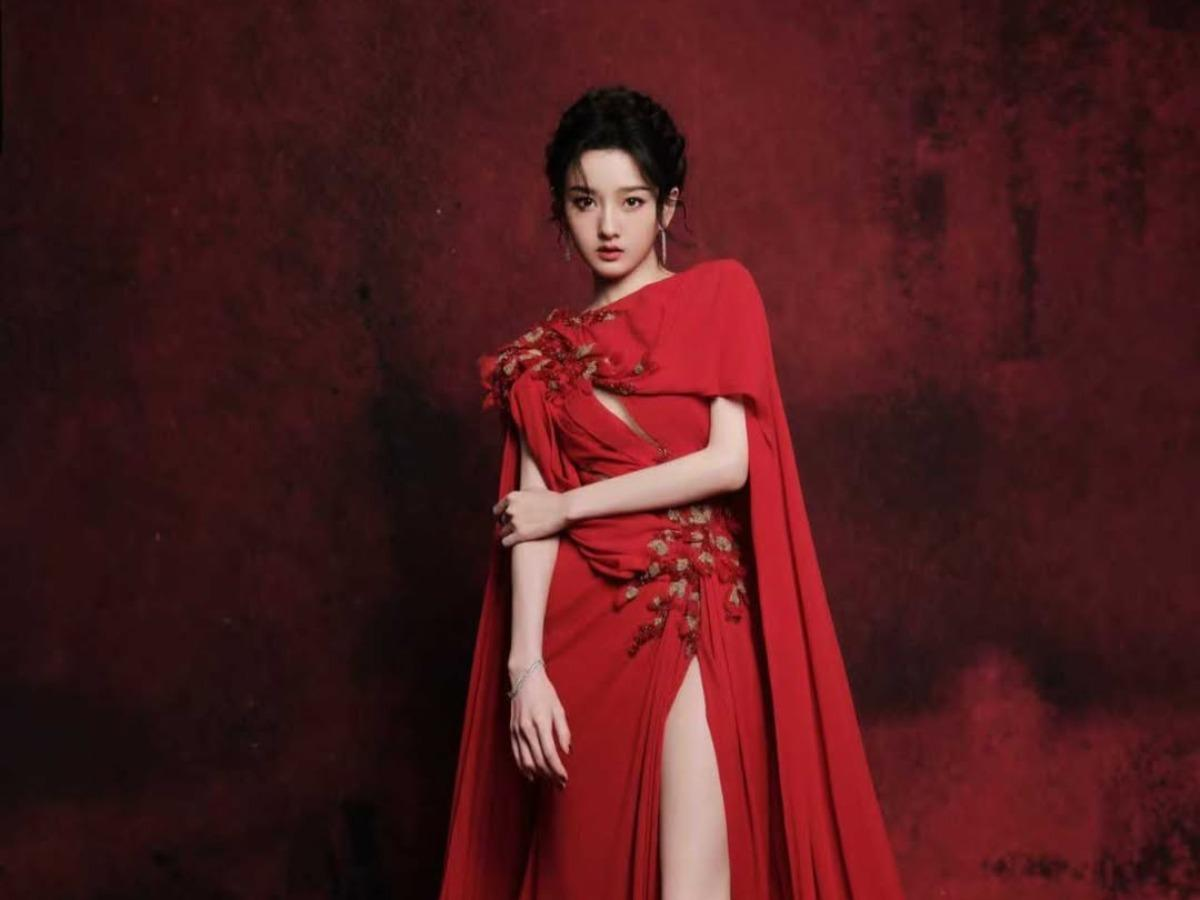
In the ever-churning landscape of Chinese entertainment, few stars encapsulate the public’s polarizing love-hate relationship quite like Song Zu’er. The 28-year-old actress—forever etched in memory as the feisty, red-clad “Little Nezha” from The Legend of Bao Lian Deng—has navigated one of the most tumultuous careers of her generation. For many, she is the girl who embodies a star-crossed narrative: half-brilliant, half-woeful. Yet, beneath the surface of her luminous smile and undeniable talent lies a field of controversy that has left public opinion perpetually fractured. To understand the Chinese audience’s relationship with Song Zu’er is to explore a story of immense promise, stark disappointment, and the fragile nature of celebrity in the digital age.
Why Chinese People Love Song Zu’er
1. She’s a Gorgeous “Childhood White Moonlight”
One thing is universally agreed upon: Song Zu’er is breathtakingly beautiful. With exquisite facial features, a petite figure, and an innate aura reminiscent of a vintage Hong Kong screen goddess, she is frequently hailed as one of the “Four Great Beauties” of the post-95s generation. Her “face of a pampered beauty” garners huge praise for its high degree of recognition, allowing her to remain stunning from childhood to adulthood—a rarity among child stars. Whether styled in flowing ancient costumes or modern, cutting-edge fashion, her visuals consistently generate viral moments online, with many calling her a “visual ceiling” of domestic entertainment.
2. An Acting Talent That Can Really Deliver
While her looks might draw people in, it is her acting that has genuinely won over skeptics. Song Zu’er is not just a “vase”; many praise her as a naturally gifted, “strength-based” performer. Her performance as the rebellious and naive Qiao Simei in The Bond is widely cited as her breakout role, showcasing a significant upgrade in her emotional range. Beyond this, her acclaimed crying scenes in The Promise of Chang’an and Luoyang have repeatedly demonstrated her ability to portray complex emotions, earning her significant acting awards and solidifying her status in the industry.
3. A Real, Unpolished Personality
In an industry often criticized for fake personas, many fans and casual viewers appreciate Song Zu’er’s natural, unfiltered, and grounded personality. She is known for being a “chatterbox” who uses humor to break the ice and make others feel comfortable. She jokingly refers to her own lazy, everyday style as “disgusting dressing,” which many initially saw as a relatable attempt to connect with ordinary people. Her role in Forget Me Not Restaurant, where she worked with elderly people suffering from Alzheimer’s disease, is frequently cited as evidence of her genuine kindness and patience, revealing a “gentle, warm, and enthusiastic heart”.
Why Chinese People Hate Song Zu’er
1. The “Trifecta” of Fatal Controversies
If there is a single reason many Chinese viewers have turned against Song Zu’er, it is not her acting or appearance, but a relentless series of explosive scandals that have severely damaged her public reputation.
- The Tax Scandal: This is the deepest wound. In 2023, a former employee accused her of tax evasion worth up to 45 million RMB, causing public outrage. Even though her studio later stated that a tax bureau investigation found no issues, the “money-laundering”-like stain proved nearly impossible to wash away, leaving her public image deeply scarred.
- The “Drunk Kicking” Incident: On another occasion, she was filmed kicking a stranger on the street while intoxicated, a behavior widely perceived as arrogant and lacking basic quality.
- Insensitive Public Comments: Her post reading “typhoon day comes to see me off” during the devastating “Doksuri” typhoon, which caused severe floods, was seen by many as profoundly insensitive and lacking empathy, triggering a wave of backlash.
2. A Disconnect Between Image and Reality
Beyond obvious scandals, many viewers have grown tired of what they see as a disingenuous or over-hyped image. Some find her habit of keeping her mouth slightly ajar during performances distracting, breaking the immersion of her characters. Furthermore, her “chatterbox” personality can irritate others; even fellow celebrity Wang Yibo once asked if her family found her annoying. There is also frustration with what is perceived as inconsistent public relations, where attempts to clarify scandals often come across as defensive or even worsen the situation, leaving audiences exasperated.
3. A Self-Defeating “Yan-Ya” Marketing Strategy
Her management has also been blamed for an aggressive and off-putting marketing approach. Critics point to a constant stream of press releases claiming she “outshines” other A-listers like Yang Zi, Ouyang Nana, and Liu Yifei, a “binding marketing” tactic seen as lazy and irritatingly arrogant.
Conclusion: A Star at a Crossroads
Song Zu’er’s story in the eyes of the Chinese public is a poignant one. The sheer volume and severity of the baggage she carries—from potential legal troubles to personal conduct scandals—have created a heavy burden that outweighs the considerable affection many once held for her. She remains a potent symbol of the “red and black” artist: someone with the talent and looks to be a major star, constantly sabotaged by the immense pressure, controversy, and perception of bad faith. While some fans remain steadfast, and the “Nezha filter” still offers a glimmer of warmth, it is an undeniable reality that many now view her through a lens of skepticism, a “spectator” wondering if she will ever truly break free from the scandals and live up to her staggering potential.
Leave a Reply