The Iran war has triggered the sharpest shock to the UK mortgage market since the 2022 mini-budget delivered by Liz Truss, analysis by Moneyfacts has revealed.
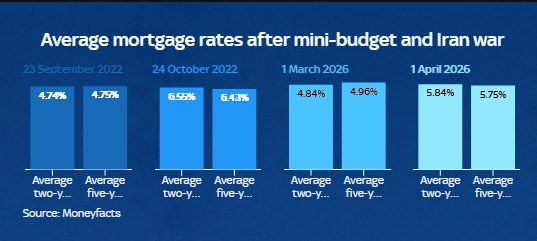
Mortgage rates have soared in recent weeks, with the average two-year fixed deal jumping 100 basis points (bps) from 4.84% to 5.84% in March.
Typical five-year fixes have jumped from 4.96% to 5.75%.
Rates have not risen this sharply since autumn 2022.
At the same time, the number of deals available to borrowers has fallen, with 1,283 products removed.
That represents 17% of the market and the steepest contraction by market share since the mini-budget disruption.
Those rolling off five-year deals have been the hardest hit, with rates up 300bps.
All of this means that typical borrowers now face costs of £150 more a month on a £250,000 loan than at the start of the conflict, with higher LTV borrowers seeing increases of up to £167 a month.
The cheapest 60% LTV two-year fixed rate has risen 109bps from 3.51% to 4.6%.
Adam French, head of consumer finance at Moneyfacts, said: “The conflict in Iran quickly upended rate expectations and sent borrowing costs skyrocketing in the biggest shock to the UK mortgage market since the aftermath of the 2022 mini-budget.
“The combination of rising rates, reduced choice and heightened volatility means borrowers and brokers are operating in a market where timing is critical and the window to secure competitive deals can be very short-lived.
“Unfortunately, anyone looking to buy or remortgage this year needs to prepare for substantially higher borrowing costs than expected before this conflict began.”
Leave a Reply