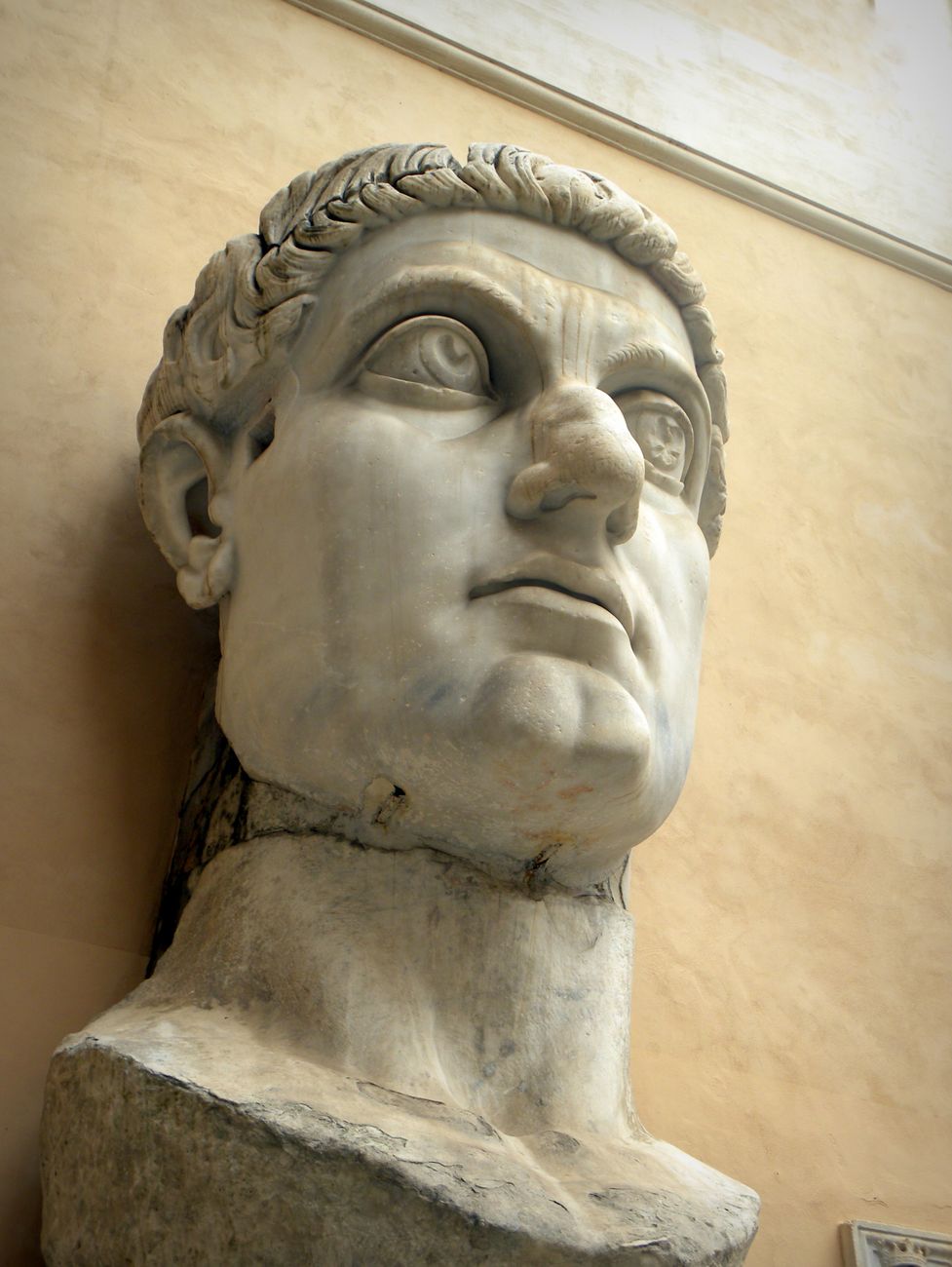
48 BC — Pompey the Great Is Assassinated in Egypt
On 28 September 48 BC, Roman general and statesman Pompey the Great was assassinated after arriving in Egypt while fleeing the forces of Julius Caesar.
Pompey had been one of the most powerful figures in the Roman Republic. He had achieved major military victories in the Mediterranean and eastern territories and had once been Caesar’s political ally as part of the First Triumvirate, alongside Caesar and Marcus Licinius Crassus.
Their alliance eventually collapsed, leading to a civil war between Pompey and Caesar. After Caesar defeated Pompey’s forces at the Battle of Pharsalus in 48 BC, Pompey fled to Egypt.
According to historical accounts, Egyptian officials arranged his assassination as he came ashore. He was killed shortly before his 59th birthday. Caesar reportedly reacted with grief and anger when he learned of Pompey’s death.
1066 — William the Conqueror Lands in England
On 28 September 1066, William, Duke of Normandy, landed at Pevensey on England’s southern coast, beginning the Norman Conquest of England.
William claimed the English throne following the death of King Edward the Confessor. The English throne had instead passed to Harold Godwinson, creating a succession dispute.
William’s invasion eventually led to the Battle of Hastings on 14 October 1066, where Harold was defeated and killed. William subsequently became King William I of England, known to history as William the Conqueror.
The Norman conquest transformed English political institutions, land ownership, architecture, language and culture.
1781 — Siege of Yorktown Begins
On 28 September 1781, American and French forces began the siege of Yorktown during the American Revolutionary War.
The allied forces commanded by George Washington and French General Rochambeau surrounded the British army commanded by General Charles Cornwallis in Yorktown, Virginia.
The siege culminated in the British surrender on 19 October 1781. The victory effectively ended major military operations in the American Revolutionary War and became a decisive moment in the establishment of American independence.
1791 — France Grants Full Citizenship to Jews
On 28 September 1791, France’s revolutionary government approved legislation granting full citizenship to Jews.
The measure followed the French Revolution’s broader transformation of the country’s legal and political system and represented a major change in the legal status of Jewish communities in France.
The decision is frequently described as the first instance of a European country granting Jews full citizenship as a general legal principle.
1864 — First International Is Established
On 28 September 1864, the International Workingmen’s Association was founded in London.
The organisation became commonly known as the First International and brought together representatives of workers’ organisations and socialist, trade-union and other political currents from several European countries.
Karl Marx became one of its most prominent figures and participated in drafting important documents for the organisation.
The First International became an influential chapter in the development of the international labour movement, although disagreements between its different factions eventually contributed to its decline.
1889 — International Standard for the Metre Is Adopted
A significant milestone in international measurement took place on 28 September 1889 when the General Conference on Weights and Measures adopted the international prototype of the metre.
The platinum-iridium bar kept at the International Bureau of Weights and Measures near Paris became the official reference for the length of a metre.
The agreement helped establish a common international measurement standard for science, engineering and commerce. The physical prototype remained the formal reference until the metre was later redefined using fundamental physical constants.
1901 — Balangiga Attack Takes Place in the Philippines
On 28 September 1901, Filipino fighters launched a surprise attack against American troops in Balangiga, Eastern Samar, during the Philippine-American War.
The attack resulted in the deaths of more than 40 American soldiers, while Filipino losses were also reported. The event was followed by severe American military reprisals in the region.
The Balangiga episode remains an important and contested part of the history of the Philippine-American War.
1912 — The Ulster Covenant Is Signed
On 28 September 1912, hundreds of thousands of Irish Unionists signed the Ulster Covenant in opposition to the proposed Third Home Rule Bill.
The document expressed opposition to the creation of an Irish parliament with authority over Ireland and reflected the intense political divisions surrounding Irish self-government.
Approximately 500,000 men and women signed the covenant and associated declaration, making it one of the largest coordinated political mobilisations in pre-First World War Ireland.
1924 — First Aerial Circumnavigation of the Globe Is Completed
On 28 September 1924, the United States Army Air Service completed the first successful aerial circumnavigation of the Earth.
The expedition had begun from Seattle on 6 April 1924 with four Douglas World Cruiser aircraft: Seattle, Chicago, Boston and New Orleans.
The aircraft faced mechanical failures, difficult weather and challenging navigation conditions. Three of the aircraft ultimately completed the journey, with Chicago and New Orleans reaching Seattle after approximately 27,500 miles of travel.
The expedition demonstrated the possibilities of long-distance aviation and represented a major achievement in the early history of air transportation.
1928 — Alexander Fleming Discovers Penicillin
One of the most consequential medical discoveries of the 20th century is associated with 28 September 1928.
Scottish bacteriologist Alexander Fleming returned to his laboratory at St Mary’s Hospital in London and examined a contaminated culture of Staphylococcus bacteria. He noticed that a mould growing on the culture had created an area around itself where the bacteria were not growing.
Fleming identified the mould as belonging to the Penicillium group and investigated the antibacterial substance it produced. He named the substance penicillin.
Although Fleming’s initial discovery did not immediately produce a usable mass-market medicine, his research provided the foundation for subsequent work by scientists including Howard Florey, Ernst Chain and their colleagues, who developed methods for producing and using penicillin as a therapeutic antibiotic.
Penicillin transformed the treatment of bacterial infections and became one of the foundations of modern antibiotic medicine.
1939 — Warsaw Surrenders During World War II
On 28 September 1939, Warsaw surrendered to German forces following a prolonged siege during the opening weeks of the Second World War.
Germany had invaded Poland on 1 September 1939. The Soviet Union invaded Poland from the east later that month, following the secret arrangements associated with the Molotov-Ribbentrop Pact.
The surrender of Warsaw marked a devastating stage in Poland’s campaign against the German invasion. Poland subsequently came under occupation by Nazi Germany and the Soviet Union.
1941 — Ted Williams Finishes a .406 Baseball Season
On 28 September 1941, American baseball player Ted Williams completed the Major League Baseball season with a batting average of .406.
Williams, playing for the Boston Red Sox, became the last MLB player to finish a season with a batting average of .400 or higher.
His achievement remains one of the most famous individual accomplishments in professional baseball. No MLB player has matched the .400 season mark since Williams achieved it in 1941.
1951 — CBS Introduces Colour Television Sets
On 28 September 1951, CBS began making its first commercial colour television sets available to the American public.
The CBS system used a mechanical colour technology involving a rotating colour wheel. Although it represented a technological advance over black-and-white television, it was incompatible with the television system that ultimately became the American standard.
CBS discontinued the sets less than a month later. Despite its short commercial life, the attempt represented an important step in the development of colour television.
1961 — United Arab Republic Comes to an End
On 28 September 1961, a military coup in Syria brought an end to the United Arab Republic, the political union between Egypt and Syria.
The union had been established in 1958 under Egyptian President Gamal Abdel Nasser. It was intended to represent a major step toward Arab political unity.
Syrian military officers opposed aspects of the union and seized control in Damascus in September 1961. Syria subsequently withdrew from the United Arab Republic, although Egypt continued to use the name officially for several more years.
1970 — Egyptian President Gamal Abdel Nasser Dies
On 28 September 1970, Egyptian President Gamal Abdel Nasser died in Cairo at the age of 52.
Nasser had been one of the most influential Arab political leaders of the 20th century. He became president of Egypt following the 1952 Egyptian Revolution and promoted Arab nationalism, state-led economic development and closer relations among Arab countries.
His death triggered widespread mourning across the Arab world and marked the end of an important era in modern Middle Eastern politics.
1980 — Cosmos Premieres on American Television
On 28 September 1980, Cosmos: A Personal Voyage made its television debut on PBS.
Presented by astronomer Carl Sagan and written by Sagan, Ann Druyan and Steven Soter, the 13-part documentary series explored astronomy, science, evolution and humanity’s place in the universe.
The programme became one of the most widely watched science documentaries in television history and helped introduce complex scientific concepts to a mass audience.
1994 — MS Estonia Sinks in the Baltic Sea
In the early hours of 28 September 1994, the passenger ferry MS Estonia sank in the Baltic Sea while travelling from Tallinn, Estonia, to Stockholm, Sweden.
The vessel encountered severe weather before sinking rapidly. Of the 989 people aboard, 852 died, making the disaster one of Europe’s deadliest maritime accidents in peacetime.
The tragedy prompted major investigations and changes in maritime safety practices concerning passenger ferries.
1995 — Israel and PLO Sign Oslo II Agreement
On 28 September 1995, Israeli Prime Minister Yitzhak Rabin and Palestine Liberation Organization Chairman Yasser Arafat signed the Interim Agreement on the West Bank and the Gaza Strip, commonly known as Oslo II.
The agreement was designed to expand Palestinian self-government and establish arrangements for the administration and security of different areas of the West Bank.
It represented another major stage in the Israeli-Palestinian peace process of the 1990s and included provisions concerning elections and the transfer of certain responsibilities to Palestinian authorities.
2000 — Pierre Trudeau Dies
On 28 September 2000, former Canadian Prime Minister Pierre Elliott Trudeau died at the age of 80.
Trudeau served as Canada’s prime minister for much of the period between 1968 and 1984, with a brief interruption in 1979–1980. He returned to office in 1980 and remained prime minister until 1984.
His political legacy included the patriation of Canada’s Constitution and the Canadian Charter of Rights and Freedoms in 1982. His death prompted national remembrance of one of Canada’s most consequential modern political figures.
2008 — SpaceX’s Falcon 1 Reaches Orbit
On 28 September 2008, SpaceX successfully launched its Falcon 1 rocket into orbit on its fourth flight.
The achievement was significant because Falcon 1 became the first privately developed liquid-fuel rocket to successfully place a payload into Earth orbit.
Earlier Falcon 1 launches had failed, making the fourth attempt particularly important for the young company. The successful mission demonstrated the potential for privately developed launch vehicles to compete in orbital spaceflight and contributed to the subsequent development of SpaceX’s larger Falcon rockets and Dragon spacecraft.
2014 — Hong Kong Protests Intensify
On 28 September 2014, major pro-democracy demonstrations in Hong Kong entered a significant new phase.
The protests were connected to disagreement over proposed arrangements for Hong Kong’s electoral system. Demonstrators occupied major roads and public areas, while police used tear gas in attempts to disperse crowds.
The movement became widely known as the Umbrella Movement, named after the umbrellas used by demonstrators for protection from rain and police crowd-control measures.
2018 — Sulawesi Earthquake and Tsunami
On 28 September 2018, a powerful earthquake struck Indonesia’s Central Sulawesi region.
The earthquake triggered a tsunami that struck coastal communities, particularly around Palu Bay. The disaster caused extensive destruction and thousands of deaths and injuries.
The event became one of Indonesia’s major natural disasters of the decade and highlighted the country’s exposure to earthquakes, tsunamis and other geological hazards.
2020 — Global COVID-19 Death Toll Passes One Million
On 28 September 2020, global reported deaths associated with COVID-19 surpassed one million during the first year of the pandemic.
The milestone illustrated the worldwide scale of the health crisis, which had spread from its initial outbreak into virtually every region of the world.
By this point, governments had introduced measures including travel restrictions, lockdowns, mask requirements and social-distancing policies, while researchers were developing vaccines and treatments.
2022 — Hurricane Ian Strikes Florida
On 28 September 2022, Hurricane Ian made landfall in Florida as a powerful Category 4 hurricane.
The storm produced catastrophic winds, storm surge and flooding, particularly in southwestern Florida. It subsequently affected other parts of the United States.
The disaster resulted in significant loss of life and extensive property damage and became one of the costliest hurricanes in United States history.
Notable People Born on 28 September
Confucius — 551 BC
Confucius, traditionally believed to have been born on 28 September 551 BC, was a Chinese philosopher whose teachings profoundly influenced Chinese society, education, government and ethics.
His ideas emphasised moral conduct, social responsibility, respect for family and the importance of education.
Bhagat Singh — 1907
Indian revolutionary Bhagat Singh was born on 28 September 1907.
He became one of the best-known figures associated with India’s independence movement and was executed by British authorities in 1931 at the age of 23.
Ed Sullivan — 1901
American television presenter Ed Sullivan was born on 28 September 1901.
His programme, The Ed Sullivan Show, became one of America’s most influential television variety programmes and introduced major performers from music and entertainment to millions of viewers.
Brigitte Bardot — 1934
French actor and singer Brigitte Bardot was born on 28 September 1934.
She became an international film star during the 1950s and 1960s and was particularly associated with films such as And God Created Woman.
Sheikh Hasina — 1947
Bangladeshi politician Sheikh Hasina was born on 28 September 1947. She served multiple terms as Bangladesh’s prime minister and became one of the country’s most prominent political figures.
Naomi Watts — 1968
British-Australian actor Naomi Watts was born on 28 September 1968. She became known internationally for films including Mulholland Drive, The Ring and 21 Grams.
Hilary Duff — 1987
American actor and singer Hilary Duff was born on 28 September 1987. She rose to fame through Disney Channel’s Lizzie McGuire before developing careers in film, television and music.
St. Vincent — 1982
American musician Annie Clark, known professionally as St. Vincent, was born on 28 September 1982. She became known for her distinctive guitar playing, songwriting and experimental approach to alternative and art-pop music.
Notable People Who Died on 28 September
Pompey the Great — 48 BC
Roman general and politician Pompey the Great died on 28 September 48 BC after being assassinated in Egypt. His death occurred during the Roman civil war that eventually established Julius Caesar’s dominance.
Louis Pasteur — 1895
French scientist Louis Pasteur died on 28 September 1895.
Pasteur made foundational contributions to microbiology and medicine, including research into infectious disease, fermentation and vaccination. His work profoundly influenced modern germ theory and public health.
Edwin Hubble — 1953
American astronomer Edwin Hubble died on 28 September 1953.
Hubble’s observations provided important evidence that galaxies exist beyond the Milky Way and that the universe is expanding. The Hubble Space Telescope was later named in his honour.
Miles Davis — 1991
American jazz trumpeter, composer and bandleader Miles Davis died on 28 September 1991.
Over a career spanning several decades, Davis became one of the most influential figures in jazz, contributing to the development of bebop, cool jazz, modal jazz, jazz fusion and other styles.
Ferdinand Marcos — 1989
Former Philippine president Ferdinand Marcos died on 28 September 1989 while in exile in Hawaii.
Marcos had governed the Philippines for many years, including a period of martial law, before leaving the country in 1986 following the People Power Revolution.
Pierre Trudeau — 2000
Former Canadian Prime Minister Pierre Trudeau died on 28 September 2000.
He remained an influential figure in Canadian political history after leaving office, particularly because of his role in constitutional reform and the adoption of the Canadian Charter of Rights and Freedoms.
September 28 and World Rabies Day
September 28 is observed internationally as World Rabies Day.
The date commemorates the death of Louis Pasteur, whose work contributed to the development of the first successful rabies vaccine. The annual observance raises awareness about rabies prevention, vaccination and access to treatment.
The date therefore links a major historical scientific figure with an ongoing global public-health campaign.
Leave a Reply