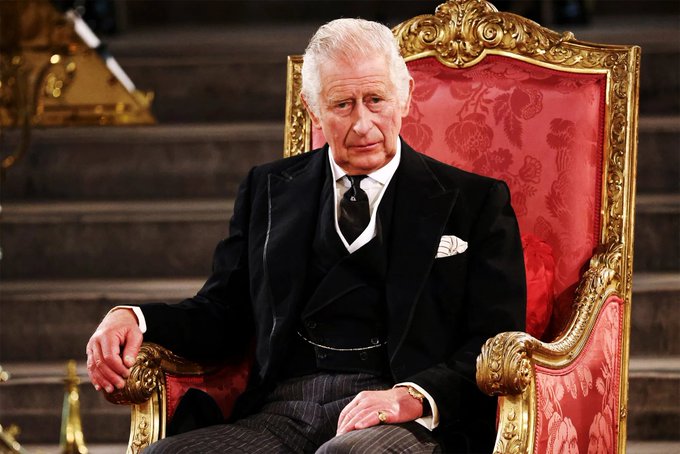
King Charles III will urge technology leaders to ensure artificial intelligence serves humanity and that mankind does “not lose control” during a conference in Scotland on Thursday.
Buckingham Palace said the gathering at Dumfries House will include senior representatives from Nvidia, Google DeepMind, OpenAI, Anthropic, and Britain’s minister for artificial intelligence.
The debate over AI risks has intensified since the start of summer, fuelled by several incidents and apocalyptic warnings from industry professionals.
“Those in our world who value our humanity and its vital moral component are anxiously seeking your reassurance that we will not lose control of our destiny,” Charles will say at the conference’s opening, according to a palace statement.
“The task before you is not merely to advance technology, but to ensure that it remains firmly in the service of humanity, community and the natural world,” the British monarch will say.
The conference could, however, be overshadowed by dramatic claims from the late Princess Diana’s brother that Charles acted insensitively following her death in a car crash almost 30 years ago.
Buckingham Palace hit back after Charles Spencer claimed in his new memoir that the then-prince, Diana’s former husband, said “we’ll forget her soon enough” days after she died in 1997.
“His Majesty is mindful that the pain of fraternal grief can cloud reason, affect judgment and colour memory in ways others do not recognise, even many years after such a loss,” a palace spokesperson said.
‘Humanity Must Remain Sacred’
The Palace has not published the full guest list, but sources close to the event say DeepMind president Demis Hassabis, Nvidia head Jensen Huang, and OpenAI chief financial officer Sarah Friar are among the participants. Niccolo de Masi, head of US quantum computing group IonQ, will also attend.
The king, who views AI development as both intriguing and deeply concerning in equal measure, will not take part in the discussions. He will join participants before the summit begins to urge them to consider how to harness AI “by putting safety at its heart” and to build international cooperation so that “no nation is left behind — and the future of mankind protected,” according to Buckingham Palace.
As artificial intelligence evolves, “our humanity must remain sacred,” he will stress.
The Sunday Times reported that a charter was drawn up ahead of the summit by the Ditchley Foundation, a UK charity overseeing the discussions.
‘Global Coordination’
Rapid advances in AI have fuelled concerns over job losses and the soaring energy demand and environmental impact of data centres.
Fears that designers of AI agents could lose control of their creations intensified after several models from OpenAI and Anthropic reportedly broke out of their confined environments on their own, accessed the internet, and intruded on websites and platforms.
Anthropic CEO Dario Amodei on Saturday called on companies in the sector to slow development to better understand the risks, receiving support from OpenAI CEO Sam Altman and Elon Musk.
Mustafa Suleyman, head of Microsoft AI, told the BBC on Thursday that developing AI capable of acting autonomously could create “a new silicon species, which will no doubt compete with us for resources.”
On Wednesday, UN Secretary-General Antonio Guterres said global coordination on AI was “indispensable,” while Pope Leo XIV warned against the temptation to delegate to algorithms decisions that fall within the exclusive realm of human responsibility.
US President Donald Trump and several members of his majority have, by contrast, reiterated in recent days their determination not to constrain the sector, officially out of concern that doing so would allow China to gain the upper hand.
Mark Zuckerberg, head of Meta, has rejected calls to slow the technology’s development, arguing that market forces and the risk of litigation are the best safeguards.
Leave a Reply