
2.0 Introduction
Food labelling has become a strategic and cost-effective public health intervention. It does not only support informed dietary decisions, but also guides consumers toward healthier eating choices at the point of purchase as obesity and diet-related diseases continue to place considerable health burden on the NHS and other stakeholders in the UK healthcare system, Therefore, supermarkets like Tesco, which serve millions of customers across the UK, play a pivotal role in shaping food environments and influencing consumer behaviour through visibility and clarity of health-related information (labels) as well as their placement on food packaging.
Retail brands like Tesco design health-focused food labels (including calorie counts, traffic light systems, and guideline daily amounts) to simplify complex nutritional data into more digestible formats (Campos et al., 2011). According to Public Health England (2023), well-informed consumers are more likely to make health-conscious decisions when purchasing pre-packaged foods. However, an empirical study by Grunert and Wills (2007) indicates these labels do not always lead to healthier choices despite widespread implementation. Porter et al (2023) identified health literacy, time constraints, taste preferences, and socio-economic status among factors that can moderate or even negate the intended impact of labelling. It is therefore important to understand how consumers interpret and respond to food labels within the context of UK food retail.
Top UK supermarket brands like Tesco often situate their stores in diverse socio-economic environments (such as Middlesbrough) where public health outcomes typically fall below national averages. This variation underscores the need for contextualised research that evaluates the effectiveness of existing labelling systems to propose data-based improvements tailored to local consumer demographics and behavioural patterns.
This chapter provides a critical review of relevant academic literature around food labelling, with focus on the following:
- Types and evolution of labelling systems in the UK.
- Behavioural and psychological mechanisms underpinning consumer responses.
- Retailer strategies and environmental influences, and
- Theoretical models that support understanding of consumer decision-making processes.
While this chapter gleans UK-specific research and international findings as basis for analysing how health-focused labels operate in real-world supermarket settings, particularly at Tesco in Middlesbrough, it remarkably examines how their impact of food labels might be improved through evidence-based strategies.
2.1 Scope of the Study
This research focuses on Middlesbrough, a town in North-East England and within the Tees Valley region. Middlesbrough has a distinctive socio-economic, cultural, and educational profile which can remarkably influence consumer behaviour and dietary decisions. Thus, the research location presents a unique setting for analysing the effectiveness of health-focused food labelling.
A 2022 report from Middlesbrough Council’s Public Health Profile noted that the town ranks among the most deprived areas in England. The study added that a large proportion of neighbourhoods in Middlesbrough fall into the lowest decile of the national Index of Multiple Deprivation. The town also characterizes low household incomes, high levels of unemployment, and reduced life expectancy. These development indicators underscore the urgent need for public health interventions (including nutrition-focused strategies) to improve health outcomes.
Educational attainment in Middlesbrough falls below UK’s national average. A significant portion of the adult population in Middlesbrough also lacks formal educational qualifications. While this challenge contributes to low nutritional literacy as well as their ability to interpret or act on food labelling, it makes the town an ideal setting for assessing whether current labelling practices such as traffic light nutrition labels or calorie information are effective in promoting healthy choices among consumers from diverse literacy and income levels.
In the aspect of culture, Middlesbrough is home to a multi-ethnic population that includes long-established white British communities. There are also growing numbers of residents from Africa, Asia, and Europe. These communities may have different beliefs, perceptions, and attitudes toward health, food, and labelling systems influenced by cultural norms and dietary traditions. On this premise, Middlesbrough presents an opportunity to explore how health-focused labelling is perceived across diverse demographic segments.
Notably, this academic inquiry focuses on Tesco Extra store located at Trunk Road, Middlesbrough. This prominent retail outlet serves both suburban and inner-city populations. Tesco is one of the largest supermarkets in the area, so the retail brand attracts a broad customer base that comprises of elderly shopper, immigrant communities, working-class families, and students from nearby Teesside University. The diverse population of shoppers at this Tesco location provides opportunity for a meaningful analysis of how health-focused labels shape the purchasing behaviour of consumers across different demographic groups. By situating this study within Middlesbrough’s complex and socially varied environment, the author aims to gather insights that are not only academically valuable, but also relevant for retailers and policymakers seeking more effective strategies to improve health choices for underrepresented and vulnerable populations.
2.2 The Concept and Purpose of Food Labelling
Food labelling refers to the information found on food packaging that informs consumers about the ingredients, nutritional value, allergens, and health claims associated with a product (i.e., food and drink) (Ikonen et al, 2023). The aim of health-focused food labelling is to guide consumers in making healthier choices, a goal achieved by simplifying nutritional data into readable formats (Campos et al., 2023).
Diagram 2.1: A food label

Photo Credit: Photo by Carlos Machado on Pexels.com
According to the UK Food Standards Agency (2023), food and beverage brands like Tesco implement food labelling initiatives for two reasons: (a) to reduce information asymmetry between manufacturers and consumers, and (b) to support national health goals. Studies by Hawley et al (2022) and Hersey et al (2023) emphasize that the presence of clear, easily interpretable labels can influence consumer purchasing decisions.
Figure 2.2: Sample label for frozen lasagna
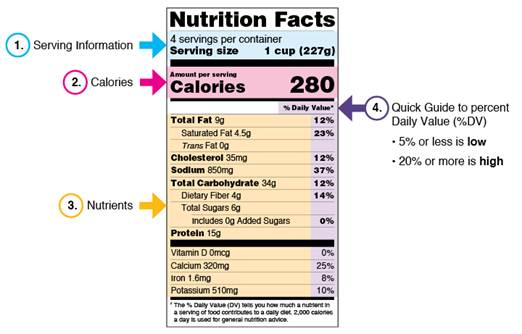
Source: Food and Drug Administration (FDA, 2025)
FDA is US government-owned organization established under the Department of Health and Human Services. The health agency saddles responsibility to ensure the safety, efficacy, and security of food, cosmetics, medical devices, drugs, electronic gadgets, and biological products that emit radiation.
Leave a Reply