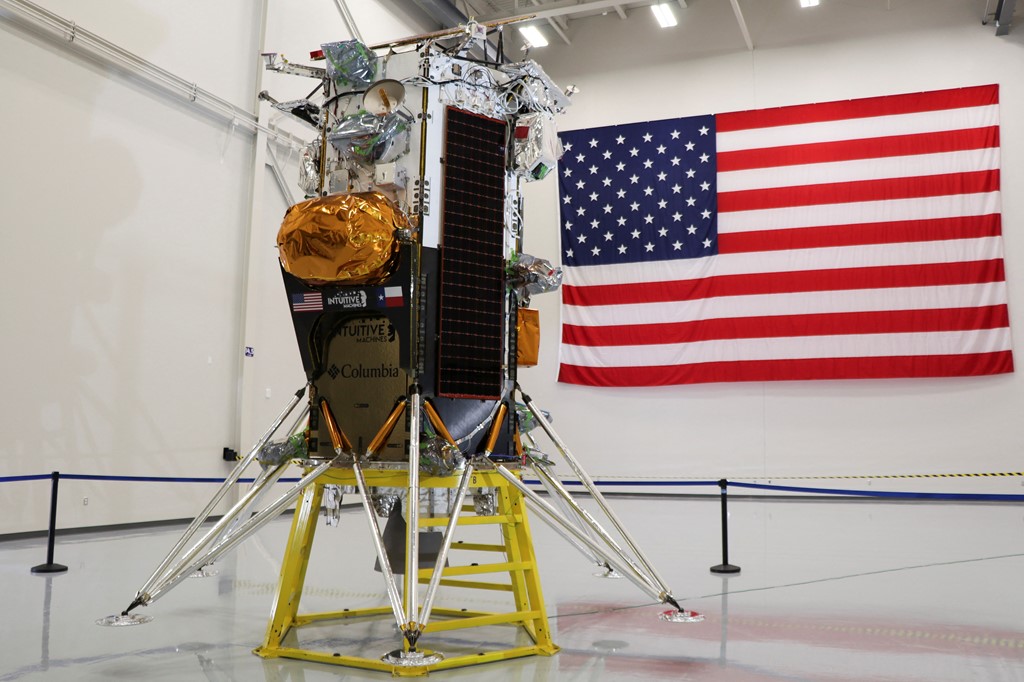
Here are a few fun facts about the IM-1 mission.
The Odysseus spacecraft is roughly the size of a phone box. Intuitive Machines, the private US company that designed and operates it, likens it to Doctor Who’s Tardis – but it’s not as big inside, nor does it time travel.
The design of Nova Control – the mission hub in Houston Texas – resembles the bridge of the USS Enterprise from Star Trek.
And the spacecraft has one mile of cables, which are all hopefully intact and working.
Now we wait to find out that everything is operating normally
The Odysseus spacecraft is now on its epic journey to the moon.
It has successfully separated from the Falcon 9 rocket that carried it into near-Earth orbit.
With the rocket travelling at 23,000mph and 139 miles above the planet, its cone opened like a clam shell and springs gently pushed the spacecraft away.
Odysseus is now powering up, activating its engines to stabilise any spin.
“We are waiting for it to send a signal to mission control in Houston, Texas, confirming that everything is operating normally.,” Thomas Moore (Sky News correspondent) said.
Explained: The lunar lander with a selfie mode
Odysseus will operate for roughly two weeks on the moon.
It “will be the farthest south that any private lander has ever been to on the moon and will give us an opportunity to test our instruments in this very hard environment”, said NASA scientist Sue Lederer.
Insulated with a shimmery gold fabric that normally lines the insides of ski jackets, the lander will first use a four-camera system to capture its descent to the surface.
This will include the EagleCam, which deploys when Nova-C is 30m from landing and aims to capture the first “selfie” of a craft making a landing in space.
The descent itself will test precision laser-landing technologies developed with funding from the UK.
Equipment for communicating from the south pole with mission control will be tested and navigation beacons dropped to help future missions.
Radiowave measuring devices will detect waves emitted from Jupiter and other planets, helping to develop technologies to detect planets.
A sculpture called Moon Phases will also be on board, created by American artist Jeff Koons.
The lander itself is a 13ft tall, 5ft wide hexagonal cylinder, weighing 675kg – approximately as heavy as a cow.
Leave a Reply