Ramaphosa faces political pressure over impeachment interdict as Parliament tensions escalate
Parliamentary tensions intensified today as legal and procedural battles surrounding President Cyril Ramaphosa’s attempted interdict against impeachment proceedings continued to dominate national debate. The Speaker of the National Assembly, Thoko Didiza, pushed back against allegations that she was shielding the presidency, insisting that Parliament would comply with court directives and provide an explanatory affidavit to the Western Cape High Court on how it handled the Constitutional Court ruling.
Within parliamentary corridors, opposition parties have framed the matter as a test of institutional independence, arguing that the executive may be exerting undue influence over legislative accountability mechanisms. Legal observers quoted in local political coverage suggest the case could set an important precedent for how impeachment procedures interact with constitutional review processes, particularly where urgent court interventions are sought to pause parliamentary action.
The political temperature has risen alongside broader frustrations over governance and accountability, with opposition benches repeatedly questioning whether procedural safeguards are being applied consistently or selectively in high-profile matters involving the presidency.
Madlanga Commission delays deepen scrutiny into alleged corruption networks and municipal contracts
Proceedings at the Madlanga Commission were disrupted after the testimony of Medicare24 CEO Mike van Wyk was postponed, following medical concerns raised by his legal team. Van Wyk was expected to provide evidence linked to alleged procurement irregularities involving Ekurhuleni municipal contracts and figures connected to suspended EMPD deputy head Julius Mkhwanazi and alleged underworld figure Vusimuzi “Cat” Matlala.
Commission officials confirmed that although the testimony has been delayed, evidence submissions already on record—including WhatsApp communications—will continue to be analysed by the inquiry team.
Elsewhere in parallel proceedings, alleged political fixer Brown Mogotsi returned to court on a renewed bail application. Mogotsi faces charges including perjury, defeating the ends of justice, and unlawful possession of a firearm, and is accused of staging a false assassination attempt in Vosloorus. His legal team argues that newly presented documentation, including proof of residence, strengthens his case for release, while prosecutors maintain that earlier bail refusals were justified due to flight risk concerns.
The broader commission proceedings continue to draw attention for their potential to expose intersections between political actors, municipal procurement systems, and organised criminal influence networks—an issue that has become increasingly central in public discourse around governance integrity.
Rising migrant tensions prompt police readiness and labour union warnings ahead of 30 June deadline
South Africa remains on high alert as authorities prepare for possible unrest linked to the unofficial 30 June deadline issued by anti-immigrant groups demanding the departure of undocumented migrants.
Acting Police Minister Firoz Cachalia confirmed that law enforcement will be deployed across identified hotspots, with additional personnel and overtime arrangements activated to manage crowd control, protest activity, and potential violence. He emphasised that police will act against unlawful behaviour while still allowing peaceful demonstrations to proceed.
Police preparedness efforts come amid warnings from labour unions including COSATU, FEDUSA, SAFTU, and NACTU, which have urged workers not to participate in planned protests. Union leaders argue that participation could jeopardise employment and deepen workplace instability, while also warning that the protests risk inflaming already tense community relations.
President Cyril Ramaphosa has also publicly cautioned against scapegoating migrants for South Africa’s economic challenges, noting that structural issues such as unemployment and inequality require long-term policy responses rather than targeting vulnerable populations. His remarks come amid rising public frustration over job scarcity and service delivery concerns.
Community organisations and international observers have expressed concern about the potential for escalation, particularly in urban centres where previous unrest has demonstrated how quickly protests can turn violent.
Migration debate intensifies amid economic strain and rising public frustration
Public discourse around immigration has become increasingly polarised, with political leaders, civil society organisations, and grassroots movements presenting sharply divergent views on the issue.
While some groups frame undocumented migration as a contributor to unemployment and pressure on public services, others argue that economic stagnation, inequality, and weak enforcement of labour protections are the underlying drivers of social tension.
Analysts quoted in recent commentary pieces warn that the politicisation of migration risk oversimplifying complex structural problems. Labour market conditions, particularly high youth unemployment, continue to fuel dissatisfaction, which in turn becomes fertile ground for scapegoating narratives.
Human rights organisations have reiterated calls for restraint and evidence-based policy responses, arguing that conflating migration with crime or economic decline risks deepening xenophobic sentiment and undermining social cohesion.
Women’s cricket: South Africa’s historic World Cup chase keeps semifinal hopes alive
South Africa’s women’s cricket team delivered one of the standout sporting performances of the tournament, defeating India in a record-breaking chase in Manchester to keep their ICC Women’s T20 World Cup semifinal hopes alive.
Veteran all-rounder Marizanne Kapp produced a match-defining innings of 81 runs, anchoring the chase after an early top-order wobble. Her performance was widely described in match reports as composed and decisive under pressure, particularly given the scale of the target and the quality of India’s bowling attack.
Post-match reflections highlighted the emotional significance of the victory within the squad. Kapp, in remarks carried by sporting outlets, noted the importance of resilience and belief in turning the game around after a slow start. Teammates echoed similar sentiments, describing the win as a “statement performance” that could reshape their tournament trajectory.
The result not only boosts South Africa’s qualification chances but also marks one of the most notable successful chases in Women’s T20 World Cup history, surpassing previous tournament benchmarks set by Australia.
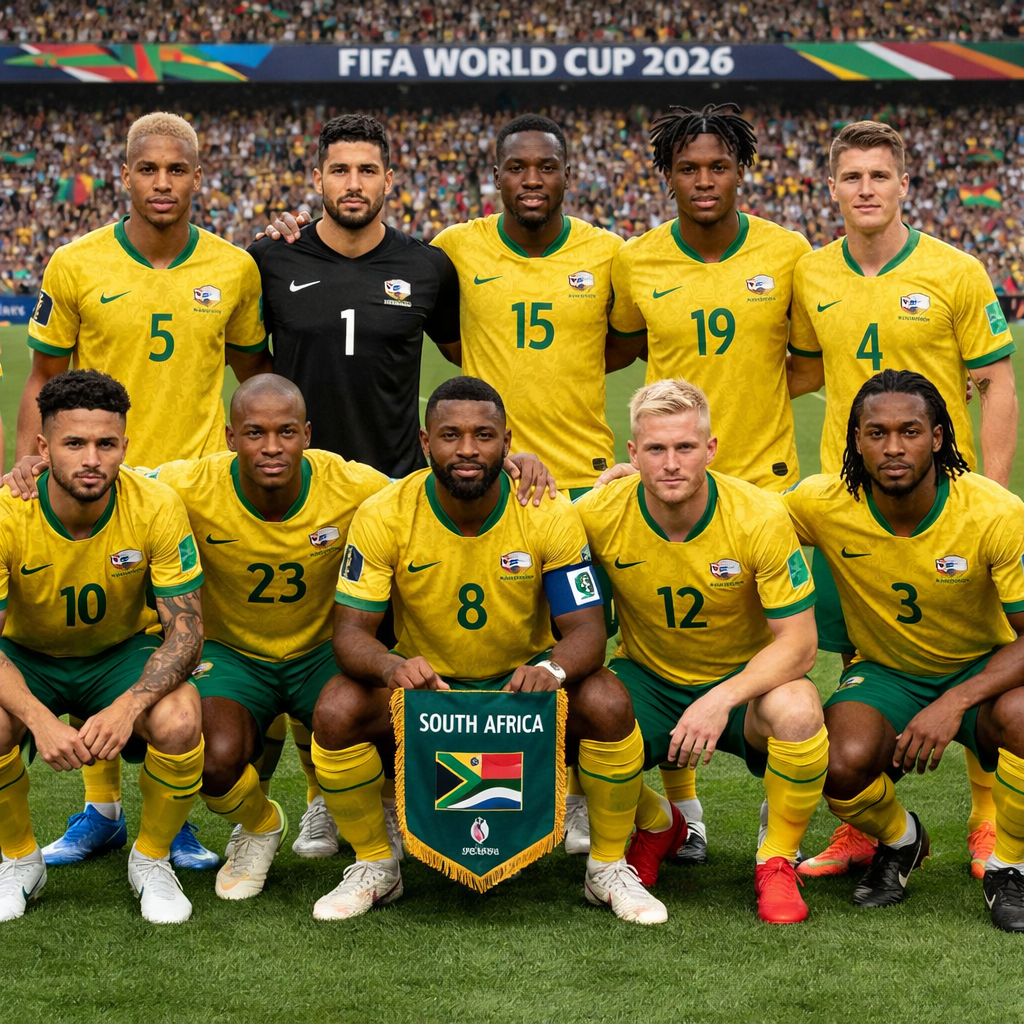
FIFA World Cup Group A: South Africa and South Korea prepare for decisive qualification clash
South Africa’s national football team faces a critical Group A encounter against South Korea as both sides battle for progression in the FIFA World Cup group stage.
South Africa enters the match with one point after a draw against Czechia and a loss to Mexico, while South Korea sits on three points following a victory over Czechia. With Mexico already securing top position in the group, the remaining qualification slot is still open, leaving both teams with everything to play for.
Coaches from both camps have emphasized attacking intent, with South Korea highlighting South Africa’s pace and transition play as a key tactical concern. However, South Africa will be forced into adjustments due to suspensions affecting key midfield personnel, creating additional pressure on squad depth and tactical flexibility.
Football analysts suggest the match could hinge on midfield control and defensive discipline, particularly in transitional phases where both teams have shown vulnerability under sustained pressure.
Crime, corruption, and public trust concerns remain central to national debate
Public confidence in governance continues to be shaped by ongoing scrutiny of corruption cases, municipal procurement disputes, and allegations of organised criminal influence within parts of the public sector.
Recent developments at investigative commissions and court proceedings have reinforced concerns about systemic weaknesses in oversight mechanisms. Civil society commentators argue that delayed testimony and procedural interruptions risk slowing accountability processes, while government officials maintain that due process must be respected to ensure fair outcomes.
At the same time, public safety remains a dominant concern, with police resources stretched across multiple potential flashpoints, including protest preparedness and ongoing crime prevention operations.
Experts interviewed in local commentary have repeatedly stressed that long-term solutions will require both institutional reform and improved coordination between law enforcement, prosecutorial services, and municipal governance structures.
Economic pressure, fuel costs, and infrastructure strain continue to shape household realities
South African households and businesses continue to feel the effects of broader economic pressures, with rising operational costs, transport dependencies, and global commodity fluctuations feeding into local inflationary concerns.
Trade analysts have pointed to external shocks—particularly fuel volatility and global supply chain instability—as key contributors to increased business uncertainty. These pressures are especially pronounced in logistics-heavy sectors, where transport costs directly affect pricing of essential goods.
While government economic policy continues to emphasise investment attraction and structural reform in energy and transport sectors, critics argue that implementation delays remain a major constraint on growth recovery.
Sports culture and national identity reflected in endurance events and mass participation races
Beyond elite competition, mass participation sporting events continue to draw national attention, particularly endurance races that attract thousands of participants across South Africa.
Recent ultramarathon events highlighted both the physical demands and social significance of long-distance running culture in the country. Participants and organisers frequently describe these races as symbolic of resilience, unity, and personal transformation, with many runners participating for deeply personal reasons ranging from health recovery to community representation.
The scale of participation underscores the enduring role of sport as both a cultural unifier and a personal milestone for thousands of South Africans each year.
Leave a Reply