Vygotsky emphasized the role of the social environment in the child’s cognitive development.
Lev Vygotsky claimed that infants are born with the basic abilities for intellectual development called “elementary mental functions” (Piaget focuses on motor reflexes and sensory abilities). These develop throughout the first two years of life due to direct environmental contact.
Elementary mental functions include –
o Attention
o Sensation
o Perception
o Memory
Eventually, through interaction within the sociocultural environment, these are developed into more sophisticated and effective mental processes, which Vygotsky refers to as “higher mental functions.”
Tools of intellectual adaptation
Each culture provides its children with tools of intellectual adaptation that allow them to use basic mental functions more effectively/adaptively.
Tools of intellectual adaptation is Vygotsky’s term for methods of thinking and problem-solving strategies that children internalize through social interactions with the more knowledgeable members of society.
For example, memory in young children is limited by biological factors. However, culture determines the type of memory strategy we develop.
For example, in Western culture, children learn note-taking to aid memory, but in pre-literate societies, other strategies must be developed, such as tying knots in a string to remember, carrying pebbles, or repeating the names of ancestors until large numbers can be repeated.
Vygotsky, therefore, sees cognitive functions, even those carried out alone, as affected by the beliefs, values, and tools of intellectual adaptation of the culture in which a person develops and, therefore, socio-culturally determined.
Therefore, intellectual adaptation tools vary from culture to culture – as in the memory example.
Social Influences on Cognitive Development
Like Piaget, Vygotsky believes that young children are curious and actively involved in their own learning and discovering and developing new understandings/schema.
However, Vygotsky emphasized social contributions to the development process, whereas Piaget emphasized self-initiated discovery.
According to Vygotsky (1978), much important learning by the child occurs through social interaction with a skillful tutor. The tutor may model behaviors and/or provide verbal instructions for the child.
Vygotsky refers to this as cooperative or collaborative dialogue. The child seeks to understand the actions or instructions provided by the tutor (often the parent or teacher) and then internalizes the information, using it to guide or regulate their performance.
Shaffer (1996) gives the example of a young girl given her first jigsaw. Alone, she performs poorly in attempting to solve the puzzle. The father then sits with her and describes or demonstrates some basic strategies, such as finding all the corner/edge pieces, and provides a couple of pieces for the child to put together herself, and offers encouragement when she does so.
As the child becomes more competent, the father allows the child to work more independently. According to Vygotsky, this social interaction involving cooperative or collaborative dialogue promotes cognitive development.
To understand Vygotsky’s theories on cognitive development, one must understand two of the main principles of Vygotsky’s work: the More Knowledgeable Other (MKO) and the Zone of Proximal Development (ZPD).
More Knowledgeable Other
The more knowledgeable other (MKO) is somewhat self-explanatory; it refers to someone who has a better understanding or a higher ability level than the learner, concerning a particular task, process, or concept.
Although the implication is that the MKO is a teacher or an older adult, this is not necessarily the case. Often, a child’s peers or an adult’s children may be the individuals with more knowledge or experience.
For example, who is more likely to know more about the newest teenage music groups, how to win at the most recent PlayStation game, or how to correctly perform the newest dance craze – a child or their parents?
In fact, the MKO need not be a person at all. To support employees in their learning process, some companies are now using electronic performance support systems.
Electronic tutors have also been used in educational settings to facilitate and guide students through learning. The key to MKOs is that they must have (or be programmed with) more knowledge about the topic being learned than the learner does.
Zone Of Proximal Development
The concept of the more knowledgeable other relates to the second important principle of Vygotsky’s work, the zone of proximal development.
This important concept relates to the difference between what a child can achieve independently and what a child can achieve with guidance and encouragement from a skilled partner.
Vygotsky consequently focuses much more closely on social interaction as an aid to learning, arguing that, left alone, children will develop – but not to their full potential.
He refers to the gap between actual and potential learning as the zone of proximal development (ZPD) – and argues that it is only through collaboration with adults and other learners that this gap can be bridged.
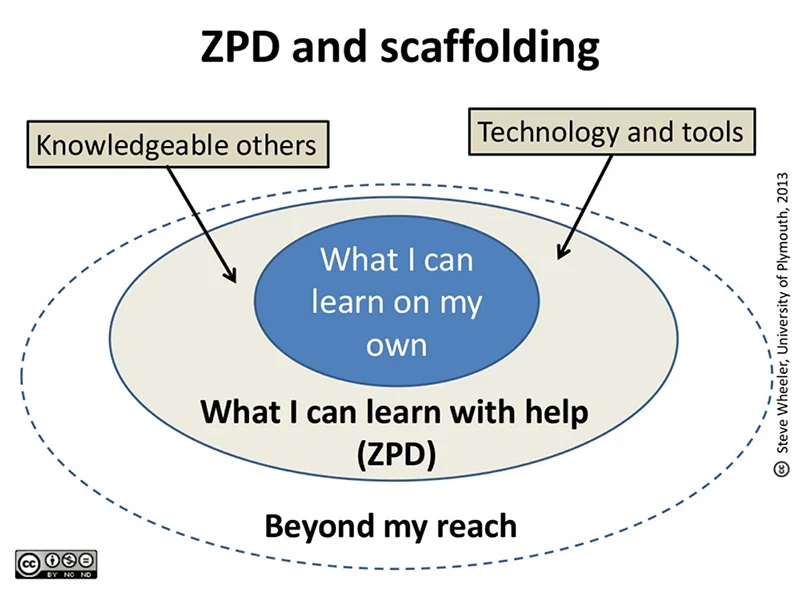
The zone of proximal development is the gap between the level of actual development, what the child can do on his own, and the level of potential development, what a child can do with the assistance of more advanced and competent individuals.
Social interaction, therefore, supports the child’s cognitive development in the ZPD, leading to a higher level of reasoning. It is generally believed that social dialogues have two important features.
The first is intersubjectivity, where two individuals who might have different understandings of a task, arrive at a shared understanding by adjusting to the perspective of the other.
The second feature is referred to as scaffolding. Adults may begin with direct instruction, but as children’s mastery of a task increases, so the adult tends to withdraw their own contributions in recognition of the child’s increasing success.
For example, the child could not solve the jigsaw puzzle (in the example above) by itself and would have taken a long time to do so (if at all), but was able to solve it following interaction with the father, and has developed competence at this skill that will be applied to future jigsaws.
ZPD is the zone where instruction is the most beneficial, as it is when the task is just beyond the individual’s capabilities. To learn, we must be presented with tasks just out of our ability range. Challenging tasks promote maximum cognitive growth.
As a result of shared dialogues with more knowledgeable others, who provide hints, instructions, and encouragement, the child can internalize the ‘how to do it’ part of the task as part of their inner or private speech. The child can then use this on later occasions when they tackle a similar task on their own.
Vygotsky (1978) sees the Zone of Proximal Development as the area where the most sensitive instruction or guidance should be given – allowing the child to develop skills they will then use on their own – developing higher mental functions.
Vygotsky also views peer interaction as an effective way of developing skills and strategies. He suggests that teachers use cooperative learning exercises where less competent children develop with help from more skillful peers – within the zone of proximal development.
Leave a Reply