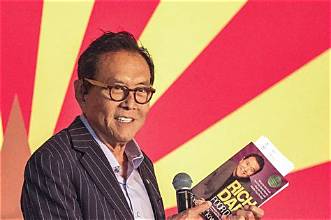
The bestselling author of “Rich Dad Poor Dad” says his massive debt is a wealth-building tool, not a liability. His ex-wife and business partner explains where the money actually sits — and why the headline figure is more nuanced than it appears.
Robert Kiyosaki, the author of the 1997 bestseller “Rich Dad Poor Dad,” has spent years telling anyone who will listen that his $1.2 billion debt is not a problem. It is, he insists, the whole point.
“I teach people how to use debt, and Dave Ramsey says don’t use debt. Most people should listen to Dave Ramsey,” Kiyosaki said in June on the “Get Rich Education” podcast.
His philosophy, laid out across dozens of books and countless podcast appearances, rejects the conventional personal finance advice of living below your means and saving cash. Instead, Kiyosaki advocates using leverage — borrowed money — to acquire assets that generate income. The goal is not to eliminate debt but to make debt work for you.
The $1.2 Billion Figure Needs Context
The headline number has sparked widespread debate, but according to Kiyosaki’s ex-wife and longtime business partner, Kim Kiyosaki, the $1.2 billion is not money Robert personally owes.
“We have a lot of apartment houses with our partners,” Kim told Vanity Fair. “So technically, yes, we have all this debt”.
The debt is tied to a real-estate portfolio containing roughly 1,500 apartment units, owned alongside business partners and structured through limited liability companies (LLCs). The partners hold the debt in a legal arrangement that removes most of their personal responsibility.
Vanity Fair estimated Kiyosaki’s personal exposure could be somewhere between $30 million and $60 million, based on his claim that he earns roughly $3 million per year. That is a far cry from $1.2 billion — though still a substantial sum.
Knowing ‘Good Debt’ From Bad
At the heart of Kiyosaki’s strategy is a simple distinction: good debt versus bad debt.
Kiyosaki defines “good debt” as an asset that produces sufficient income to cover the loan payment, with cash left over. He lists rental properties, dividend-producing stocks, and options strategies as examples. “Instead of cutting $300 per month from a budget to afford something, a Rich Dad investor asks what asset they could acquire that generates $300 in monthly cash flow,” Kiyosaki wrote in a blog post. “Once the asset is in place, the $300 is no longer a budget sacrifice. It arrives every month from the asset while the asset also continues appreciating”.
Brock Harris, a real estate agent and investor in Los Angeles, embraces this definition. “There is good debt and bad debt,” Harris said. “You tell the difference by asking who is paying it down. If it’s not you, it’s good debt”.
Firewalls: ‘That’s the Way the Rich Play the Game’
Kiyosaki’s real-estate strategy involves borrowing against the increasing equity in his properties. When a property’s value rises, he borrows more money against that equity and treats the loan proceeds as tax-free income, rather than selling the asset to access its value.
Each investment is also separated inside its own LLC, creating a firewall between properties. If one investment fails, the bank may be left with the problem while Kiyosaki remains protected by the corporate structure.
“If it all comes to hell, you can talk to my attorney,” Kiyosaki told Vanity Fair. “Firewalls — that’s the way the rich play the game”.
He was even blunter in a 2024 Instagram Reel: “If I go bust, the bank goes bust. Not my problem”.
A History of Strategic Bankruptcy
This is not the first time Kiyosaki has used corporate structures to shield himself from financial fallout. In August 2012, one of his corporate entities, Rich Global LLC, filed for Chapter 7 bankruptcy protection after a U.S. court ordered it to pay just under $24 million to The Learning Annex and its chairman, Bill Zanker.
The bankruptcy filing listed corporate debts of almost $26 million but assets of only $1.8 million — including two bank accounts and notes receivable from Robert and Kim Kiyosaki personally.
Forbes noted at the time that it was a corporate bankruptcy, not a personal one, and that Kiyosaki would not be putting any of his personal fortune toward the settlement. He now conducts much of his business through a different entity, Rich Dad Co..
The Bitcoin and Gold Evangelist
Kiyosaki’s debt philosophy is inextricably linked to his broader warnings about the global financial system. He has long criticized the U.S. Treasury and the Federal Reserve for printing “fake money” to support government spending, and he urges followers to hold gold, silver, Bitcoin, and Ethereum instead.
His price predictions are characteristically bold. In March 2026, he forecast that Bitcoin would hit $750,000 and Ethereum $95,000 one year after the next major financial crash. He also projected gold would reach $35,000 per ounce and silver $200.
“Why am I buying as much Bitcoin, gold, silver, and Ethereum as I can before the bubble bursts?” Kiyosaki wrote on X. “Because once the bubble bursts, the prices of these assets will skyrocket… Profits are made at the buy, not the sell”.
He has consistently bought more of these assets during market downturns. “Every time the price drops, I buy more,” he said of Bitcoin. “A market crash is when quality assets are sold at a discount”.
The Critics’ Warning
Not everyone is convinced Kiyosaki’s strategy is replicable. Chris Galeski, a wealth advisor at Morton Wealth, told Yahoo Finance that the attention surrounding the $1.2 billion figure can be misleading.
“My frustration with how the $1.2 billion figure gets covered is that it’s presented as if it’s a forward-looking strategy, when really it’s a description of what worked for Kiyosaki looking backward, over a uniquely favorable stretch for real estate,” Galeski said. “Someone starting today is working with a very different set of conditions. The headline number gets all the attention, but the discipline behind it is what actually matters”.
Kiyosaki himself has acknowledged that his approach is not for everyone. On the “Get Rich Education” podcast, he made a point of saying that most people should listen to Dave Ramsey — the personal finance host who famously advocates for debt-free living.
For Kiyosaki, the strategy is simple: use debt to control assets, separate investments through legal structures, and keep the financing moving. In his world, the goal is not to avoid creditors. It is to stay one step ahead of them.
Leave a Reply