There is dearth of knowledge about consumer attitudes toward food labelling. Among persisting gaps in the body of knowledge, there are very few locality-specific studies examining the interplay between demographics and label effectiveness (Rayner et al., 2023). Existing literature in the field focusses more on consumer intention, ignoring their actual purchasing behaviour (Jabson & McLoughlin, 2021). Lastly, Thirdly, few scholars have combined data sources (that is, quantitative and qualitative secondary data) to offer a more holistic understanding of the variables (Osman & Jenkins, 2023)
Given these gaps, this study focusing on specific communities that feature socio-economic disparity and public health concerns (e.g., Middlesbrough) will add more to the existing body of knowledge.
Theoretical Frameworks Supporting Label Use
Behavioural science theories broaden understanding of how individuals react to health-focused food labelling. Two among the prominent theories — Theory of Planned Behaviour (TPB) and Nudge Theory — offer insightful frameworks for explaining consumer decisions. These theories form the basis of recommendations for improving the effectiveness of food labelling systems.
- Theory of Planned Behaviour (Ajzen, 1991)
Theory of Planned Behaviour (TPB) suggests that human actions are driven by the following three considerations:
- Attitude toward the behaviour: – The extent to which people consider behaviours as favourable or unfavourable (e.g., the belief that healthy eating is important).
- Subjective norms: – The perceived social pressures that either encourage or disapprove performance of certain behaviours (such as friends or family teasing someone for overeating and linking excessive bodyweight to unhealthy eating habits).
- Perceived behavioural control: – Individualized conclusion or belief that performing certain behaviours (such as buying foods only after reading health-focused labels or eating healthy over a period) is easy or difficult.
According to the theory (TPB), these three components have direct impact on people’s behavioural intentions, which determine actual behaviour (Conner & Sparks, 2005). Thus, nutrition labels enhance consumers’ perceived control by empowering them to understand food label ratings before making purchase decisions (Silva et al, 2024). However, this idea takes effect only when there is no interference from other barriers like cultural preferences and price sensitivity (McDermott et al., 2015).
Diagram 2.3 explains TPB flowchart as follows:
[Attitude] + [Subjective Norms] + [Perceived Behavioural Control] → [Intention] → [Behaviour]
Diagram 2.3: Theory of Planned Behaviour in the Context of Food Labelling
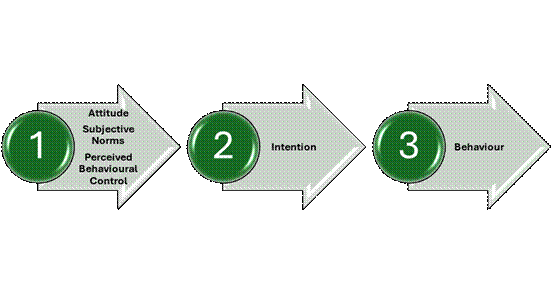
Adapted to TPB Theory (2025)
As depicted in Diagram 2.1, shoppers at Tesco in Middlesbrough who have a positive outlook towards healthy eating and clearly understand traffic light labels may disregard their intentions if they perceive healthy options as “more expensive” (Silva et al, 2024).
- Nudge Theory (Thaler & Sunstein, 2008)
The Nudge Theory suggests that small, strategic changes in how retailers present choices can significantly influence decision-making. Thus, nudges are marketing strategies that do not force behavioural change, but they appeal to shoppers and drive them toward making expected choices (better decisions) by making healthier options more visible, easily accessible, and even more attractive (Ikonen et al, 2023).
Identified nudging techniques seen in supermarkets include:
- Using larger fonts and simple icons on food labels.
- Displaying healthy items (food and drinks) with green labels at eye level.
- Positioning healthy foods near checkout areas.
- Exploring attractive signages to promote nutritional awareness.
Diagram 2.2 explained Nudge Theory as follows:
[Choice Architecture] → [Automatic Cognitive Biases] → [Improved Food Choices]
Diagram 2.4: Nudge Interventions in Food Retail

Adapted to the Nudge Theory (2025)
Studies indicate retailers combining the nudging strategy with health labelling are more effective in influencing consumer decision than either method alone (Ikonen et al, 2023). Tesco, for instance, combines traffic light labelling (TLL) with promotional messaging and better shelf placement not only to improve consumer choices but to achieve competitive advantage (Packer et al, 2021).
- Integrated Theoretical Approach
While the Theory of Planned Behaviour (TPB) examines people’s motivation and purchase intention, the Nudge Theory aims to identify how the retailers in the decision-making environment (i.e., business setting) can either encourage or undermine those purchase intentions. A combination of both theories therefore offers a more holistic strategy for promoting purchase of healthier food products:
Key characteristics of the integrated theoretical approach are:
- TPB broadens retailers’ understanding of psychological drivers (i.e., norms, attitudes, and perceived control).
- Nudge Theory suggests strategies that businesses can implement to shape the decision-making environment, thus, making healthy choices more intuitive and accessible (Ikonen et al, 2023).
Porter et al (2023) support use of both approaches. The scholars agree that these theories are more effective because the strategies target both the external shopping environment and consumers’ individual cognitive processes.
Therefore:
[Motivation (TPB)] + [Environment (Nudge)] → [Effective Food Labelling] → [Healthier Purchases]
Diagram 2.5: Combined TPB and Nudge Framework for Label Use in Retail Marketing

Adapted to the TPB and Nudge Framework (2025)
As depicted in Diagram 3, Tesco outlet in Middlesbrough, England, is combing both frameworks (i.e., “visible labels with redesigned in-store layout” and “community engagement strategies”) to help consumers consistently make informed healthy food choices.
Conclusion
The chapter presents an extensive review of literature on health-focused food labelling, including consumer behaviour, label formats, and other contextual factors affecting its effectiveness. While studies highlight the usefulness of labels (in both theory and practice) as an effective tool for boosting health awareness, reducing diet-related illnesses, and increasing business profitability, practical challenges remain in their interpretation and influence on real-world purchasing. Tesco, among other frontline UK retailers, is transforming label-consumer interaction through different strategies (e.g., product promotions, store layout, and demographic engagement).
Leave a Reply