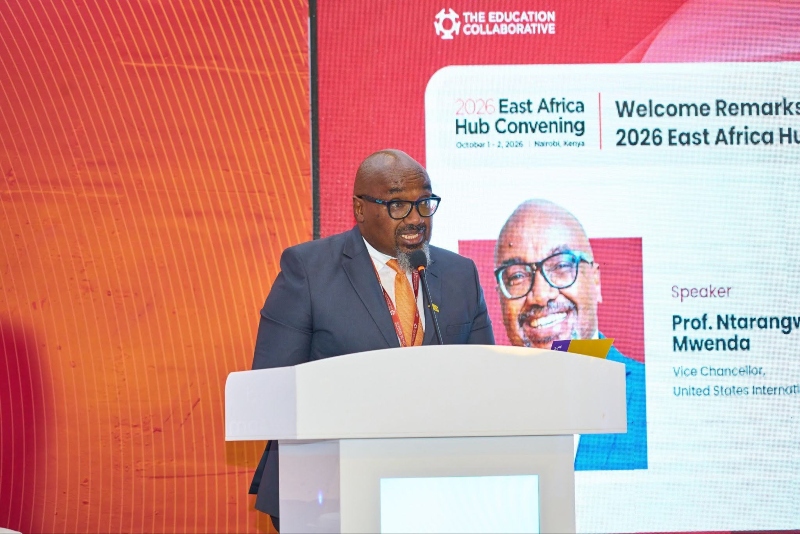
More than 150 representatives from over 30 institutions across 10 countries gathered in Nairobi on 1–2 October for the 2026 East Africa Hub Convening, where 40-plus speakers led discussions on the challenges and opportunities facing African higher education.
The event marked the Hub’s fourth Convening and five years of operation. Between 2022 and 2024, member institutions made 213 commitments, and nearly 90% of those from 2024 are already complete. That work has produced six institution-wide systems spanning career services, e-internships and entrepreneurship ecosystems, reaching more than 34,000 students.
According to Dr George Mugabe, Director of the East Africa Hub, accountability is what turned pledges into results: commitments were tracked, shared and revisited, with peers expecting follow-through. Larger, systemic commitments were also completed more often than smaller ones.
Are campuses built around students?
The theme was “Students First: Advancing Sustainable, Tech-Enabled Campuses for Equitable & Transformative Student Outcomes,” with discussions probing whether universities are genuinely designed around students or still expect students to fit existing systems.
Technology featured prominently, but the focus was on improving the student experience rather than adopting tools for their own sake. Prof. Mwenda Ntarangwi, Vice Chancellor of host institution United States International University-Africa, described the best future campuses as those where technology becomes invisible because it serves human connection, belonging and success. He warned: “Technology can widen inequity if we are careless. Putting students first means using it ethically, transparently, and with students as partners.”
Keynote rule and debate
Dr Beatrice Muganda, Principal Secretary in Kenya’s State Department of Higher Education, delivered the keynote and set a rule: “Nothing about students should be designed without students.” She urged universities to move from pilots to institutional change.
An opening debate facilitated by Claude Kabengera of Kepler College tested that principle. Prof. Wanja Tenambergen of Riara University argued that universities know student numbers, not real students, and that support remains fragmented. Collette Utetanase Ganza of the University of Rwanda described students as recipients of decisions rather than partners in making them. Dr Vincent Ogutu of Strathmore University and USIU-Africa student president Olatunji Lincoln Oladayo offered a more hopeful view, citing student governments, involvement in strategic planning and financial aid as signs of progress, while acknowledging the work is unfinished. The practical takeaway: define what student-centred means and measure it.
Tools built for students
Career services yielded clear examples. The University of Embu built a portal tracking each student’s career path, while the University of Cape Coast developed a digital CV builder accessible through its student portal, now being shared across the network. At the AI Innovations Showcase, Kepler College demonstrated Iga Africa, which gives instructors AI summaries of student strengths and weaknesses; USIU-Africa showed a dashboard flagging at-risk students; and Tanzania’s Muhimbili University of Health and Allied Sciences described building AI under 16 policy statements and a governance committee.
Rankings roundtable
The Africa Higher Education Rankings roundtable concluded that Africans should define excellence themselves, measure it by impact and purpose, and pursue it collectively. Prof. Robert Gateru of Riara University noted that what gets measured gets done, so measures should reflect African values. Dr Olive Sabiiti of Cavendish University Uganda urged institutions to assess graduates’ community impact rather than counting outputs, while Prof. DeBrenna Agbenyiga of the International University of Grand Bassam, Côte d’Ivoire, offered a test: can graduates create jobs, not only get them?
Communications Connect
An invitation-only evening gave communications professionals across the Hub a space to share what works. Key takeaways included the need for stronger relationships among communications and marketing teams, a more structured community for these professionals, shared priorities and deliverables, and greater continuity in institutional engagement.
Five years of the Hub
Prof. Samuel Gudu of Rongo University traced the Hub to a simple idea: universities should help each other grow instead of competing. Dr Sabiiti pointed to Cavendish’s new career office and innovation hub, and to a network where institutions “do not see each other as competitors but as collaborators.” Dr Juster Nyaga of the Management University of Africa credited the Collaborative for her university’s first career office and first career fair, held this year. Prof. Ntarangwi called the Hub’s completion record “returns on trust.”
Looking ahead
The next Convening takes place on 2–3 June 2027, marking ten years of the network, with a widened focus on industry, regulators and policy. Dr Mugabe outlined the Hub’s direction: deepening mentorship, expanding mobility for faculty, staff and students, strengthening cross-border partnerships, growing investment in systems change, and influencing education policy across the continent.
Rose Dodd, Executive Director of The Education Collaborative, closed by reminding participants that no institution solves its challenges alone, highlighting USIU-Africa’s decision to fund the campus visit, a coffee break and a hosted dinner from its own resources as a model of ownership. She ended on a note of pride: “We see the shape of Africa worn proudly, in necklaces, earrings, and symbols of home. There is a deep connection to this continent and pride in what we are building here. We should build on that pride: looking inward, learning from one another, and investing in the people and institutions already moving Africa forward.”
Leave a Reply