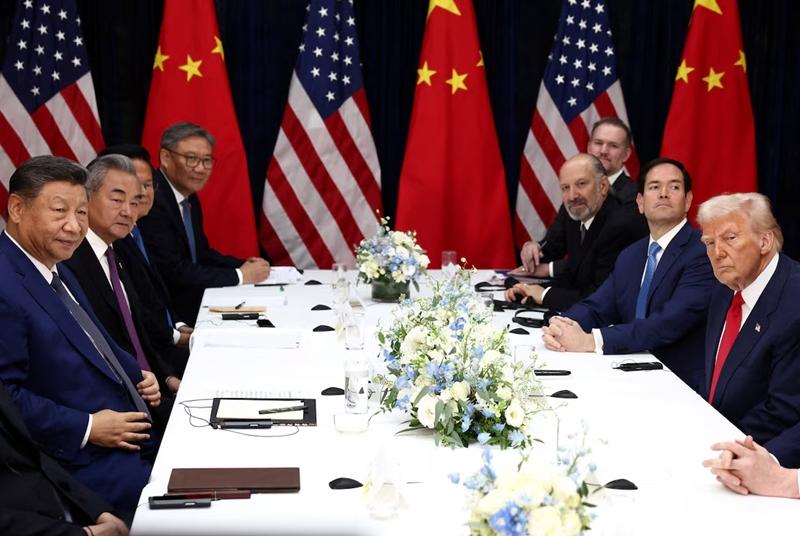
China’s diplomatic influence, economic ambitions, technological development and relations with neighbouring countries are dominating major news developments on Friday, November 20, 2026.
The historic meeting between Chinese President Xi Jinping, US President Donald Trump and Russian President Vladimir Putin in Shenzhen has attracted international attention, while China’s engagement with Australia, South Korea and other countries is generating fresh diplomatic and economic developments.
Meanwhile, renewed US restrictions on Chinese artificial intelligence technology, falling Hong Kong stocks, Taiwan Strait military activities and changing trade relationships are highlighting the challenges confronting the world’s second-largest economy.
1. Xi Jinping Hosts Historic Trilateral Summit With Trump and Putin in Shenzhen
One of the biggest international developments involving China is the historic trilateral meeting between President Xi Jinping, US President Donald Trump and Russian President Vladimir Putin in Shenzhen.
The November 19 gathering brought together the leaders of three major nuclear powers for their first formal trilateral summit, creating an important diplomatic moment for Beijing and attracting international attention.
The meeting produced a joint declaration addressing nuclear risks, international peace, energy cooperation and global governance. The leaders also indicated their willingness to maintain high-level communication despite differences in their national interests.
One of the central messages of the declaration concerned the dangers of nuclear conflict. The three countries reaffirmed the principle that nuclear war must never be fought.
The summit also provided Xi Jinping with an opportunity to demonstrate China’s growing diplomatic influence and its ambition to position itself as an important participant in discussions about international stability.
According to reporting by the Associated Press, the meeting did not produce major breakthroughs on longstanding disagreements between Washington and Beijing. Nevertheless, the gathering offered a significant diplomatic platform for the three leaders.
Xi and Trump have met several times this year, with their personal relationship becoming an important part of efforts to manage tensions between their countries.
However, unresolved disagreements over trade, advanced technology, rare-earth materials and other strategic issues continue to complicate relations.
The summit’s outcome will therefore be judged not only by the joint declaration but also by whether the three governments translate their commitments into practical cooperation.
2. Xi Calls for Stronger Asia-Pacific Cooperation at APEC Meeting
President Xi Jinping has called for stronger regional cooperation and the development of an Asia-Pacific community as China hosts the 33rd Asia-Pacific Economic Cooperation (APEC) Economic Leaders’ Meeting.
According to China’s state-run news service, Xinhua, Xi chaired the APEC meeting on November 20, using the gathering to promote regional economic cooperation.
The Chinese president has consistently presented economic integration, trade cooperation and regional development as important elements of China’s approach to international relations.
The APEC gathering provides Beijing with an opportunity to engage governments and business leaders across the Asia-Pacific region at a time when trade disputes, geopolitical competition and economic uncertainty are affecting international commerce.
China is particularly interested in maintaining strong commercial relationships with Asia-Pacific economies because the region remains central to its manufacturing, export and investment strategies.
The meeting also comes amid renewed tensions between the United States and China over technology exports, market access and strategic competition.
Xi’s call for an Asia-Pacific community reflects Beijing’s preference for regional economic cooperation and greater connectivity among participating economies.
Source: Xinhua and China News Service, November 20, 2026.
3. US Restrictions on AI Chips Put Pressure on Chinese Technology Companies
China’s technology industry is facing renewed pressure following a series of US measures restricting Chinese companies’ access to advanced artificial intelligence chips and computing infrastructure.
A November 20 report by Reuters says the restrictions are weighing on Chinese technology stocks and could complicate Beijing’s ambitions to develop a competitive domestic AI industry.
The latest American measures include restrictions on Chinese companies’ remote access to advanced AI chips, the suspension of some Nvidia chip shipments to China and proposed disclosure requirements affecting American companies using Chinese AI models.
The measures demonstrate that competition between Washington and Beijing is expanding beyond semiconductor exports into cloud computing, software development and artificial intelligence services.
Neil Shah, vice president of research at Counterpoint Research, told Reuters:
“Closing the gap at the leading edge before 2028, or even by 2030, looks difficult.”
The restrictions could have a particularly significant impact on Chinese AI startups that require substantial computing resources to train advanced models.
Companies potentially affected include DeepSeek, Moonshot AI, Z.AI and MiniMax.
Reuters reported that shares in Z.AI had fallen 22 per cent while MiniMax had declined 34 per cent over the preceding two weeks.
China’s major technology companies are nevertheless exploring ways to reduce their dependence on American semiconductor technology.
Tencent President Martin Lau said the restrictions would slow the development of the company’s next-generation AI model in the near term while accelerating China’s transition towards domestic chips.
Alibaba CEO Eddie Wu also warned that the new US rules would affect the company’s products and services next year.
Alibaba expects its cloud revenue growth to slow to between 30 and 45 per cent next year, compared with 53 per cent in its latest quarter.
The challenge for China is that domestic semiconductor manufacturing still faces limitations, particularly in producing advanced processors at sufficient scale.
Semiconductor Manufacturing International Corporation remains an important component of China’s domestic chip industry, with much of its advanced production capacity allocated to Huawei’s Ascend AI processors.
The latest restrictions are therefore likely to strengthen Beijing’s determination to develop an independent semiconductor supply chain.
4. China and South Korea Complete Substantial Talks on Upgrading Trade Agreement
China and South Korea have substantially completed negotiations aimed at upgrading their existing free trade agreement, marking a potentially important development in economic relations between the two Asian economies.
According to Caixin Global’s November 20 reporting, the proposed agreement would expand access to services and investment markets while introducing additional commitments involving Korean films and video games.
The negotiations are significant because China and South Korea maintain extensive commercial relationships across manufacturing, technology, consumer products and entertainment.
An upgraded trade agreement could create additional opportunities for companies operating in both markets, particularly in industries where investment and cross-border services are becoming increasingly important.
However, the conclusion of negotiations does not mean that the agreement has already entered into force. Signing and domestic approval procedures remain necessary.
The development comes at a time when Asian economies are seeking to strengthen regional commercial relationships amid international trade uncertainty.
For Beijing, closer economic engagement with Seoul could support its broader efforts to maintain trade relationships across Asia despite continuing geopolitical disagreements.
For South Korea, improved access to the Chinese market could benefit businesses operating in entertainment, technology, services and investment.
5. DeepSeek Secures 100 Billion Yuan Funding Round
Chinese artificial intelligence company DeepSeek has reportedly closed a funding round worth 100 billion yuan, according to a November 20 report published by Caixin Global.
The funding round represents another major development in China’s rapidly expanding artificial intelligence industry.
The report identifies investment funds linked to Tencent and CATL among the participants in the company’s second external funding round.
DeepSeek has attracted international attention through its development of artificial intelligence models and its contribution to China’s efforts to compete with leading American AI companies.
The reported investment is particularly significant because Chinese AI developers are facing increasing difficulties accessing advanced foreign semiconductor technology.
The availability of substantial domestic investment could help DeepSeek strengthen its computing infrastructure, recruit technical personnel and continue developing its artificial intelligence products.
The development also illustrates the growing interest of Chinese investors in domestic AI companies as the country seeks to reduce its reliance on foreign technology.
However, the funding announcement should be distinguished from confirmation of how the money will be spent or the company’s future commercial performance.
6. Xi Jinping Seeks Stronger Relations With Australia
Chinese President Xi Jinping has called for a trust-based partnership with Australia during bilateral discussions in Shenzhen on the sidelines of the APEC gathering.
The meeting is part of China’s wider diplomatic engagement with Asia-Pacific governments during the summit.
Relations between Beijing and Canberra have experienced periods of tension over trade, national security, regional influence and Australia’s relationship with the United States.
Nevertheless, both countries have important economic interests in maintaining commercial engagement.
Australia is a significant supplier of minerals, agricultural commodities and energy resources, while China remains one of its most important trading partners.
Stronger diplomatic communication could help both governments manage disagreements and maintain economic cooperation.
The discussions also come as China seeks to strengthen its regional relationships amid growing competition with Washington.
The South China Morning Post reported Xi’s call for a trust-based partnership in its November 20 coverage of the bilateral meeting.
7. China Faces Renewed Scrutiny Over Military Activities Around Taiwan
Military activities around Taiwan remain another important regional security development involving China.
Taiwan’s Ministry of National Defense reported on November 20 that it had detected Chinese military aircraft, naval vessels and balloons operating around the island during the preceding 24-hour reporting period.
According to Taiwan News, the ministry tracked eight Chinese military aircraft, seven naval vessels, two official ships and four balloons between 6 a.m. Thursday and 6 a.m. Friday.
Six of the eight aircraft reportedly crossed the Taiwan Strait median line and entered Taiwan’s northern and southwestern air defence identification zone.
Taiwan said it responded by deploying aircraft, naval vessels and coastal-based missile systems.
The ministry also reported that four Chinese balloons crossed the median line.
Separately, two Russian Tu-95 strategic bombers entered Taiwan’s air defence identification zone on Thursday morning, prompting Taiwanese F-16 fighter jets to monitor their movements.
Taiwan’s defence authorities said the Russian aircraft travelled north along airspace off the island’s eastern coast before exiting northeast of Keelung.
The military developments come amid continuing disagreements between Beijing and Taipei over Taiwan’s political status and security arrangements.
China considers Taiwan part of its territory, while Taiwan maintains its own democratically elected government and military.
The latest developments underscore the continuing security challenges in the Taiwan Strait, particularly as regional governments closely monitor military activities involving China and Russia.
8. Hong Kong Stocks Fall to Four-Month Low Amid Renewed US-China Tensions
Hong Kong’s financial market experienced another difficult trading session on November 20, with the Hang Seng Index falling to its lowest level in approximately four months.
A report published by Reuters and carried by Business Recorder said the Hang Seng Index dropped 2 per cent, while the Hang Seng Tech Index reached a 26-month low.
The technology index extended its losing streak to seven consecutive sessions.
Mainland Chinese equities also remained under pressure. The CSI300 blue-chip index finished flat, while the Shanghai Composite Index declined 0.3 per cent, reaching its lowest level in more than 15 months.
The market weakness came despite the high-profile meeting between Xi Jinping and Donald Trump in Shenzhen.
Investors remain concerned about renewed trade tensions between the two countries, particularly following Washington’s latest economic and technology restrictions against Chinese businesses.
Chinese President Xi had said he remained committed to working with Trump to steer bilateral relations in the right direction.
However, China’s Commerce Ministry also expressed strong opposition to recent American economic and trade restrictions.
The market reaction demonstrates that diplomatic engagement does not automatically eliminate investor concerns about trade policy, technology competition and international economic uncertainty.
The possibility of further US interest-rate increases also contributed to concerns about global liquidity and investment appetite.
For Hong Kong, which serves as an important international financial centre and gateway to mainland China, prolonged market weakness could affect investor confidence and the broader financial environment.
9. China and Indonesia Discuss South China Sea Cooperation and $15 Billion Business Deals
China and Indonesia have discussed expanding economic cooperation and exploring joint development opportunities in the South China Sea during a meeting between President Xi Jinping and Indonesian President Prabowo Subianto in Shenzhen.
The discussions took place on November 20 on the sidelines of the APEC summit.
According to Reuters, the Indonesian government said both countries had made progress in discussions about potential joint development areas in the strategically important South China Sea.
The two countries also announced significant commercial developments. Prabowo’s office said businesses from China and Indonesia had agreed to 35 deals worth approximately $15 billion.
China and Indonesia also launched negotiations on a Comprehensive Economic Partnership Agreement, according to China’s Xinhua news agency.
Prabowo expressed optimism about the relationship between the two countries during his meeting with Xi.
“Our relationship, we think, keeps growing stronger,” Prabowo told Xi in Shenzhen.
He added:
“We have reached a more aligned understanding.”
The proposed maritime cooperation is particularly important because the South China Sea remains a sensitive geopolitical area involving competing territorial claims and maritime interests.
Indonesia has previously faced domestic controversy over language used in a 2024 maritime development agreement with China concerning areas of overlapping claims.
The Indonesian government subsequently clarified that it did not recognise China’s claims over the South China Sea.
Consequently, any new cooperation involving the disputed waterway is likely to attract attention from regional governments and security analysts.
The economic agreements, meanwhile, demonstrate the importance both countries attach to expanding trade, investment and commercial cooperation.
10. Xi Jinping Calls for Stronger China-Singapore Strategic Cooperation
President Xi Jinping has called for stronger strategic communication and closer coordination between China and Singapore during discussions with Singaporean Prime Minister Lawrence Wong.
The meeting forms part of China’s diplomatic engagement with regional leaders attending the APEC gathering.
China and Singapore maintain extensive economic and diplomatic relationships, with cooperation spanning financial services, manufacturing, technology, education and infrastructure development.
Singapore is also an important commercial gateway for international companies seeking access to Southeast Asian markets.
Xi’s appeal for stronger coordination reflects Beijing’s interest in maintaining close relationships with Southeast Asian countries as competition between major global powers intensifies.
Singapore, for its part, has traditionally sought to maintain constructive relationships with both China and the United States while protecting its economic and strategic interests.
The discussions provide another indication of the importance China attaches to regional diplomatic engagement.
According to China’s State Council Information Office, Xi’s November 20 diplomatic programme also included meetings with the prime ministers of Thailand and Malaysia.
These engagements demonstrate the broad regional diplomatic activity surrounding the APEC summit.
11. Xi and Trump Summit Raises Questions About China’s Relationship With the United States
Although the trilateral meeting involving China, Russia and the United States attracted considerable international attention, the relationship between Xi Jinping and Donald Trump remains one of the most consequential issues emerging from the Shenzhen diplomatic gathering.
The two leaders have continued diplomatic engagement despite disagreements involving trade, technology, military security and international influence.
The Associated Press reported that Xi described the relationship between the two countries as enjoying constructive strategic stability.
During their meeting, Xi also praised Trump’s contribution to improving bilateral relations.
“The efforts you have made are there for all to see and will go down in history,” Xi told Trump.
However, the summit did not resolve several outstanding commercial disagreements.
Washington has expressed concerns about China’s commitments to purchase American agricultural products and increase exports of rare-earth materials.
The two governments have also been discussing a possible framework covering trade in non-sensitive goods worth $30 billion on each side.
Nevertheless, no announcement resolving these issues emerged from the summit.
Artificial intelligence cooperation was identified as one area where some progress might be possible.
Wendy Cutler, senior vice-president at the Asia Society Policy Institute, told the Associated Press:
“AI seems to be the one area where some progress has been made, with China affirming its concerns about safety and security and welcoming bilateral work.”
The challenge for both governments will be translating diplomatic engagement into practical agreements capable of reducing economic and technological tensions.
The relationship remains particularly important because the United States and China are among the world’s largest economies and their decisions have consequences for international trade, investment and financial markets.
12. US Moves Against Chinese Telecommunications Companies After Shenzhen Summit
Another development attracting attention is the reported American action against Chinese telecommunications companies shortly after the Xi-Trump meeting.
The South China Morning Post reported on November 20 that the United States had moved against China Mobile, China Telecom and China Unicom, among other providers of internet-protocol-enabled services.
The action would prevent the affected companies from having direct access to US telephone numbers.
The development highlights the continuing security and regulatory disagreements between Washington and Beijing, even as their leaders pursue diplomatic engagement.
Telecommunications infrastructure has become an important area of international competition because governments increasingly regard communication networks, data management and digital infrastructure as national security issues.
The timing of the American action is particularly notable because it followed the high-profile summit in Shenzhen.
It illustrates the difficulty of separating diplomatic cooperation from the wider strategic competition between the two countries.
The latest developments also reinforce concerns among international businesses that US-China disagreements could continue affecting technology supply chains and cross-border commercial operations.
13. China Issues Weather Warning as Snow and Rain Affect Several Regions
China’s National Meteorological Centre has issued a weather bulletin warning of snowfall, rain and strong winds across several parts of the country.
The November 20 bulletin indicated that much of China had experienced relatively little rainfall, although the Shandong Peninsula recorded snow and rain mixed with snow.
The meteorological authority warned that parts of eastern Shandong could experience heavy snowfall, with isolated areas potentially receiving between 10 and 12 millimetres of precipitation.
Other areas expected to experience rainfall included parts of Yunnan, Guangxi, Guangdong, Hainan and Taiwan.
The forecast also identified strong winds across parts of Inner Mongolia, northeastern China and the Shandong Peninsula.
From November 22, rainfall was expected to affect parts of southwestern China, Jiangnan and southern China, while northeastern areas could experience additional snowfall.
The authorities highlighted potential implications for transportation, urban operations and public health.
The weather conditions are particularly important for road transportation and communities in areas experiencing heavy snowfall and strong winds.
Source: China’s National Meteorological Centre, November 20, 2026.
14. China Continues to Strengthen Its Position in International Technology and Economic Cooperation
The developments reported on November 20 collectively illustrate China’s efforts to strengthen its international economic and diplomatic position while confronting growing competition from the United States.
The APEC gathering has provided Beijing with an opportunity to engage several important trading partners, including Australia, Singapore, Indonesia, Thailand and Malaysia.
At the same time, the country is facing pressure from American restrictions targeting its access to advanced semiconductor technology.
The reported 100-billion-yuan DeepSeek funding round demonstrates that domestic investors remain willing to commit substantial resources to artificial intelligence development.
However, the difficulties facing Chinese technology companies show that financial investment alone cannot resolve the country’s challenges in advanced semiconductor manufacturing.
China’s diplomatic engagement with Australia and Indonesia also demonstrates the importance of maintaining regional commercial relationships.
Meanwhile, the latest developments around Taiwan highlight the security concerns that continue to complicate China’s relationships with neighbouring governments.
The combination of diplomatic initiatives, technological investment, trade negotiations and military developments makes November 20 an important day in China’s international affairs.
Leave a Reply