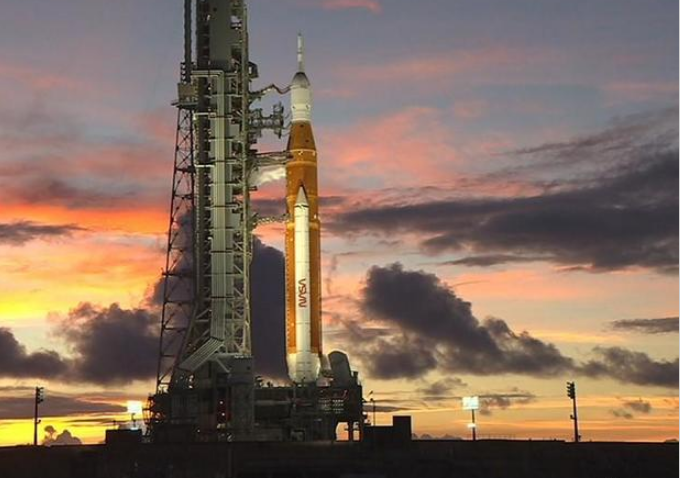
A fuel leak and then an engine problem during final lift-off preparations led NASA to postpone the much-anticipated launch of its giant new Moon rocket on Monday.
The next launch attempt will not take place until Friday (September 2) at the earliest.
The rocket was set to blast off on a mission to propel an uncrewed capsule into lunar orbit, bringing the US closer to putting astronauts back on the Moon for the first time since the Apollo program ended 50 years ago.
But shortly before the planned lift-off, NASA repeatedly stopped and re-started the fuelling of its Space Launch System (SLS) rocket with super-cold hydrogen and oxygen because of a leak of highly explosive hydrogen in the same place that saw a leak during a dress rehearsal back in the spring.
Then, NASA ran into new trouble when it was unable to properly chill one of the rocket’s four main engines, officials said.
Engineers continued working to gather data and pinpoint the source of the problem after it was announced the launch was being scrubbed.
‘Very complicated machine’
The Artemis 1 mission is a test flight of massive importance. The launch, which was originally scheduled for Monday during a two-hour window starting at 08:33 local time (14:33 CEST), will see an unmanned Orion module put into orbit around the Moon before returning to Earth 42 days later.
It will gather crucial data ahead of the next stages in the mission – a manned launch of the Orion module to lunar orbit, followed by the first mission to land humans on the Moon since 1972.
NASA Administrator Bill Nelson said the scrubbed launch is “illustrative that this is a very complicated machine, a very complicated system, and all of those things have to work”.
“You don’t want to light the candle until it’s ready to go,” he added, reminding viewers on NASA TV that as an astronaut, he was among the crew of the 24th flight of the Space Shuttle, a flight that was delayed four times before it launched on the fifth try.

What is Artemis 1?
This is the first stage of the Artemis mission, which has the ultimate goal of establishing a long-term presence on the Moon’s surface.
NASA will launch an unmanned Orion spacecraft into orbit around the Moon on a test run to ensure manned missions are as safe as possible.
The Orion spacecraft will be launched from the Kennedy Space Center in Florida on NASA’s giant rocket, called the Space Launch System (SLS).
It is, according to NASA, the world’s most powerful rocket, able to carry more payload into deep space than any other vehicle.
Standing at almost 100 m tall, the SLS can deliver 4 million kg of thrust. Two minutes into launch, two boosters will detach from the rocket, followed by the core stage (which acts as the backbone of the rocket, doing most of the heavy lifting).
These parts will fall into the Pacific Ocean, as the Orion spacecraft continues on course toward the Moon.
Orion will travel 450,000 km from Earth, and thousands of kilometres beyond the Moon over the course of the four-to-six-week mission.
“We’re going to stress it and test it. We’re going to make it do things that we would never do with a crew on it in order to try to make it as safe as possible,” NASA Administrator Bill Nelson said on Wednesday (August 24).
Orion will be propelled towards the Moon by a service module provided by the European Space Agency (ESA).
Flight test dummies
The Orion spacecraft, which is 3 metres tall, can seat four astronauts.
A full-size dummy in an orange flight suit is going to occupy the commander’s seat for this flight, rigged with vibration and acceleration sensors.
Two other mannequins made of material simulating human tissue will measure cosmic radiation, which is one of the biggest risks of spaceflight.
The flight will also see ten shoebox-sized satellites pop off the capsule once it is en route to the Moon, which will measure radiation, amongst other things.
Leave a Reply