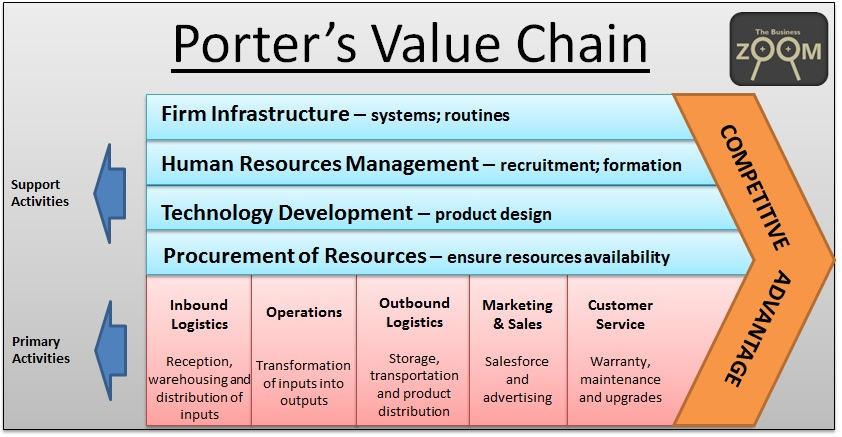
The representation of procurement in Porter’s value chain came as a recognition of the (strategic) importance that procurement gained as a function inside the firm.
Value Chain Model: A tool to analyse firm’s sources of competitive advantage
According to Cambridge University, the Value Chain is a model used to define the core competencies and activities that will create a competitive advantage for the company. McGrath and Bates (2013) defined Michael Porter’s value chain as a strategic business planning tool used to identify the sources of competitive advantage in the firm. Harvard Business School (Institute for strategy and competitiveness) explains that the model was developed by Michael Porter and used throughout the world for nearly 30 years, and that it constitutes a powerful tool that helps dis-aggregating a company into its strategically pertinent activities with aim to focus on the sources of competitive advantage. McGrath and Bates (2013, p.226) advocate that the tool “tracks the impact made on a product or service by every process from its start to delivery. The nine main stages of the value chain are grouped together as five primary activities and four support activities”.
In his paper dated 1985 and called: “the value chain and competitive advantage’ Porter considers every firm as a ‘’collection of activities that are performed to design, produce, market, deliver and support its product’ (Porter 1985, p. 51). Porter suggests the necessity -if we are to analyse the firm’s sources of competitive advantage- to systematically examine all the activities a firm performs and the way they interact. He represented these activities using a value chain (Fig. 1) that he introduced as a basic tool to perform this systematic assessment.
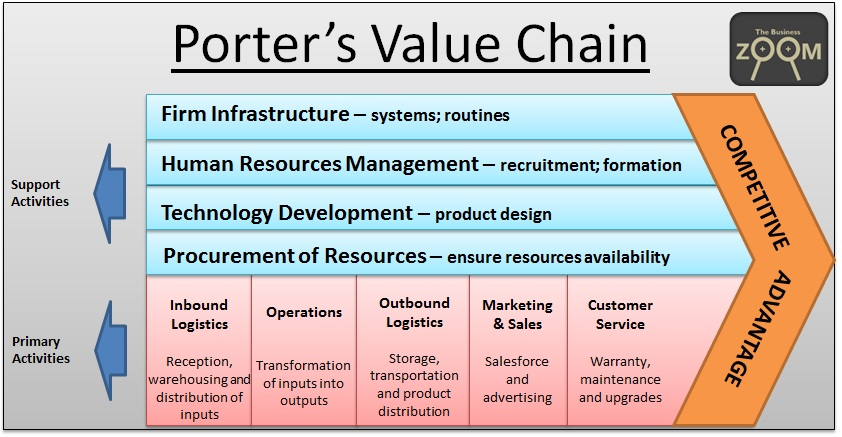
Figure 1- Porter’s value chain
Source: Harvard Business School, institute for strategy and competitiveness
Value activities: Primary activities and Support activities
According to Porter, the value chain displays total value, and consists of value activities and margin. For him the value chain dis-aggregates a firm into its strategically relevant activities, thus helping to understand the costs and potential sources of differentiation.
He defines the value activities as “the building blocks by which a firm creates a product valuable to its buyers’, and the margin as “the difference between total value and the collective costs of performing the value activities’ (Porter 1985, p.52). He divided value activities into primary activities(activities involved in the physical creation of the product, its sale to the buyer and after sale service), and support activities (activities supporting the primary activities).
How competitive advantage is generated?
Porter’s main idea is that competitive advantage cannot be understood when looking at a firm as a whole, as it derives from the different activities the firm performs during the product life-cycle. He defined these activities as “strategically important’ to the firm (Porter 1985, p.52). He further claimed the potential source of competitive advantage between firms resides in the way a firm’s value chain is organized and the strategic activities -forming the value chain- are performed, as each of these activities can contribute to a firm’s relative cost position, creating a basis for differentiation.
Where does procurement stand in Porter’s model?
Though procurement stands in his model within the support activities category, Porter argued that Procurement can be associated with specific primary activities and also support the entire chain. He explained that procurement could be divided into a number of distinct value activities such as qualifying new suppliers, procurement of different groups of purchased inputs (sourcing: RFQ, negotiation and setting the contract), and ongoing monitoring of supplier performance.
In his proposed model(tool), Porter’s employed the term Procurement rather than purchasing to define the procurement function because the usual connotation of purchasing is too narrow among managers.
How can Procurement support firms creating competitive advantage?
He defined procurement as “the function of purchas(ing) inputs used in the firm’s value chain’ and emphasized that it is different from what he called “the purchas(ed) inputs themselves’ (Porter 1985, p. 54). He further explained that the purchas(ed) inputs include assets and equipment, raw materials, suppliers, and other consumables. According to him even if the purchas(ed) inputs are commonly associated with primary activities, they are still present in every value activity including support activities.
Porter concluded that though procurement activities from cost perspective are not of high value, but it still often has a large impact on the firm’s overall costs and differentiation, arguing that improved purchasing practices could strongly impact the cost and quality of purchas(ed) inputs.
Porter got interested by the linkages within the value chain, after defining the value activities as the building blocks of the competitive advantage, he argues that the value chain is not a collection of independent activities but rather a system of interdependent activities related by linkages within the value chain. He claims that competitive advantage is generated from linkages between activities similar to that from the individual activities themselves. He suggests that competitive advantage from linkages between activities could be achieved either through optimization or coordination.
In his paper, while he stressed on the importance of the linkages between the value activities, Porter however mentioned mostly the linkages between activities involving suppliers base management (procurement/SCM activities) and other value activities, and how a more coordinated and aligned work between procurement and those mentioned activities could impact their cost or performance.
He concluded his discussion on the linkages between value activities that one not less important perspective is the linkages between the firm’s value chain and those of its suppliers, he claimed that the linkages between both value chains provide opportunities for the firm to take its competitive advantage to another level (Porter, 1985).
Leave a Reply