As the presidents of Mexico and the U.S. engaged in a diplomatic spat over tariffs earlier this month, one Mexican politician sprang into action. Samuel García, the governor of Nuevo León, a border state and key producer of parts for electric vehicles, announced plans to mitigate the “possible economic crisis.”
Nuevo León will “remain in first place,” a defiant García said at a briefing, as a fresh 25% tariff on goods from Mexico took effect. García — a Tesla enthusiast who has previously joked about naming his daughter after Elon Musk — announced tax cuts and fiscal stimuli for businesses, and said they would target alternative markets, including Europe and Asia. A “Made in Nuevo León” program would boost local consumption, he said.
This week, President Donald Trump reiterated that the 25% tariff on all vehicles imported into the U.S. goes into effect on April 2, after a monthlong exception for automakers who met the conditions under the United States–Mexico–Canada Agreement (USMCA) that he had negotiated during his first term. Mexico’s growing EV manufacturing sector could pay a heavy price.
Nuevo León is not the only EV manufacturing hub trying to protect its industry from the impact of tariffs: The central state of Guanajuato launched a similar plan in February, while the governor of Puebla recently said his government would buy some 500 vehicles from the local Volkswagen plant. Despite these incentives and President Claudia Sheinbaum’s promise to defend Mexican interests, the fallout from the tariffs is inevitable, and will be felt across large swaths of the country, industry experts said.
“This uncertainty is affecting investments both new and ongoing,” Manuel Montoya, director-general of Cluster Automotriz de Nuevo León, the top automotive industry chamber in the state, told Rest of World. With the U.S. accounting for nearly 80% of Mexico’s vehicle exports including EVs, no other market can make up for it, he said.
“We would lose that business and we would have to go into another line of work.”
In the decades after the original North American Free Trade Agreement came into effect in 1994, a combination of low labor costs, geographic proximity, and preferential market access turned many Mexican states, especially those near the U.S. border, into manufacturing hubs. Most major carmakers now have factories in Mexico, and the country is the seventh largest producer of cars in the world, employing around 1 million workers.
Meanwhile, the number of EVs produced has grown 30-fold since 2020, according to data from Cluster Industrial, a Mexican mobility consulting firm. Last year, some 206,900 EVs were produced in the country, nearly doubling from the previous year.
Nuevo León, across the border from Texas, does not produce EVs, but accounts for nearly a fifth of the electric mobility supply chain in Mexico, a report from Cluster Industrial showed. Tesla’s gigafactory was meant to be built in the state, and even though that plan is in limbo, it is home to more than 70 companies that supply Musk’s company. More than half the new investments in the state’s auto industry between October 2021 and May 2024 went to electric mobility, according to official data.
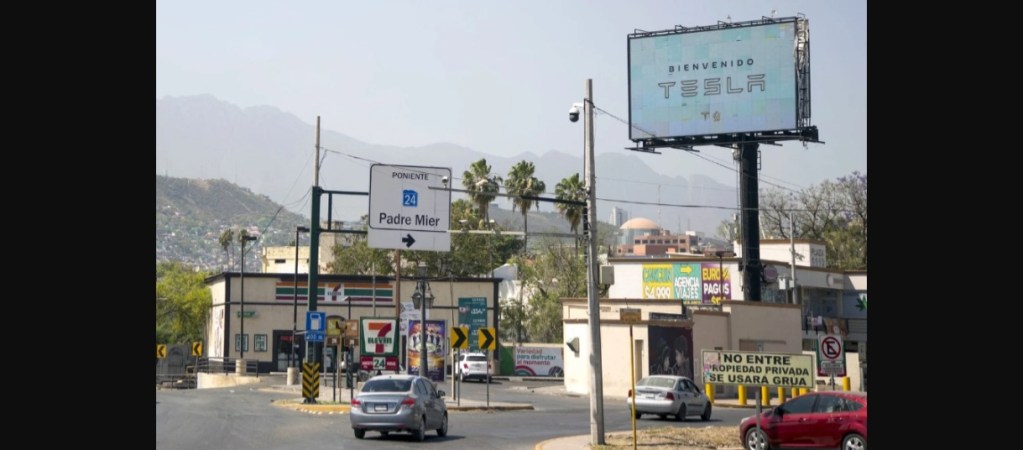
Governor García had earlier forecast that investments in electromobility would result in $5 billion in revenue for the state. His recently announced plan will ensure that “this tariff war [affects] us as little as it can,” García said at the briefing.
In Guanajuato, where Ford Motor said last year it would invest $273 million in its EV plant, the governor has introduced a plan to protect local investment — including the creation of a war room of business leaders and experts in the auto industry — to make strategic decisions.
But it’s not just the threat of tariffs that is sending a chill through Mexico’s EV industry. President Trump has said he would end the Biden administration’s EV mandate, pausing a federal clean energy program to expand the country’s network of EV charging stations and ending a federal EV tax credit. A potential decrease in EV demand in the U.S., coupled with the levies, will hit Mexico hard.
There is a lack “of clarity about the future,” Gil Tal, director of the Electric Vehicle Research Center at the University of California, Davis, told Rest of World. A cutback in EV manufacturing could have a serious effect on Mexico’s EV ambitions, he said.
“If you put money into building new assembly lines, training new people, it’s a growing economy,” Tal said. That “has a lot of multiplier effects versus the economy that just keeps making the same cars, staying behind on technologies and not growing.”
Foreign auto companies are being more cautious about investing in an industry built, in part, on supplying the U.S., Lourdes Cobos, president of Clúster de la Industria Automotriz de Coahuila, an industry body, told Rest of World. Coahuila state, which borders Nuevo León, is home to General Motors, the largest EV automaker in Mexico.
Production volume will likely fall because of the uncertainty generated by the threat of tariffs, Cobos said. “I can’t say it’s business as usual.”
To try and counter the effect, Mexico has been turning to Chinese EV makers that make up nearly 10% of new car sales. JAC Motors has production facilities aimed at the domestic market. SAIC’s MG Motor said last year it would build a manufacturing plant in Mexico. Also last year, García met with Stella Li, chief executive of BYD Americas. But earlier this month, China said it was delaying approval for the BYD plant because of concerns over the possible leak of its technology to the U.S. The factory was slated to create 10,000 jobs, and produce 150,000 vehicles a year.
The loss of jobs and investment can have another, more serious consequence: strengthen the very same criminal organizations that President Trump is pressuring Mexico to suppress.
The levies will “take away economic and well-being opportunities from our society,” the Mexican Association for the Automotive Industry said in a statement. That will “generate a breeding ground for the criminal activities that we seek to combat.”
Leave a Reply