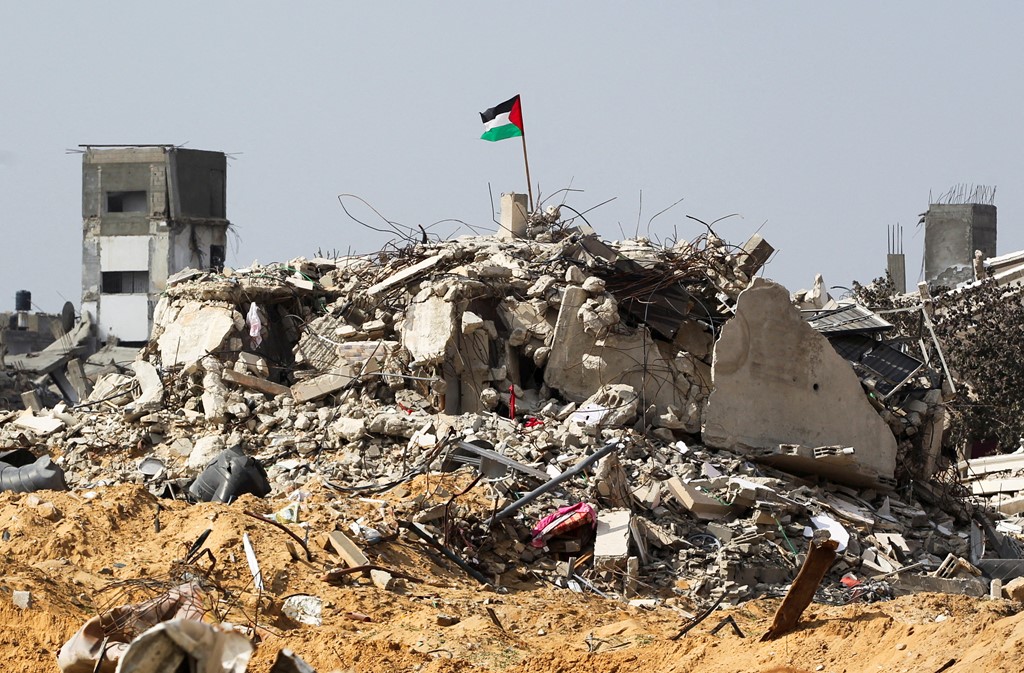
Palestinians should be able to return to their homes and “rebuild their shattered lives” in Gaza – that’s the view of the UK government, according to the environment secretary Steve Reed, who has told us peace can “only be based on a two-state solution”.
Speaking to the media, he said Palestinians have faced “a living nightmare for the last 14 months” and should be able to start rebuilding their homes with the help of the international community.
The UK government wants to reach “a long-lasting peace” in the region, he continued, which “can only be based on a two-state solution with a secure Israel living at peace with its neighbours, and a free and viable Palestinian side state alongside”.
Pushed for a specific response to Donald Trump’s comments, Reed said he won’t “provide a running commentary on the pronouncements of the president of the United States or any other world leader”.
He added, however, that he was not being disparaging of Trump in any way, and gave him credit for helping secure the current ceasefire.
Explained: What is the two-state solution?
After Trump’s shock proposal that the US “take over” Gaza, many countries have reaffirmed their commitment to a two-state solution – like the UK in our previous post.
But what is it?
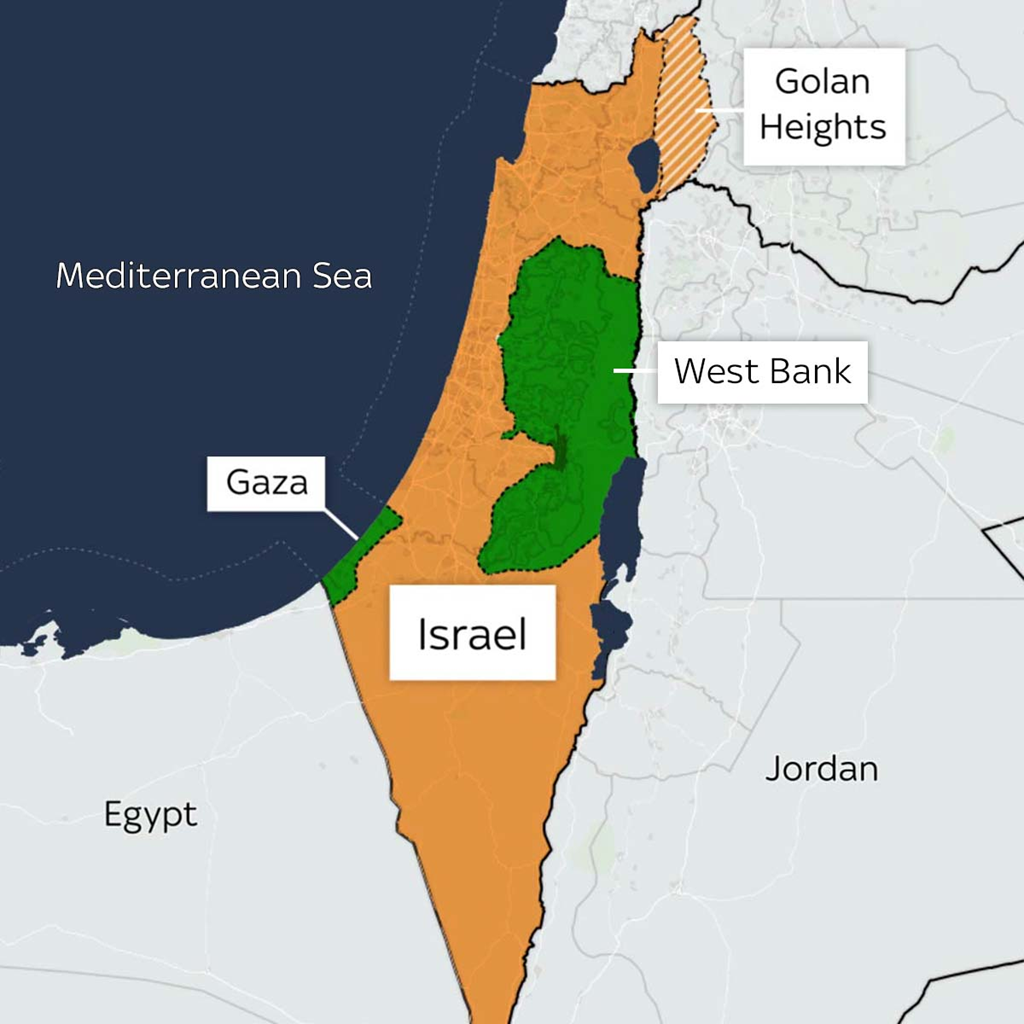
The two-state solution long been proposed as the best hope for peace in the Israeli-Palestinian conflict. It would see an independent Palestinian state established alongside the existing one of Israel – giving both peoples their own territory.
It is the official position of the UK, US and the United Nations.
What would it look like – and who would live where?
The biggest obstacle to a two-state solution is deciding what the borders of a potential Palestinian state would be.
Many believe they should be the same ones that existed before the 1967 Six-Day War, which saw Israel occupy East Jerusalem, the West Bank and Gaza.
Since then, increasing numbers of Israeli settlements have been established inside the West Bank, with around 600,000 Israelis now living there and in Occupied East Jerusalem.
Although these settlements are considered illegal under international law, their existence makes the territory increasingly difficult to designate as Palestinian.
The creation of Israel and the subsequent Arab-Israeli war of 1948 saw many Palestinians forced from their homes, in what is known as the Nakba, or “catastrophe” in English.
As such, the UN gave around 750,000 people refugee status, defined as people “whose normal place of residence was Palestine during the period 1 June 1946 to 15 May 1948, and who lost both home and means of livelihood as a result of the 1948 conflict”.
But under the same criteria, 5.9 million Palestinians – who live in the West Bank, Gaza, East Jerusalem and in camps across Jordan, Lebanon and Syria – now qualify, and many would want to return to their homeland.
There would not be space for this increased number of people inside the occupied territories, meaning some would have to be resettled in Israeli territory, which Israel is unlikely to tolerate.
There are particular border difficulties with Jerusalem.
Both sides claim the ancient city as their capital. This is because of its huge historical and religious significance for both Israelis and Palestinians and the fact it is home to several holy sites in Judaism, Islam, and Christianity.
Far-right Israeli politician Ben-Gvir praises Trump idea as ‘only solution’
A critic of Donald Trump’s comments during the conference with Israeli president, Benjamin Netanyahu, has said the words are “red meat” to those in Israel who have long wanted to resettle Gaza.
Far-right politician Itamar Ben Gvir was quick out the blocks to praise Trump, describing the president’s idea to resettle Gazans elsewhere as the “only solution”.
In a post on social media, he said “encouraging” Gazans to migrate from the enclave was the only correct strategy, urging Prime Minister Benjamin Netanyahu to adopt this policy “immediately”.
“When I said this time and again during the war that this was the solution to Gaza, they mocked me,” he added.
“Now it is clear: this is the only solution to the Gaza problem – this is the strategy for the ‘day after’.”
Ben Gvir, who is part of a movement advocating for Jewish settlement in the territory, resigned from Netanyahu’s cabinet last month over the ceasefire deal.
Turkey blasts Trump’s Gaza remarks as ‘wrong and absurd’
Donald Trump’s comments are provoking a strong reaction from US allies and adversaries alike.
Fellow NATO member Turkey is the latest to describe Trump’s idea to resettle Gazans elsewhere as “unacceptable”.
Foreign minister Hakan Fidan said past displacement of Palestinians and the settlement of Israelis in those areas is the root cause of the conflict.
“The issue of deportations from Gaza is not something that either the region or we would accept,” he told the state-run Anadolu Agency.
“Even thinking about it, in my opinion, is wrong and absurd.”
China, which has frosty relations with Washington and is embroiled in a tariff trade war with Trump, also rejected the suggestion.
Foreign Ministry spokesperson Lin Jian said: “China has always believed that Palestinian rule is the basic principle of post-war governance in Gaza.”
He repeated Beijing’s longstanding support for a two-state solution – see our 9.16am post for more on what that entails.
Leave a Reply