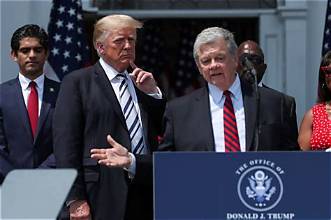
The Democratic Party’s victory in the 2026 United States midterm elections could significantly influence President Donald Trump’s remaining years in office, raising questions about his administration’s approach to international relations, trade and security in Asia.
Although Trump was not personally contesting the November 3 elections, he had urged Americans to treat the polls as a referendum on his presidency. The outcome, however, represented a major political setback for his Republican Party, with Democrats taking control of both chambers of Congress.
The results reflected widespread dissatisfaction among voters over the administration’s economic policies, the rising cost of living and its handling of international affairs. The consequences of the Iran War, particularly its impact on energy prices, also contributed to growing criticism of the president and Republican candidates.
The scale of the Democratic victory was substantial. Rather than experiencing a modest electoral setback, Republicans faced significant losses in congressional contests, allowing Democrats to secure majorities in both the House of Representatives and the Senate.
For Trump, the election outcome presents a complicated political environment. Democrats will have greater authority to scrutinise his administration, challenge legislative priorities and obstruct some of his domestic policy initiatives. However, the president retains considerable executive powers, particularly in foreign affairs.
Kevin Chen, an associate research fellow with the US Programme at Singapore’s S Rajaratnam School of International Studies (RSIS), argues that the election could produce an unusual situation in which Trump becomes more confrontational rather than politically restrained.
Trump Could Become an ‘Angry Duck’ Rather Than a Lame-Duck President
In American politics, a lame-duck president is generally understood as a leader whose political influence has weakened because of electoral defeat, declining congressional support or the approaching end of an administration.
With Democrats controlling Congress, Trump could face substantial difficulties advancing his domestic agenda during the remainder of his presidential term.
The House of Representatives exercises considerable influence over federal spending and government oversight. Democratic lawmakers will therefore have opportunities to challenge the administration’s financial priorities, investigate executive decisions and organise congressional hearings examining presidential actions.
Control of the Senate also gives Democrats additional influence over the confirmation process for senior government appointments. They could delay or block some of Trump’s nominees to important federal positions, complicating efforts to fill key administrative and judicial offices.
Nevertheless, the president’s political record suggests that congressional opposition may not necessarily prevent him from pursuing controversial policies.
Chen points to Trump’s previous confrontation with a Democratic-controlled Congress in 2019 over funding for his proposed wall along the United States-Mexico border. After lawmakers refused to provide the full amount he requested, Trump declared a national emergency and redirected money from other government budgets towards the project.
That episode demonstrated his willingness to use executive authority when legislative negotiations failed.
Consequently, Chen suggests that describing Trump as a conventional lame-duck president may underestimate the possibility of a more aggressive political response.
Rather than accepting a reduced role, Trump could intensify confrontations with Democratic lawmakers, rely on presidential veto powers and use his public platform to challenge congressional opposition.
The possibility of an increasingly combative White House raises questions about how domestic political tensions could influence the administration’s decisions on international affairs.
Foreign Policy Could Become Less Constrained
One of the most important consequences of the election could emerge in the area of American foreign policy.
Unlike many domestic policy initiatives, international relations provide presidents with considerable constitutional and practical discretion. American presidents can negotiate directly with foreign leaders, establish diplomatic priorities and authorise certain military operations without first obtaining congressional approval.
This authority could become particularly significant as Trump faces increasing resistance from Democrats on domestic matters.
According to Chen, the president may find it easier to pursue foreign policy initiatives than to advance his domestic legislative agenda, especially where congressional opposition cannot immediately prevent executive action.
Historical experience provides examples of presidents maintaining ambitious foreign policy programmes despite suffering electoral defeats.
In the 2006 midterm elections, Democrats won control of Congress during George W Bush’s presidency. Despite the political setback, Bush proceeded with his controversial 2007 decision to increase American troop deployments in Iraq, an initiative commonly referred to as the Iraq surge.
The episode illustrates the limitations of congressional influence over certain presidential decisions involving national security and military strategy.
Although Congress possesses important oversight and funding powers, restricting presidential military action can be difficult without sufficient political support. Overriding a presidential veto, for instance, generally requires a two-thirds majority in both the House and Senate.
The Democratic victories in 2026 did not provide the party with such a majority.
Consequently, concerns remain over whether Trump could pursue more confrontational international policies during the remainder of his administration.
The ongoing Iran War represents one area attracting attention. There are also questions about whether Washington could increase pressure on countries such as Cuba.
For international observers, the central concern is whether domestic political frustration could encourage the president to concentrate more heavily on foreign policy initiatives where his executive authority remains substantial.
Leave a Reply