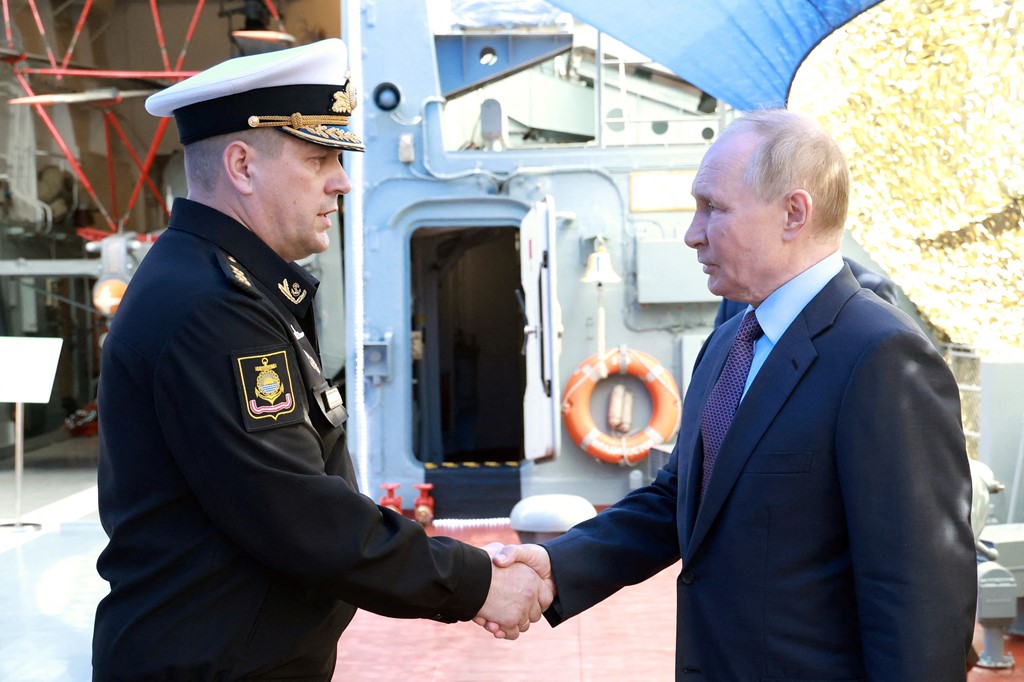
Russia entered May 10 under the shadow of war, heightened political tension, and a carefully choreographed display of national power. The dominant story across Russian and international newspapers today is the aftermath of Moscow’s scaled-down Victory Day celebrations and President Vladimir Putin signaling that the war in Ukraine may be “coming to an end.” The statement immediately became the lead headline across major Russian-linked outlets including TASS, RIA Novosti, RBC, Kommersant, and independent publications such as Meduza. (The Guardian)
The tone across Russian media today reflects a country balancing wartime fatigue with official optimism. Discussions around ceasefires, prisoner exchanges, military security, economic pressure, and tightening state control dominate newspaper coverage.
Putin Says Ukraine War Is “Heading to an End”
The biggest development today came from Putin’s comments following the May 9 Victory Day events in Moscow. Speaking to journalists, the Russian president declared that he believes the conflict with Ukraine is “heading to an end,” while also insisting Russia would not abandon its strategic objectives. (The Guardian)
Russian state newspapers framed the remarks as evidence that Moscow now believes it holds the upper hand militarily and diplomatically. Several publications highlighted Putin’s statement that Western countries had expected Russia to collapse under sanctions and military pressure, but “it didn’t work out.” (The Guardian Nigeria)
At the same time, international analysts noted that Putin’s comments came during one of the most subdued Victory Day commemorations in recent memory. Security fears and ongoing drone threats forced authorities to scale back the traditional parade in Red Square. For the first time in nearly two decades, Russia avoided displaying tanks and heavy military hardware during the parade. (AP News)
The Kremlin presented the reduced display as a strategic wartime adjustment rather than a sign of weakness. Russian coverage emphasized patriotism, military sacrifice, and the symbolism of Soviet victory in World War II. However, foreign newspapers widely interpreted the smaller parade as evidence of mounting security concerns inside Russia itself. (AP News)
Fragile Ceasefire Dominates Headlines
Another major story across Russian newspapers today is the fragile three-day ceasefire between Russia and Ukraine. Moscow and Kyiv have accused each other of repeatedly violating the temporary truce brokered around Victory Day celebrations. (The Guardian)
Russian media claimed Ukrainian forces launched hundreds of attacks during the pause, while Ukrainian authorities accused Russia of continuing artillery and drone strikes. Despite the ceasefire officially remaining in place, battlefield activity reportedly continued across several regions. (The Guardian)
Russian state outlets emphasized Moscow’s willingness to negotiate and highlighted discussions surrounding a planned prisoner exchange involving 1,000 detainees from each side. The exchange is being portrayed domestically as a humanitarian breakthrough and one of the few areas where dialogue between Moscow and Kyiv remains functional. (The Guardian)
Independent Russian-language outlets, however, pointed out that neither side appears prepared for a full political settlement yet. Many analysts quoted in today’s coverage warned that while talk of negotiations has intensified, core disagreements over territory and NATO influence remain unresolved. (The Guardian)
Moscow’s Victory Day Parade Overshadowed by Security Fears
Russia’s annual Victory Day parade remains one of the country’s most politically important public events, but this year’s ceremony unfolded under extraordinary security measures. (Reuters)
Russian newspapers today described widespread mobile signal disruptions, tightened surveillance, anti-drone systems, and extensive police deployments across Moscow. Kremlin spokesman Dmitry Peskov said security had been strengthened due to ongoing “terrorist threats.” (Reuters)
The atmosphere surrounding the parade reflected how deeply the Ukraine war now shapes Russian domestic life. Several reports noted that Moscow airports experienced temporary shutdowns in the days before the parade because of drone attack concerns. (Reuters)
Despite the tension, the Kremlin sought to present the event as proof of national resilience. Foreign guests from countries including Belarus, Kazakhstan, Laos, and Malaysia attended the celebrations. North Korean troops also reportedly participated in the parade for the first time, drawing international attention and reinforcing perceptions of growing military cooperation between Moscow and Pyongyang. (AP News)
Russian nationalist commentators praised the ceremony as evidence that Russia remains internationally connected despite Western sanctions and diplomatic isolation. Meanwhile, opposition voices argued the reduced scale of the parade exposed the growing strain created by four years of war. (AP News)
Kremlin–Armenia Tensions Escalate
Another major geopolitical story in Russian media today concerns worsening relations between Moscow and Armenia. The Kremlin accused Armenia of allowing Ukrainian President Volodymyr Zelenskyy to make anti-Russian remarks during a recent visit to Yerevan. (Reuters)
Russian outlets reported that Moscow summoned Armenia’s ambassador for explanations after Zelenskyy jokingly suggested drones could “buzz over Red Square” during Victory Day events. Russian officials interpreted the remark as a provocative threat. (Reuters)
The dispute highlights Russia’s weakening influence in parts of the former Soviet sphere. Since Azerbaijan regained control over Nagorno-Karabakh in 2023, Armenian confidence in Russian security guarantees has sharply declined. Russian newspapers increasingly portray Armenia’s growing relationship with the European Union as a strategic challenge. (Reuters)
Several Russian commentators today warned that Moscow risks losing influence in the South Caucasus at a time when it is already heavily focused on Ukraine and sanctions-related economic pressures.
Russian Media and Internet Controls Tighten Further
Technology and censorship issues also feature prominently in Russian news coverage today. Reports linked to RBC indicate the Russian government has continued expanding restrictions on internet access and VPN usage. (Meduza)
According to reports cited by independent media, Russia’s Digital Development Ministry has requested that major online platforms block users accessing services through active VPN connections. Authorities argue the move is necessary for cybersecurity and information control, but critics see it as another step toward isolating the Russian internet from the wider world. (Meduza)
Russian newspapers also continue debating the future of Telegram, which remains one of the country’s most influential media ecosystems. Analysts note that state outlets such as TASS, RBC, Interfax, and Kommersant now rely heavily on Telegram channels for audience reach and rapid news distribution. (The Moscow Times)
Independent journalists warn that further restrictions could severely limit remaining spaces for uncensored public discussion inside Russia.
Pressure on Independent Media Continues
Russian independent media organizations remain under intense state pressure. Publications linked to exile journalism and opposition reporting continue documenting arrests, investigations, and new censorship measures. (Meduza)
One of the stories still receiving attention today involves the detention and questioning of executives connected to the major Russian publishing house Eksmo. Authorities reportedly linked the investigation to alleged extremist activities connected to LGBTQ-themed publications. (Meduza)
The case has intensified fears among writers, publishers, and journalists that cultural industries are becoming increasingly vulnerable to political prosecution. Russian commentators sympathetic to the government argue the measures are necessary to defend “traditional values,” while critics describe them as another phase in the broader suppression of dissent. (Meduza)
Independent Russian journalists operating from abroad continue to warn that media freedom inside Russia has deteriorated dramatically since the invasion of Ukraine began in 2022. (The Guardian)
Expanding Powers for Russia’s Security Services
Russian political newspapers are also paying close attention to the growing influence of the country’s security apparatus. Analysts report that the Federal Security Service, commonly known as the FSB, has received expanded powers in recent months. (Eurasia Review)
Reports suggest the agency now has broader authority over internet regulation, digital surveillance, academic cooperation, and detention systems. Critics argue the changes reflect the Kremlin’s increasing reliance on internal security structures as the war drags on and economic uncertainty deepens. (Eurasia Review)
Russian state-aligned commentators defend the measures as necessary wartime protections against sabotage, foreign influence, and terrorism. Opposition analysts, however, see them as signs of growing political centralization and insecurity within the ruling elite. (Eurasia Review)
Economic Concerns Remain in the Background
Although military and geopolitical news dominate Russian front pages, economic concerns continue simmering beneath the surface. Russian business newspapers today discuss inflation, wartime spending, labor shortages, and sanctions-related adaptation.
Some outlets argue Russia has successfully stabilized parts of its economy despite Western sanctions. Others warn that prolonged military expenditure and isolation from Western markets continue placing pressure on long-term growth. Discussions around defense production, state subsidies, and energy exports remain central themes in business reporting.
Analysts quoted across several publications note that while Russia has avoided the economic collapse predicted in early 2022, living costs and workforce shortages are becoming increasingly difficult challenges for ordinary citizens.
Russian Society Shows Signs of War Fatigue
One of the underlying themes emerging across multiple newspapers today is growing war fatigue within Russian society. Although public criticism of the government remains dangerous inside Russia, independent analysts and exile commentators increasingly point to declining enthusiasm for prolonged conflict. (The Sun)
Former oligarch and Kremlin critic Mikhail Khodorkovsky argued in interviews published today that Putin’s political position may gradually weaken as the war continues and economic pressure intensifies. (The Sun)
Russian state polling still shows significant support for the government, but analysts caution that wartime opinion measurements inside authoritarian systems are difficult to interpret fully. Some commentators believe the Kremlin’s emphasis on patriotic symbolism, Victory Day celebrations, and wartime narratives reflects an attempt to sustain public unity amid uncertainty.
International Attention Remains Fixed on Moscow
Global attention toward Russia remains intensely focused on whether recent diplomatic signals could eventually produce negotiations over Ukraine. Putin’s suggestion that the conflict may be nearing an end generated cautious international reactions today. (The Guardian)
Western analysts remain skeptical about immediate peace prospects, arguing that neither Russia nor Ukraine has yet softened core strategic positions enough for a comprehensive settlement. However, the ceasefire, prisoner exchange discussions, and reduced rhetoric surrounding Victory Day have created cautious speculation that diplomatic momentum could slowly increase during the coming months. (The Guardian)
For now, Russia’s headlines reflect a nation still deeply consumed by war but increasingly aware of its long-term costs. The Kremlin continues projecting strength and resilience, while independent observers point to security fears, tighter censorship, and social fatigue beneath the surface.
As May 10 comes to a close, the central question dominating Russian newspapers is whether the Kremlin’s latest language signals a genuine shift toward negotiations — or simply another tactical phase in a conflict that has already reshaped Russia’s politics, economy, and relationship with the world.
Leave a Reply