
- INTRODUCTION
Large corporations internationalize to increase brand awareness, gain access to new markets and technologies, improve risk management, reduce export costs, and increase earnings (Vinhas da Silva et al, 2023). Internationalization of business does not only enhance productive capacity, but it also grants true independence from volatilities in the local business environment. In the case of Dangote Group’s ambition to increase visibility in global markets, currently in countries within the European Union (EU), the business expansion concerns are not only how to increase market share and profitability but to identify effective market penetration strategies that can sustain business growth with minimal risks (Misbauddin & Nabi, 2019).
Multinational companies actualize their global expansion goals by strategically exploring economies of scale, cross-border commerce, and capital. However, the internationalization process requires companies to design and differentiate products that satisfy the demands of foreign consumers whose habits, tastes or cultural needs may be different from the domestic market. In setting objectives and evaluating performance, companies therefore identify their internal core competencies (e.g., workforce capacity, level of innovation, finance, brand equity, and strategy) and examine competitors’ performance in these areas to determine business prospects. Also, data-based studies indicate that the success of internationalization depends on the network of technology, capital, suppliers, distributors, customers, researchers, and affiliation to foreign governments. Therefore, using Dangote Group as a case study, this report gleans relevant international business theories like the Dunning theory of eclectic paradigm, Monopolistic Advantage / Economies of Scale theory, and the Uppsala model, which suggests that companies should penetrate international markets, gradually starting from markets that are psychically close to the local market, and later expanding business to more complex markets as perceived risks decrease. Although advancements in Information Communication Technologies (ICTs) make it easier for businesses to enter directly into foreign markets due to the availability of local and international market data, the World Trade Organization (WTO) has transformed global trade into a closeknit, interdependent network of relationships driven by Foreign Direct Investment (FDI) (Eduardsen et al, 2021; Moradlou et al, 2021).
The aim of this report is to critically analyse Dangote Group activities using appropriate international business theories. Three theoretical frameworks applied in this study are: (a) the Dunning Theory of Eclectic Paradigm (b) Economies of Scale/Monopolistic Advantage, and (c) the Uppsala Model. The report is structured into four parts: Section 2 presents an overview of Dangote Group’s profile, business environment, and activities; Section 3 aims at closing the gap between theory and practice using the Group’s diversification pattern; whereas Section 4 discusses a new international initiative for the company with highlight the reason and benefits for the proposed business decision.
- THE COMPANY
Dangote Group is a Nigerian multinational brand founded by Aliko Dangote in 1978 to provide value-added products and services. Headquartered in Lagos, Nigeria, the diversified industrial conglomerate comprises eighteen subsidiaries with strong presence in ten African countries. The company operates a fully integrated business in sugar, cement, oil and gas, fertilizer, poly-sacks, rice, salt, and seasoning production as well as port operations and interests in real estate, mining, automotive, education, logistics etc. Dangote Cement is listed on the Nigerian Stock Exchange (NSE) with market capitalization valued at $14 billion (almost twenty percent of the total NSE capitalization). In 2017, Dangote Group announced total revenue of $4.1 billion. Strategies explores to achieve competitiveness and profitability include a high degree of vertical and backward integration whereas its internationalization strategy hinges on mergers and acquisition, which transformed Dangote Cement into Africa’s largest cement production company (Igwe & Kanyembo, 2019).
Dangote Group gained competitiveness in Nigeria due Aliko Dangote’s affiliation to the federal government which led to the enactment of Nigeria’s Backward Integration Policy (BIP) in 2002. Through the indigenization policy, which offers tax breaks, low levies, and minimal tariffs to indigenous companies in the manufacturing sector, Dangote Group acquired hectares of land at strategic locations to gain monopolistic access to raw materials. With its acquisition of technical and financial support from the government, the Group invested in advanced technologies, acquired ownership of the Obajana Cement plant, offered attractive compensations to host communities and built a strong supply chain network to achieve the competitive advantage it needs to gradually become the largest manufacturer of cement in Nigeria and Sub-Saharan Africa. The conglomerate has therefore increased cross-border mergers and acquisitions to acquire more assets and maximize synergy with foreign-owned companies to protect and augment its competitive advantages in global markets (Moradlou et al, 2021; Vinhas da Silva et al, 2023).
1.2 AIMS AND OBJECTIVE
The aim of this report is to analyse the global marketing environment, review Dangote Group’s internationalization activities, and examine its strengths and weaknesses. The purpose is to propose new market penetration strategies that can improve maximization of new market opportunities in the EU region.
- METHODOLOGY
This report is based on secondary data collated from various sources such as academic journals, books, websites, and annual reports.
2.0 INTERNATIONALIZATION PATTERNS
This section contains an analysis of Dangote Group’s business environment, mission, strategy, and pattern of internationalization.
2.1 DANGOTE GROUP’S SWOT ANALYSIS
Large-scale enterprises face immense pressures to create sustainable value and expand globally for more competitive advantage and profits. However, building workforce capacity and pooling adequate capital to compete favourably in a different political and socio-cultural setting requires business leaders to conduct resource-based and value-chain analysis for in-depth knowledge about the business environment. For example, a SWOT Analysis allows identification of the internal factors (strengths and weaknesses) and external factors (opportunities and threats) that can enhance or impede opportunities for economies of scale and competitiveness (Misbauddin & Nabi, 2019).
Figure 1: Dangote Group’s SWOT Analysis
| STRENGTHS | WEAKNESSES |
| Dangote Group has approximately 10,000 employees.It is Africa’s largest multinational and most capitalized company on the Nigerian Stock Exchange (NSE).Strong balance sheet and low net debt.The largest producer of cement in Nigeria.Strong distribution channel with over 5,000 self-owned trucks.Dangote Groups owns Africa’s largest cement factory located in Abuja.Efficient low-cost production plants located closely to essential national resources. | Dangote Group has poor market visibility outside Nigeria and selected countries within Africa.Manufacturing activities take place mainly in Nigeria.Does not leverage opportunities in Foreign Direct Investment (FDI) to increase global presence.Leadership lacks the right business model and internationalization strategies to expand beyond the African continent.Explores vertical and backward integration in its supply chain, with low merger and acquisition records. |
| OPPORTUNITIES | THREATS |
| Increasing demand for quality cement across Africa.Absence of limestone in countries importing bulk cement or related products from Dangote Group.Popularity as a reliable manufacturer of household and industrial products in over ten African countries increases opportunities for global expansion through mergers and acquisitions.Historical success in the cement manufacturing sector increases potential to explore production of building materials using brand equity, perceived quality, and customer trust. | Strong competition from LaFarge, Holcim, HeidelbergCement, Jidong, Siam, and Cemex.Fluctuations in the global and local prices of raw materials.Language barriers and poor knowledge of demand trends in foreign markets.Big brands in the global cement industry currently do not operate in Africa, but their entry into African markets would threaten Dangote Group’s dominance.Corporate governance frameworks in African countries are stringent, a reason Dangote Group achieved competitive advantage and huge profits, however, global expansion exposes the multinational to regulatory risks that could reduce profitability. |
Source: The Author (2023)
Every globalization strategy has its high and low points because there are different levels of uncertainties, risks, and opportunities inherent in new markets. For example, strict government controls, changing needs of consumers, cultural issues, legal restraints, and other uncontrollable elements can negatively affect business prospects if a company does not consider the economic, political, and socio-cultural differences between its local environment and target market (Igwe & Kanyembo, 2019).
2.2 REASONS FOR INTERNATIONALIZATION
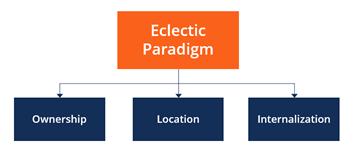
An internationalization process describes how corporations undergo a learning process to adjust their marketing and distribution strategies and successfully create demand for products/services in a complex and diverse foreign market (Misbauddin & Nabi, 2019). According to John H. Dunning, businesses should avoid open-market transactions if the cost of completing the same action internally (or in-house) is lower, but advancements in technology have removed cross-border barriers to global trade thereby creating limitless opportunities for investors. The eclectic paradigm—an analytical method for examining the benefits of making foreign direct investment (FDI)—is an aspect of Dunning’s theory built on the “ownership, location, and internationalization (OLI)” factors that can determine the success or failure of business in international markets (Moradlou et al, 2021). First, the ownership advantage in Dunning’s “OLI” framework hinges on direct access to a unique, valuable resource that offers competitive advantage against potential foreign competitors. It also highlights attractiveness attached to the foreignness of products offered by potential market entrants/investors who are non-natives in the country of FDI (Eden & Dai, 2010). Considering the risks in Figure 1, Dunning theory suggests that business owners should analyse opportunities and threats of a target market to ascertain if transference of competitive advantage (that is, exploitation of monopoly power) outweighs financial losses that may accrue from the decision. Second, the eclectic paradigm highlights locational advantages as a determinant factor in the growth of multinational corporations (MNCs). Internationalization, thus, emphasizes the importance of risk diversification through geographical spread of foreign investment (Eduardsen et al, 2021).
Figure 1: The OLI Framework
Source: Dunning (1979)
Dangote Group dominates the Nigerian consumer market, with LaFarge being its strongest competitor in cement manufacturing business. The expansion across Africa, and now the EU, is a strategic move to actualize economic advancement of the African continent. Dangote brand is already one of the most preferred among African consumers based on perceived quality, brand equity, and trust. Therefore, reason for the ongoing plan to expand to EU countries is not just to diversify risks but to (a) achieve greater economies of scale (b) improve productivity, profitability, and competitive advantage (c) attract global talents and explore new customer segments (d) benefit from favourable government policies and regulations, and (e) increase shareholder earnings (Mahabir et al, 2020; Panibratov, 2022).
Figure 2: Reasons for Internationalization

Source: The Author (2023)
2.3 PART OF BUSINESS BEING INTERNATIONALIZED
Dangote Group has an ambition to operate as an economic partner adding value to the EU region. Apart from maximizing access to talents, raw materials, and economic/technological infrastructures in the EU, the conglomerate also aims at reducing risks and costs associated with exports. Many countries in Sub-Saharan Africa (SSA) have more than 132 trillion barrels of proven oil reserves as of July 2022 (over 8% of the global supply) but the region exports most of this natural resource to overseas refineries[1]. The challenge of having no functional refinery within SSA does not only add to the national expenditure but increases the cost of petroleum and related products in a region where nearly 50% of the population live below $1.25 per day. Therefore, Dangote Group is internationalizing its refinery business to forge partnership with indigenous companies within Europe, tap into the strong infrastructure base across EU countries, and expand its supply chain to create and distribute products efficiently without selling through middlemen. This project will eliminate fuel importation in Nigeria and drastically reduce costs for countries in SSA currently importing petroleum from Europe. Additionally, Dangote Group’s internationalization to the EU will significantly reduce foreign exchange outflows with an expected impact of Nigeria’s Gross Domestic Product (GDP) earnings (Misbauddin & Nabi, 2019; Mahabir et al, 2020; Vinhas da Silva et al, 2023).
2.4 REGION OF CHOICE AND WHY
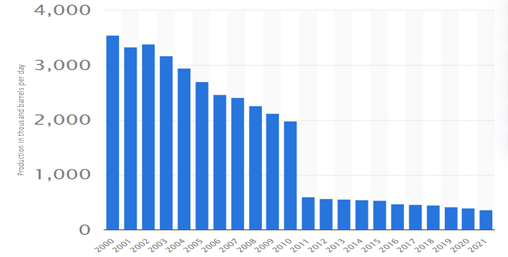
According to a 2018 data from the BP Statistical Review of World Energy, the EU region refines over 14 million barrels a day (which is about 14% of global capacity), an indication that the region is among the world’s three largest refining market that alongside the United States and China. Although Statista records indicate that oil production in EU countries was 366,000 barrels pe day in 2021, the graph below shows a significant decline between 2010 and 2021, the worst period noticed since 2021 due to the pandemic and UK’s separation from the EU (Moradlou et al, 2021).
Figure 3: Oil Production in the EU between 2000 – 2021.
Source: Statista (2023)
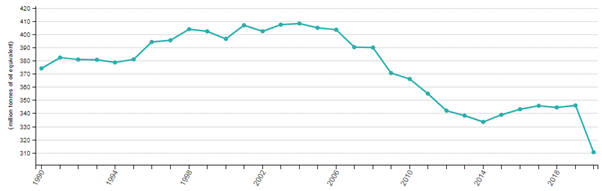
A 2023 Eurostat data on oil and petroleum production show that restrictions during the COVID-19 pandemic reduced consumption of oil products in the EU, with jet kerosene decreasing by 56.4 per cent. In the same period, crude oil production declined to a record-low level thus causing huge losses in the transport sector which depends heavily on oil products, Oxford Analytica (2023) data indicates. This unexpected economic breakdown occurred because the UK was EU’s main oil producer followed by Denmark and Italy although contributions from both countries are very low when compared to major oil nations like the U.S. and Saudi Arabia. As shown in Figure 3, oil production across the EU, excluding the UK, totalled 366 thousand barrels per day (Eduardsen et al, 2021; Vinhas da Silva et al, 2023).
Figure 4: Petroleum Products Consumption in the EU (excluding biofuel portions) between 1990 – 2021.
Source: Eurostat (2023)
Importantly, the EU transport sector is still heavily dependent on crude oil products. In 2020, import dependency across EU countries reached a record-high level with net imports of crude oil and petroleum totalling 96.96 per cent, according to Eurostat data. These reliable statistics indicate there are opportunities for Dangote Group to explore in Europe before completing its ongoing refinery construction in the Lekki area of Lagos, Nigeria. The integrated refinery project is expected to become the biggest oil refinery in Africa, and the world’s biggest single-train facility (Mahabir et al, 2020).
2.5 MODE OF INTERNATIONALIZATION
Fundamentally, internationalization is more attractive when the company has a sound online reputation, strong corporate culture, brand equity, economics of scale, and access to advanced technology. Also, Dunning theory emphasizes possession of some scarce, unique, and sustainable capabilities and resources that provide superior technical advantage over competitors who do not possess them. This resource-based strategy reflects on Dangote Group’s pattern of industrialization because Dangote Group has these characterizations (Rahman et al, 2018; Igwe & Kanyembo, 2019).
Dangote Group has achieved success through its backward integration strategy, which supports part or full ownership of the supply chain from the extraction, manufacturing and distribution processes. Thus, in line with the ownership advantage, the Nigeria-based multinational has some kind of barrier to entry in the cement manufacturing business due to the scarcity of limestone in the global market, affiliation to the Nigerian government, direct access to the raw material, and possession of advanced technologies. The Group’s diversification into the EU petroleum production industry highlights both ownership and location advantages. For example, its commencement of refinery activities in Nigeria, a country with abundant crude oil reserves, requires technology transfer from a developed economy to an emerging market. The multinational has also used the forward integration strategy to expand its cement manufacturing and distribution business within Africa, so it will explore same location-based strategy to sell petroleum products across the EU thereby benefitting from economies of scale, cheap labour, economic/technological infrastructure, and a developed market (Moradlou et al, 2021). To achieve this expansion objective through the third aspect of Dunning theory, internationalization, Dangote Group invests in FDI, starting with mergers and acquisitions of foreign-owned companies in the target market. The company has also diversified into to the transportation, shipping, logistics sector to lower cost of distributing raw and finished products in the global market (Rahman et al, 2018; Mahabir et al, 2020).
3. NEW INTERNATIONALIZATION INITIATIVE
As global markets become more liberalized and technology-driven, with knowledge-intensive wealth creation opportunities, Dunning’s “OLI” framework suggests that factors driving a company’s internationalization can be one or more internal and external forces such as the objectives to expand R&D investments, support global sustainability, and diversify into international markets to achieve wealth distribution ideas (Rahman et al, 2018). However, the Monopolistic Advantage Theory argues that MNCs are at a disadvantage when competing in a foreign market due to the liabilities of foreignness such as the cost of knowledge acquisition in another country, strict regulations on hiring local talents, and cultural barriers among other challenges. But from a positive perspective, Stephen Hymer (the proponent of monopolistic theory) opines that MNCs can use FDI to gain control over resources and capabilities (Firm-Specific Advantages) in foreign markets through proprietorship knowledge, patents, sole ownership, unique know-how, government protection, closeness to target consumers, and other assets that offer a degree of monopolistic advantage relative to indigenous companies in the new market. But while indigenous companies in the foreign market can purchase technology and acquire numerous advantages from the MNC due to the effective resource allocation position, such benefits cannot translate to quasi-monopoly or financial profits for rivals because of market imperfections from capital, management, workforce capacity, proprietary knowledge etc. Therefore, in the refinery business, Dangote Group has competitive advantages from access to crude oil in Nigeria, support from the government, advanced technology, and the availability of human and material resources required to explore the petroleum crisis in the EU region (Igwe & Kanyembo, 2019).
Considering the complexities of today’s volatile, uncertain, complex, and ambiguous business world where events in one country have immediate effects on other countries, the internationalization and localization processes should occur as a relatively continuous process (that is, taking gradual steps over a period) of maximizing human capital, physical capital, and organizational capital to increase competitiveness and profitability. This pattern of internationalization aligns with the Uppsala model, which emphasizes incremental entry into global markets starting from the accumulation of generic and specific knowledge about the characteristics of customers/suppliers, structure of competitors and cultural elements, and applying them in incremental decision making so that information acquired in one phase improves decision at the next levels. This incremental behaviour increases the market commitment of MNCs, empowers them to maintain control over their foreign activities, and eventually facilitates attainment of sustainable growth in diversified foreign markets (Vahlne & Johanson, 2013; Panibratov et al, 2022).
From a practical perspective, Dunning’s eclectic paradigm and Hymer’s monopolistic advantage theories highlight the benefits an MNC can gain by accessing resources that can be internalized (exploited within) or sold in foreign markets via duopolies or oligopolies. Interestingly, some companies with monopolistic advantage do not have internationalization objectives and the Uppsala approach does not fit the service industry. Also, both “OLI” and monopolistic advantage perspectives are product-oriented with limitations in today’s technology- and knowledge-driven business world where internal capacity is considered a valuable asset. Lastly, the theories ignored the global impact of external factors such as market potential and competitive forces which can override the psychic distance challenge and influence management decision making. Thus, Dangote Group and any business seeking to expand globally should first invest in a team of competent and innovative managers who can analyse business environments to identify, acquire, and harness capital, physical and organizational resources and capabilities in ways that add efficiency and effectiveness to business models (Rahman et al, 2018). Beyond increasing profits and competitive advantage, the new internationalization initiative includes:
- Creating a strong corporate culture built on diversity, inclusion, and equity.
- Strengthening organizational agility and collaboration by identifying stakeholders who support or oppose internationalization and opening lines of communication with key internal and external stakeholders.
- Integrating data-informed decision making in the business model to improve priority setting.
- Establishing leadership and structure that supports innovation and transformation
- CONCLUSION
Internationalization has more benefits than risks in today’s open market economies. New dimensions of industrialization theories also emphasize the importance of integrating a knowledge-driven approach to product-based ideologies propounded bin the Eclectic Paradigm, Monopolistic Advantage, and Uppsala schools of thought. Therefore, in line with the resource-based view, Dangote Group’s internationalization pattern does not focus only on exploiting resources in the local market but tapping into foreign knowledge to enhance its ongoing refinery project in Lagos that is expected to meet 100 per cent of Nigeria’s requirement for refined products—with surpluses to export. Importantly, diversification to the EU region in this era of petroleum crisis will strengthen the Group’s economies of scale and competitive advantage in the global oil and gas market.
REFERENCES
Eden, L. and Dai, L. (2010), “Rethinking the O in Dunning’s OLI/Eclectic Paradigm”, Multinational Business Review, Vol. 18 No. 2, pp. 13-34.
Eduardsen, J., Marinova, S., Vlačić, B. and González-Loureiro, M. (2021), “Business Group Affiliation and Export Propensity in New Ventures”, Verbeke, A., van Tulder, R., Rose, E.L. and Wei, Y. (Ed.) The Multiple Dimensions of Institutional Complexity in International Business Research (Progress in International Business Research, Vol. 15), Emerald Publishing Limited, Bingley, pp. 129-153.
Eurostat (2023). Oil and Petroleum Products – A Statistical Overview. Statistics Explains. Available Online: https://tinyurl.com/ydjzbk7r
Igwe, P.A. and Kanyembo, F. (2019), “The Cage Around Internationalisation of SMEs and The Role of Government”, Haddoud, M.Y., Jones, P. and Onjewu, A.-K.E. (Ed.) International Entrepreneurship in Emerging Markets: Nature, Drivers, Barriers and Determinants (Contemporary Issues in Entrepreneurship Research, Vol. 10), Emerald Publishing Limited, Bingley, pp. 161-176.
Mahabir, A., Fan, J. and Mullings, R. (2020), “Does the African Growth and Opportunity Act (AGOA) impact EU-15 imports from Africa?”, Journal of Economic Studies, Vol. 47 No. 5, pp. 1155-1180.
Misbauddin, S.M. and Nabi, M.N.U. (2019), “Internationalization of Social Business: Toward a Comprehensive Conceptual Understanding”, Dana, L.-P. and Ratten, V. (Ed.) Societal Entrepreneurship and Competitiveness, Emerald Publishing Limited, Bingley, pp. 117-136.
Moradlou, H., Reefke, H., Skipworth, H. and Roscoe, S. (2021), “Geopolitical disruptions and the manufacturing location decision in multinational company supply chains: a Delphi study on Brexit”, International Journal of Operations & Production Management, Vol. 41 No. 2, pp. 102-130.
Oxford Analytica (2023), “EU ban to hurt Russian oil products more than crude.” Expert Briefings: Emerald Publishing.
Panibratov, A., Garanina, O., Ameyaw, A.-K. and Anand, A. (2022), “POLI advantages of state-owned multinationals”, International Journal of Emerging Markets, Vol. ahead-of-print No. ahead-of-print.
Rahman, A., Bridge, A.J., Rowlinson, S., Hubbard, B. and Xia, B. (2018), “Multinational contracting and the eclectic paradigm of internationalization”, Engineering, Construction and Architectural Management, Vol. 25 No. 11, pp. 1418-1435.
Statista (2023). Oil Production in the European Union (2000 – 2021). Available Online: https://tinyurl.com/465srtce
Vahlne, J.-E. and Johanson, J. (2013), “The Uppsala model on evolution of the multinational business enterprise – from internalization to coordination of networks”, International Marketing Review, Vol. 30 No. 3, pp. 189-210.
Vinhas da Silva, R., Ferreira-Lopes, A., Carvalho, H. and Duarte, J. (2023), “When firms go international: deliberate or random?”, Review of International Business and Strategy, Vol. 33 No. 2, pp. 219-245.
[1] Refineries process crude oils into finished products (such as fuels and lubricants for power generators, vehicles, ships, and aircraft engines) By-products from crude oil undergo a petrochemical process to form materials such as foams and plastics.
Leave a Reply