
A credible corporate climate commitment begins with setting an emissions reduction target that covers both a company’s direct and indirect greenhouse gas emissions: if a company does not already have an emissions baseline from which to set a target, creating one is a necessary first step.
Aligning such a target’s ambition level with the latest climate science is widely seen as best practice. In other words, the target needs to be in line with the level of decarbonization required to limit global warming to well below 2 degrees Celsius above preindustrial levels at a minimum—and ideally be in line with a 1.5-degree pathway, which scientists estimate would reduce the odds of initiating the most dangerous and irreversible effects of climate change. The Science Based Targets initiative has developed methodologies for setting such a target, which have been already adopted by more than 1,000 companies, including many leading multinationals. To achieve the required emissions reductions, companies can pull levers such as improving energy efficiency, transitioning to renewable energy, and addressing value chain emissions.
As a next step, a company may commit to a target that involves the use of voluntary carbon credits—either to compensate for emissions that it has not been able to eliminate yet or to neutralize residual emissions that cannot be further reduced due to prohibitive costs or technological limitations. These types of targets come with various designations (for example, carbon neutral, climate neutral, net-zero, carbon negative, climate positive) but they all typically involve a company supplementing reductions achieved within its own carbon footprint by financing reductions elsewhere through the purchase and retirement of voluntary carbon credits (see sidebar, “Types of carbon targets”). By offsetting its remaining emissions in this way, a company can claim it is mitigating its residual impact on the climate. Some, such as Microsoft, have gone further by setting aspirations to make a net-positive impact on the climate.
Strong momentum, mainly driven by new corporate commitments and point-of-sale offerings
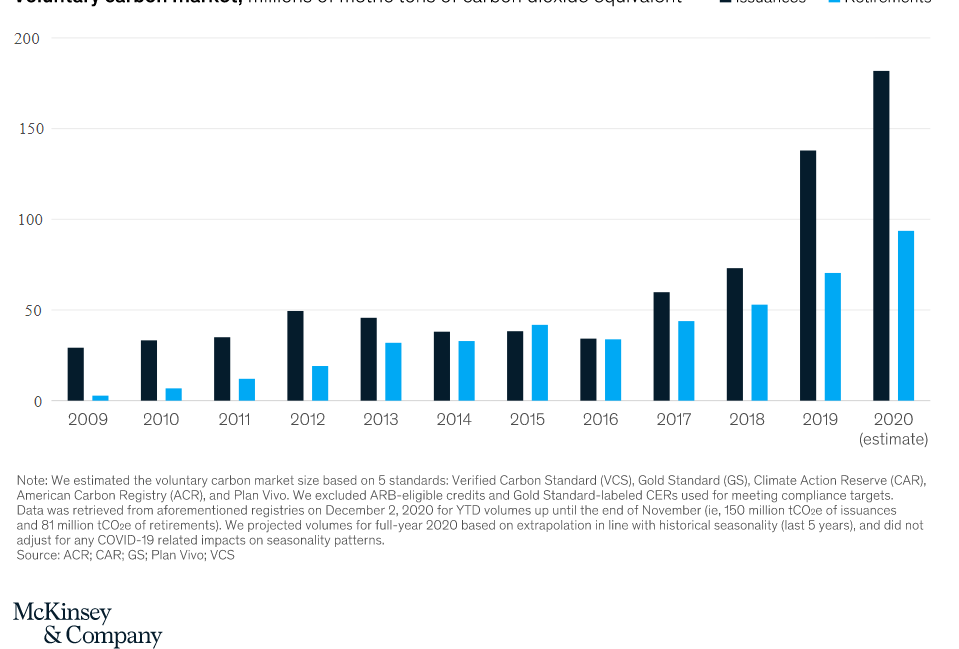
Following three years of robust growth, the voluntary carbon market2 reached a record high in 2019, both in terms of issuances and retirements (exhibit). Issuances were 138 million tons of carbon-dioxide equivalent—almost double the 2018 volume—and retirements 70 million, a 33 percent increase compared with 2018. This growth has been driven by a combination of new corporate climate commitments, such as those to carbon neutrality and net-zero, as well as so-called “point of sale” offerings of voluntary carbon credits, such as Shell’s carbon-neutral fuel, which is a bundled retail offering of gasoline and voluntary carbon credits, and airline passenger offsetting programs, which enable passengers to offset the emissions of their flights through the airline’s website.
Exhibit
Leave a Reply