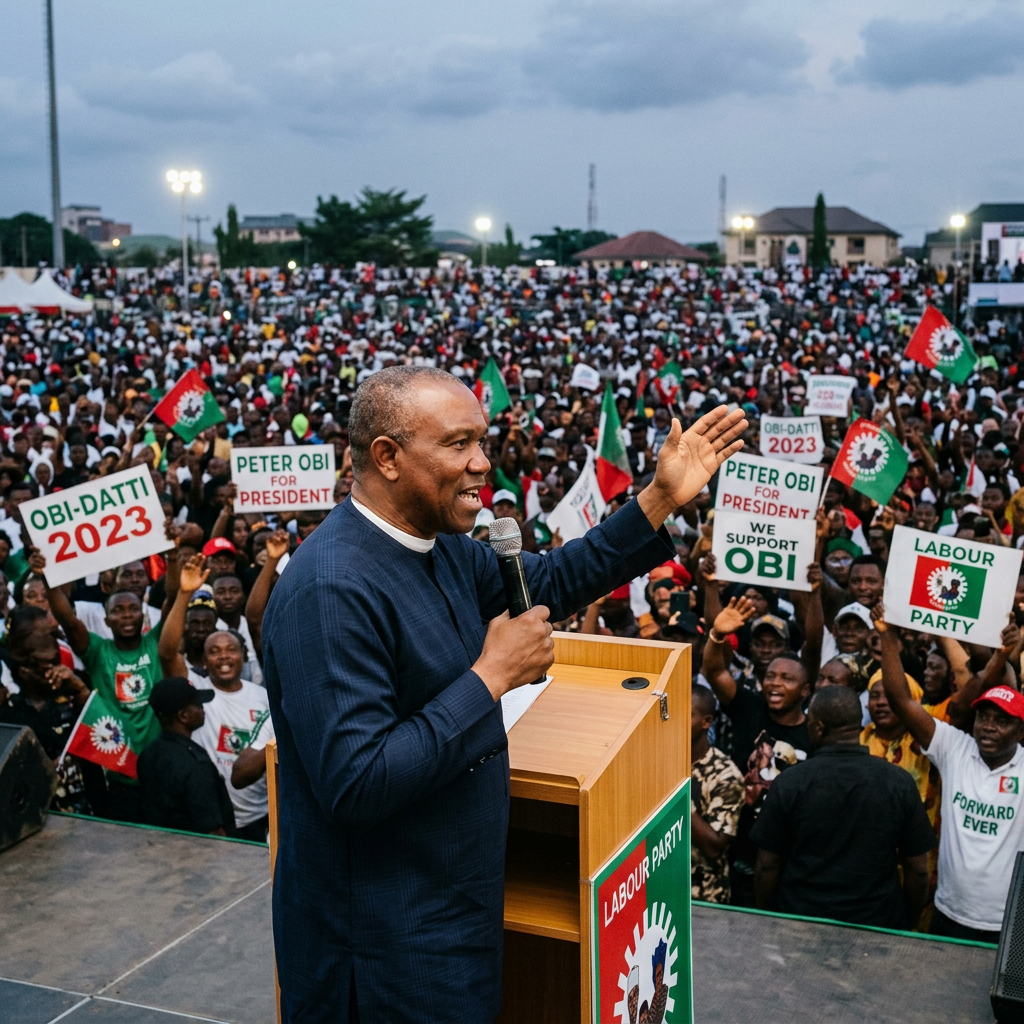
Since Nigeria returned to democratic rule in 1999, presidential elections have followed a predictable pattern—a two-horse race between the two dominant parties. Then came Peter Obi. In 2023, the former Anambra State governor shattered that duopoly, transforming a campaign into a national movement and forcing Nigeria’s political establishment into a state of panic it has yet to recover from. To understand why millions of ordinary Nigerians yearn for Obi’s presidency—and why the ruling class works tirelessly to keep him from power—one must understand the man, the message, and the mortal threat he poses to a system built on extraction and impunity.
The Man Who Would Not Spend
Peter Obi is, by any measure, an anomaly in Nigerian politics. A millionaire businessman who started as a drinks trader in Onitsha before becoming chairman of Fidelity Bank, he carries none of the flamboyance that defines Nigeria’s political class. Bespectacled and reserved, he campaigns not with promises of patronage but with arguments about fiscal discipline, accountability, and productive investment. This is a man who, as governor of Anambra State for eight years, left office without misappropriating public funds—a claim he has repeatedly challenged anyone to disprove. By the end of his tenure in 2014, he reportedly left behind billions in savings and investments, including ₦27 billion in local investments, US$156 million in foreign reserves, and ₦28 billion in bank balances, despite inheriting a state burdened by unpaid salaries and debt. He governed without borrowing a single kobo, paid over ₦33 billion owed to pensioners, and pioneered a Sub-Sovereign Wealth savings scheme.
To the political elite, these are not virtues. They are indictments. When Obi refused to inflate state budgets and contracts, he was dismissed as “too stingy”. But to a younger generation that had grown weary of flamboyance and waste, that very quality became his badge of honor. In a country where governors routinely leave office with untraceable wealth while pensioners starve, Obi’s record was not just refreshing—it was revolutionary.
The Birth of the Obidient Movement
When Obi declared his intention to contest for the presidency in 2022, first under the PDP and later under the Labour Party, something unprecedented happened. His candidacy did not spread through the traditional machinery of Nigerian politics—the ward chairs, the party bigwigs, the bought delegates. Instead, it spread like wildfire through WhatsApp groups, Twitter threads, Instagram reels, and TikTok videos. For the first time in Nigeria’s political history, a candidate’s campaign became almost entirely people-driven.
The Obidient Movement was born not of political calculation but of desperation. Young Nigerians, traumatized by the #EndSARS crackdown of 2020, where security forces opened fire on peaceful protesters, killing at least 15 people at Lagos’s Lekki tollgate, and by endless university strikes that stole years of their lives, were searching for a vessel for their rage. Obi became that vessel. To be Obidient meant you were tired of corruption, tired of recycled politicians, tired of a system that demanded suffering from the majority while rewarding the few. It meant you believed Nigeria could still be saved.
The rallies that followed were unlike anything Nigeria had ever witnessed. In Lagos, the “Two Million March” filled the streets with music and chants. In Kaduna, thousands defied political intimidation to wave Labour Party flags. Nigerians in the diaspora—scattered across the UK, the US, Canada, and Europe—rallied in solidarity, wearing Obidient t-shirts in Times Square and holding rallies in London. This was not a campaign built by politicians. It was built by ordinary citizens who designed posters, organized rallies, and fundraised across the globe.
Why the Masses Want Him
The reasons Nigerians flock to Peter Obi are as varied as the nation itself, but they coalesce around several powerful themes.
First, fiscal discipline. Obi has made himself the voice of accountability in a country drowning in debt. Nigeria’s public debt has increased from about N87 trillion in 2023 to nearly N200 trillion under the current administration, yet Nigerians have received little information on how these borrowings have been deployed. Obi has repeatedly warned that “borrowing for consumption slowly eats away at the health, reputation, and autonomy of a nation”, describing such debt as both “leprosy” and a “killer cancer”. He insists that every loan must be tied to a specific, productive investment capable of generating economic value and creating jobs. To ordinary Nigerians watching their purchasing power evaporate while politicians borrow without accountability, this message resonates with the force of prophecy.
Second, a rejection of the status quo. The Obidient Movement represents the collective hopes of millions who long for a just, equitable, and economically free country that works for everyone. These are Nigerians who have watched the same faces recycle through power for decades, enriching themselves while the nation crumbles. Obi’s opponents dismissed his supporters as “noisy social media children without structure”, but that mockery only fueled the movement further. The youths flipped the insult into pride: if having no structure meant rejecting the corrupt structures that had kept Nigeria underdeveloped, then they wanted none of it.
Third, integrity in a morally bankrupt system. Obi has been described as “the antidote to big man-ism”, a rare figure in Nigerian politics with a reputation for probity. Despite being one of the most potent political threats to the ruling establishment, no anti-corruption agency or security institution has been able to pin a corruption scandal or criminal allegation on him. As one analyst put it, attacks against Obi “don’t stick much because he has little or nothing that is scandalous or corrupt”—a record that other presidential contenders cannot boast. For a population exhausted by leaders who treat public office as a license to steal, this is nothing short of magnetic.
Fourth, generational hope. Obi, at 61, was the youngest among the three front-runners in 2023. With 84% of the 10 million new voters in 2023 aged 18 to 34, he became the standard-bearer for a generation that had been told their votes didn’t matter. For the first time, young Nigerians felt politically alive. The Obidient Movement was not a fleeting trend; it was a generational uprising.
Why the Ruling Class Hates Him
If the masses adore Peter Obi, the ruling class despises him with an intensity that borders on obsession. This hatred is not personal—it is existential.
Obi represents a threat to the entire political structure. The Nigerian political establishment is built on patronage, extraction, and impunity. It is a system where elections are won through money, manipulation, and machinery—not ideas or integrity. Obi, with his refusal to “give people money to do the wrong thing”, with his insistence on transparency and accountability, with his very existence as a politician who cannot be bought, represents an existential threat to that system. He is the bête noire of the political class, hated by those who see him as their nemesis—a hatred borne out of fear. One commentator captured it succinctly: “In his simplicity, he has emerged a mega force in Nigeria’s shifting political landscape”.
The ruling elite know he actually won. Intelligence available to the ruling elite confirms who truly won the 2023 election, even if INEC and the courts declared otherwise. Obi has since emerged as a “Shadow President,” persistently interrogating Tinubu’s policies, exposing security failures, and criticizing economic mismanagement. The fear of Peter Obi has become shorthand for the APC’s growing anxiety. This fear has transformed into a full-scale offensive—from factionalizing the Labour Party to using the courts and INEC to frustrate his political aspirations.
He cannot be controlled. Nigerian politics operates on the principle that every politician can be co-opted, bought off, or intimidated into submission. Obi, however, has proven immune to these methods. His political history is one of resistance against entrenched interests. He joined the PDP but was frustrated by those threatened by his discipline and integrity. Forced out, he joined APGA and won the governorship, only to be denied his mandate and forced to spend three years in court to reclaim it. Within APGA, he faced resistance because his governance style challenged those accustomed to abusing public funds. He returned to the PDP only to be sidelined again. Each time, the establishment tried to contain him. Each time, he emerged stronger.
He exposes their hypocrisy. Obi’s mere existence as a frugal, accountable politician is a living rebuke to the excesses of Nigeria’s political class. When he speaks of “fiscal rascality” and “debt for consumption,” he is not just criticizing policy—he is indicting a way of life. When he warns that borrowing without accountability amounts to “transferring the burden of today’s debts to future generations”, he is calling out a system that enriches the present at the expense of the unborn. This is why the establishment has mobilized every instrument of state power against him—from governors declaring him persona non grata to universities barring him from visiting, from legal battles to media campaigns.
He cannot be labeled corrupt. Perhaps the most frustrating thing for Obi’s detractors is that they cannot find anything to pin on him. Despite being “one of the most potent political threats to the ruling establishment,” no corruption scandal has stuck. In a country where political opponents are routinely destroyed through selective prosecution and manufactured scandals, Obi’s integrity has become his armor. This is why the attacks against him have increasingly taken the form of elitist criticism rather than revelations of wrongdoing—his record in public service has shielded him in a way that few other politicians can claim.
The Contradiction That Haunts Him
Yet Obi is not without his critics, and even his most ardent supporters must grapple with uncomfortable contradictions. In December 2025, Obi left the Labour Party for the African Democratic Congress (ADC)—a coalition dominated by the very political elite he once condemned as a “structure of criminality”. Figures like former Vice President Atiku Abubakar, former Kaduna governor Nasir el-Rufai, former Senate President David Mark, and others—many of whom were part of the previous administration blamed for Nigeria’s economic problems, widespread insecurity, and institutional decay—now orbit the same political space as the man who promised to dismantle the old order.
For critics, this was the moment Obi’s mask slipped. As one analyst put it, “How can you spend years condemning a system only to return to it in the name of convenience? This seems more like reintegration than reform”. The ADC coalition, critics argue, is not a change but a power transfer—replacing one political elite class with another.
Obi insists that joining the coalition is a strategic move to remove President Tinubu from power. His supporters, for the most part, have remained loyal, seeing the alliance as a necessary evil in the fight against a greater one. But the contradiction is real, and it raises questions about whether the movement can move beyond the politics of personality to build something that lasts.
Conclusion
The phenomenon of Peter Obi is ultimately a story of two Nigerias. One Nigeria is the Nigeria of the masses—young, frustrated, desperate for change, and willing to believe that a different kind of leadership is possible. The other Nigeria is the Nigeria of the elite—comfortable with the status quo, terrified of accountability, and willing to use every instrument of state power to preserve a system that serves them.
The masses want Peter Obi because he represents everything the system is not: accountable, disciplined, incorruptible, and genuinely committed to a new Nigeria. The ruling class hates him for the same reasons. He is their nightmare—an unstoppable force that disrupts their comfort, a living reminder that another way is possible. Whether he ever becomes president remains to be seen. But one thing is certain: Peter Obi has already changed Nigeria forever. He has shown a generation that the old order can be challenged, that the two-horse race can be broken, and that ordinary citizens—not party bosses, moneybags or godfathers—can build a political movement from the ground up. For that alone, the establishment will never forgive him.
Leave a Reply