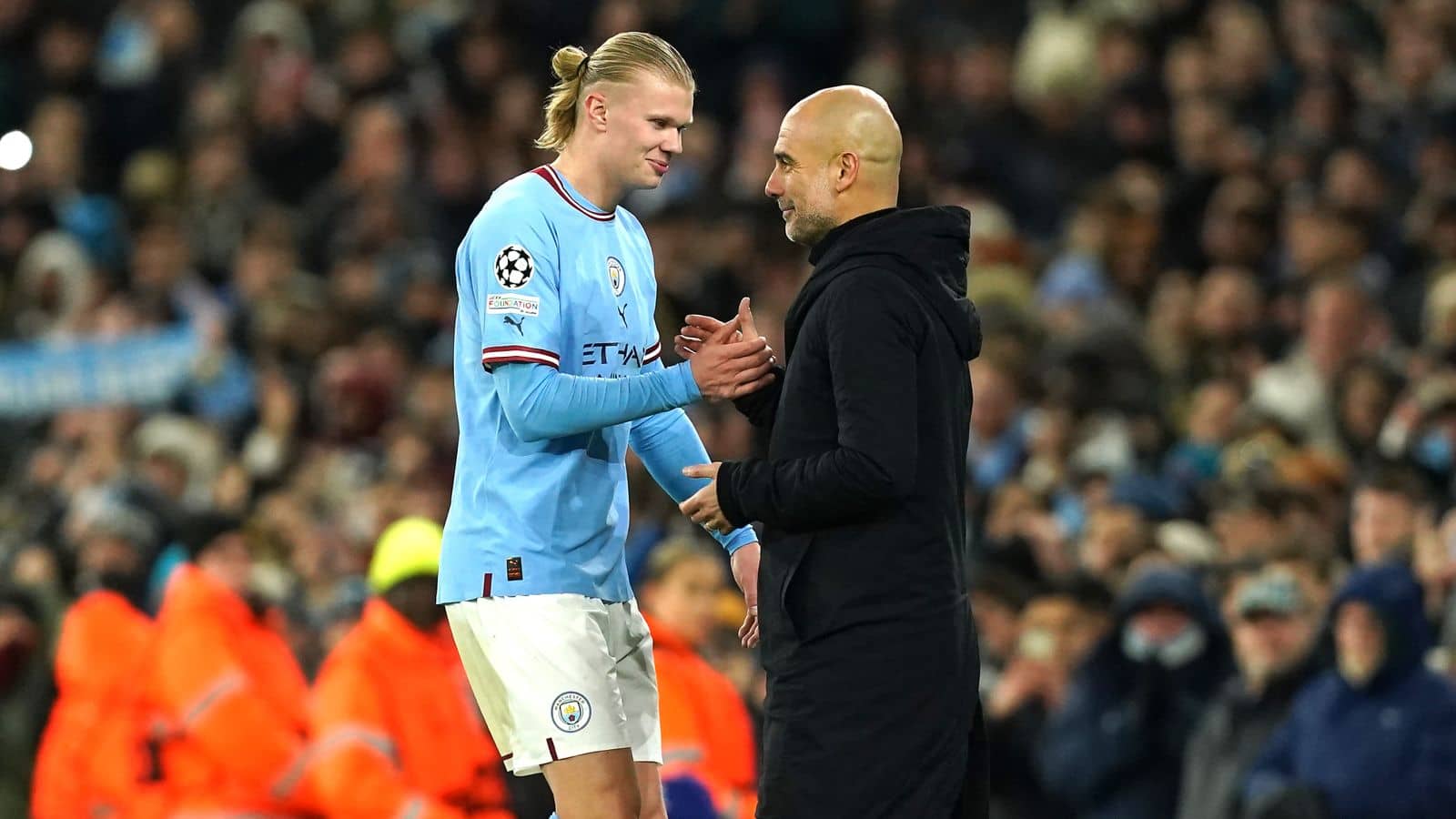
In the pantheon of football management, the ghosts of the past sit in gilded chairs. There is Rinus Michels, the father of Total Football. There is Arrigo Sacchi, who rebuilt the very geometry of the pitch. There is Sir Alex Ferguson, the monarch of dynastic longevity, and Bill Shankly, the soul of the people.
For decades, the question of the “Greatest Coach of All Time” (GOAT) was a respectful nod to history. But a man wearing a casual zip-up hoodie and a five-o’clock shadow has kicked that door down.
Pep Guardiola is not just one of the best coaches ever; as of 2026, he has silenced every remaining critic. In an era defined by financial disparity, data saturation, and tactical hyper-specialization, Guardiola has done more than win trophies—he has fundamentally altered the genetic code of football.
Here is the case for the man from Santpedor, updated for the present day.
1. The Tactical Evolution: From “Juego de Posición” to the Hybrid Backline
When discussing Guardiola, we must first discard a lazy myth: that he is a dogmatic purist who only knows one way to play.
Yes, his Barcelona team (2008-2012) was the apex of Juego de Posición (positional play). The premise was simple in theory, impossible in execution: occupy every vertical and horizontal line of the pitch to create numerical superiority, pass the ball into the net, and the moment you lose it, win it back in six seconds.
But that was nearly two decades ago. Since then, Guardiola has been a relentless inventor, destroying his own creations to build better ones.
- The False Nine: He didn’t invent it, but he weaponized it. By pushing Lionel Messi into the center, he broke the traditional 4-4-2 diamond of Serie A and the rigid man-marking systems of Europe.
- The Bayern Munich Overload: In Germany, he realized the Bundesliga was too physical for tiki-taka. So, he inverted the full-backs (Phillip Lahm and David Alaba) into central midfield, creating a 2-3-5 formation in possession that suffocated the counter-attack.
- The Manchester City “Box Midfield”: In the Premier League, where transition is king, he introduced the “box” (four midfielders in a 2-2 shape). He turned John Stones into a roaming midfielder (the ‘Stones role’) and utilized players like Bernardo Silva and Kevin De Bruyne as hybrid wingers.
- The 2025 Evolution: In the 2024-25 season, Guardiola unveiled yet another mutation: a fluid 3-1-5-1 system that saw his left-back tuck into a playmaking role behind a front five. The league took six months to even understand how to press it.
Guardiola adapts. He evolves. He is a software developer who deletes the code and starts fresh every two years.
2. The “Rinus Michels” Effect: Changing the League Itself
Great coaches win trophies. Legendary coaches change the way the league plays against them.
When Guardiola arrived at Manchester City in 2016, the Premier League was a track meet of heavy metal football. It was end-to-end, high-intensity, and tactically naive by continental standards.
Within three years, the entire league had transformed. Everyone from the relegation battlers to the title contenders started trying to “play out from the back.” Suddenly, every goalkeeper needed to be a sweeper. Every center-back needed passing range. Why? Because if you tried to boot the ball long against Guardiola, his team would simply win it back and hurt you again.
Now, a decade later, the Premier League is the most tactically sophisticated league on earth—and much of the credit belongs to Guardiola. Even his rivals admit it. Jurgen Klopp, his greatest foil, acknowledged before his 2024 departure that Guardiola’s obsession with control forced Liverpool to become more patient, more precise. Mikel Arteta, his former assistant, built a title-winning Arsenal (2023-24) on the principles of positional play.
Guardiola is a rising tide that has lifted (and sometimes sunk) every tactical ship in the harbor.
3. The Messi Exception and the “No Excuses” Legacy
The easiest criticism leveled at Guardiola is the “Messi argument.” “Anyone can win with Lionel Messi.”
It is a lazy critique that collapses under the weight of his other achievements. Since leaving Barcelona, Guardiola has won league titles in Germany and England at a staggering clip. He won the Bundesliga every year. He has won the Premier League six times in nine seasons—including an unprecedented four in a row from 2020 to 2024, and another title in 2025.
But the deeper counterpoint is this: He made Messi.
Before Guardiola, Messi was a breathtakingly talented winger who got injured frequently and drifted in and out of big games. In 2008, Guardiola walked into a dressing room dominated by Ronaldinho and Deco. He sold them immediately and built the team around a 21-year-old.
4. The Psychology of the Control Freak
Tactics are only half the battle. Managing a dressing room full of millionaires with egos the size of the Etihad Stadium is the other half. Guardiola’s methodology is famously intense.
He is known for his “manic” pre-match meetings, where he shows the opposition 80 clips of their weaknesses. He has famously fallen out with stars who don’t fit the system (Zlatan Ibrahimovic, Yaya Toure, Joao Cancelo). He demands absolute obedience to the structure.
But beneath the intensity lies a profound emotional intelligence. He created the “hug” culture at Barcelona, turning a fractured club into a family. At City, after the traumatic Champions League final loss to Chelsea in 2021, he didn’t scream. He told his players he loved them and that they would try again.
The proof of his psychological mastery is the 2023 Treble. But the proof of his longevity is what happened next. After a disappointing 2024 Champions League exit to Real Madrid on penalties, Guardiola didn’t tear the squad apart. He held a summit with his senior players. He admitted his own tactical overreach. The result? A 2025 domestic double and a return to the Champions League semifinals.
In 2026, at age 55, Guardiola remains as hungry as ever. He recently told The Athletic: “When I wake up afraid of losing, I know I’m still alive.”
5. The Trophy Cabinet: An Embarrassment of Riches (2026 Update)
Let’s not be coy. You cannot be the GOAT without the silverware. As of April 2026, here is the updated tally:
- 42 major trophies (and counting).
- 3 UEFA Champions Leagues (2 with Barcelona, 1 with City—plus three finals overall, and a semifinal appearance in 2025).
- 13 League Titles (3 La Liga, 3 Bundesliga, 7 Premier League—the 2025-26 title is still mathematically possible as of this writing).
- 2 Trebles (2009 Barcelona, 2023 Manchester City). Only he has done it twice.
- The Sextuple (2009): The only men’s team in history to win six trophies in a calendar year.
- 5 League Cups, 2 FA Cups, 4 UEFA Super Cups, 3 Club World Cups.
But the numbers don’t tell the full story. It is the dominance of the numbers. In 2018-19, City won the domestic treble while scoring 95 points. In 2017-18, they hit 100 points—a record. In 2024-25, despite losing Haaland, City finished with 91 points and a goal difference of +62.
When Guardiola wins, he doesn’t scrape by. He demolishes the metric charts. His teams break passing records, possession records, and goal differential records. Winning is the baseline; humiliation of the record books is the objective.
6. The Sacchi Standard: Aesthetics as Morality
Arrigo Sacchi once said, “It is not enough to win. You have to win with beauty.” Guardiola lives by this creed.
In an age of pragmatism—where managers like Diego Simeone and José Mourinho have perfected the art of the ugly win—Guardiola refuses to compromise. He would rather lose playing his way than win playing reactive football.
This is not stubbornness; it is a philosophical stance. He believes that beautiful football is effective football. The more you control the ball, the less the opponent can hurt you. The higher your line, the closer you are to the opponent’s goal.
However, this pursuit of perfection has been his tragic flaw. The “Overthinking” meme—where Guardiola tinkers with his formation in the Champions League knockout stages—is rooted in truth. His losses to Chelsea (2021), Real Madrid (2022), and Lyon (2020) were classic examples. Even as recently as 2024, his decision to play a midfield without a natural holding player against Real Madrid backfired spectacularly.
But even that failure is telling. He loses because he is trying to find a perfect, unbeatable system. He is chasing a ghost. Most coaches lose because they are afraid. Guardiola loses because he is dreaming.
7. The Legacy Tree: The Coaching Dynasty
One final metric separates Guardiola from the rest: the “Coaching Tree.”
Sir Alex Ferguson was a titan, but his disciples (Steve Bruce, Roy Keane, Ole Gunnar Solskjaer) rarely succeeded at the top level.
Guardiola is a coaching factory. His assistants and former players have spread across Europe like a tactical virus. By 2026, the tree has only grown:
- Mikel Arteta (Arsenal): Took Guardiola’s positional play and added defensive steel. Won the Premier League in 2023-24, breaking City’s four-year stranglehold.
- Xabi Alonso (Bayer Leverkusen): Undefeated domestic double winner in 2024, playing a hybrid of Pep’s control and German verticality. Now at Liverpool (2025–present).
- Enzo Maresca (Chelsea): Direct disciple of the positional school. Took Chelsea to a Champions League final in 2025.
- Vincent Kompany (Bayern Munich): Implementing high-risk, high-line football. Won the Bundesliga in 2025.
- Carlos Corberán (Valencia): Another lesser-known branch of the tree, keeping Valencia in Champions League contention.
The “Guardiola School” is now the dominant philosophy of world football. When your students become the headmasters of Arsenal, Liverpool, Chelsea, and Bayern Munich, you have shifted the axis of the sport.
8. The Contract Question (2026 Update)
In the original version of this article, a line mentioned that Guardiola’s contract expired in 2025. That is now ancient history.
Here is the reality as of 2026: In November 2024, with speculation swirling about his future, Guardiola signed a two-year extension at Manchester City, keeping him at the Etihad until the summer of 2027. He later revealed in an interview that his wife had “stopped asking” about moving back to Spain. His children are settled in Manchester. The project, he said, “is not finished.”
That extension came after a summer of intense courtship from the Brazilian national team and a lucrative offer from the Saudi Pro League. Guardiola turned them both down. Why? Because, as he put it: “Where else can I find a challenge like trying to win the Champions League with a team that just lost its best striker? That is the puzzle I love.”
As of April 2026, Guardiola is deep into planning for the 2026-27 season. He is already blooding three academy players—a 17-year-old winger, an 18-year-old holding midfielder, and a 19-year-old sweeper-keeper—into the first-team setup. The cycle continues.
The Verdict: Why He is the Best
We are witnessing the final, fully realized version of a coaching prodigy.
At Barcelona, he was the romantic, the revolutionary who weaponized the youth academy.
At Bayern, he was the professor, experimenting with shapes that didn’t yet have names.
At Manchester City, he has become the cyborg—and then, remarkably, the elder statesman. He has mastered the Premier League to such an extent that a 2-0 victory on a wet Wednesday in Wolverhampton is considered routine. He has solved English football.
The only remaining argument against him is the financial one. Yes, he has spent money. He has had the luxury of transfer budgets that smaller clubs can only dream of. But money doesn’t guarantee success. For every Guardiola, there is a PSG with Neymar and Messi failing to win the Champions League. For every Manchester City, there is a Manchester United spending the same amount to get worse.
Money buys you players. It doesn’t buy you the 2-3-5 formation. It doesn’t buy you the tactical discipline to press for 94 minutes. It doesn’t buy you the emotional intelligence to convince Kevin De Bruyne to play right-back for a single match to win a title. And it certainly doesn’t buy you the humility, after 42 trophies, to stay late at the training ground teaching an 18-year-old how to receive the ball on the half-turn.
Pep Guardiola is the best coach ever because he has solved the fundamental equation of football: How do you control the uncontrollable?
Football is chaos. It is a low-scoring game where luck plays a massive role. But Guardiola has built systems so robust, so redundant, so perfectly calibrated that he has reduced luck to a statistical anomaly.
He turned football from a game of random chance into a game of chess. And he is always four moves ahead.
As he enters the final chapter of his career (with his current contract running through 2027 and speculation about a possible World Cup management role in 2030), we should not ask if he is the best. We should simply thank him for showing us what the future of the sport looks like.
Long live the architect.
Leave a Reply