SpaceX has finally given the world a concrete answer to one of the most sci-fi questions in tech: when are we actually getting data centers in orbit?
And according to CFO Bret Johnsen, the answer is a lot sooner than you’d think.
First Orbital Compute Satellites Launch Next Year
Speaking at the Goldman Sachs Communacopia & Tech conference on Thursday, Johnsen — in his first post-IPO investor conference appearance — laid out a timeline that caught the industry off guard.
“We’re actually targeting to fly our first orbital compute satellites next year,” Johnsen said. “I think that will be an enormous moment when they start, and when everybody starts to see that we’re putting up huge amounts of compute into space going into 2028, because that’s the right way to do this anyway, and then everyone will see that the timeline is far shorter than people had expected.”
That’s right. First test flights in 2027, with significant scale coming by 2028.
For context, SpaceX’s own IPO filing had previously said orbital data centers could begin deployment “as early as 2028.” The new timeline is notably more aggressive — and it signals that Musk and co. aren’t messing around.
What Exactly Are We Talking About?
The project has a name: Starmind. It involves a satellite called AI1 that essentially functions as an orbiting server rack, delivering around 150 kilowatts of peak computing power. The satellite spans about 70 meters tip to tip — wider than a Boeing 747 — and is equipped with chips designed to run xAI’s Grok models.
The broader vision is a constellation of solar-powered AI satellites, each equipped with onboard compute racks, heat radiators for thermal management, and high-speed laser links to communicate with each other and with existing Starlink satellites. Data would be transmitted to the ground via antennas or laser connections at low latency.
Musk has described it as “racks of compute” distributed across orbit, interconnected in real time — essentially a distributed supercomputer above the atmosphere.
And the scale? SpaceX has filed an application with the FCC to launch up to 1 million satellites as part of its Orbital Data Center System.
The Technology Is Already There (Apparently)
If you’re thinking this sounds like a massive engineering challenge, Musk would like a word.
Speaking in a video posted to X earlier this year, Musk said: “A lot of this technology, we’ve already made for the Starlink V3 satellites. We don’t think this is a super-hard problem, compared to things we already do.”
He pointed to Starlink V3 — the next generation of the company’s broadband satellites — as the technological bridge. SpaceX’s experience managing large satellite constellations at scale is, in Musk’s view, a competitive moat no rival can currently match. “We are the only operator that has any experience of that scale,” he said.
The first AI satellites will likely use Nvidia chips, and Musk has claimed their computing power will be equivalent to an Nvidia GB300 rack. SpaceX is planning to open its own orbital factory dedicated to manufacturing AI satellites before the end of 2026.
The Numbers Behind the Hype
This isn’t just a moonshot (or rather, an orbit-shot) — it’s a core part of SpaceX’s post-IPO growth story. The company has pitched itself to investors as “the only company with a commercially viable path to building orbital AI compute at scale.”
And the market is paying attention. SpaceX stock rallied from an intraday low of $104.83 on August 3 to nearly $150 this month, though it’s still well below its record high of $225.64 reached shortly after its public market debut in June.
About 80% of sell-side analysts rate SpaceX a Buy or Strong Buy, according to Yahoo Finance.
Analyst Kutgun Maral of Evercore ISI wrote: “We walk away incrementally more bullish on the visibility and monetization of the AI infrastructure opportunity, while also seeing a more aggressive competitive posture emerging in mobile. The roadmap is getting more specific, but Starship cadence and reuse remain the common execution dependency across broadband, Mobile and orbital compute.”
But Not Everyone Is Convinced
The skepticism is real — and it’s coming from some heavy hitters.
Masayoshi Son, founder of SoftBank, questioned the entire premise earlier this year. His argument: the biggest advantage of space-based data centers is dramatically lower electricity costs, but power only accounts for about 7% of AI infrastructure operating costs. The savings from avoiding that cost are outweighed by space transport expenses, additional maintenance costs, and network latency. In his view, the AI race will ultimately be decided by computing resources on Earth.
Sam Altman, OpenAI’s CEO, was even more blunt. In February, he called the idea of putting data centers in orbit “ridiculous” and said it won’t scale meaningfully within 10 years. Launch costs and maintenance difficulties remain enormous obstacles, he argued.
And SpaceX’s own IPO filing has acknowledged the risk, warning that orbital AI data centers “involve significant technical complexity and unproven technologies.”
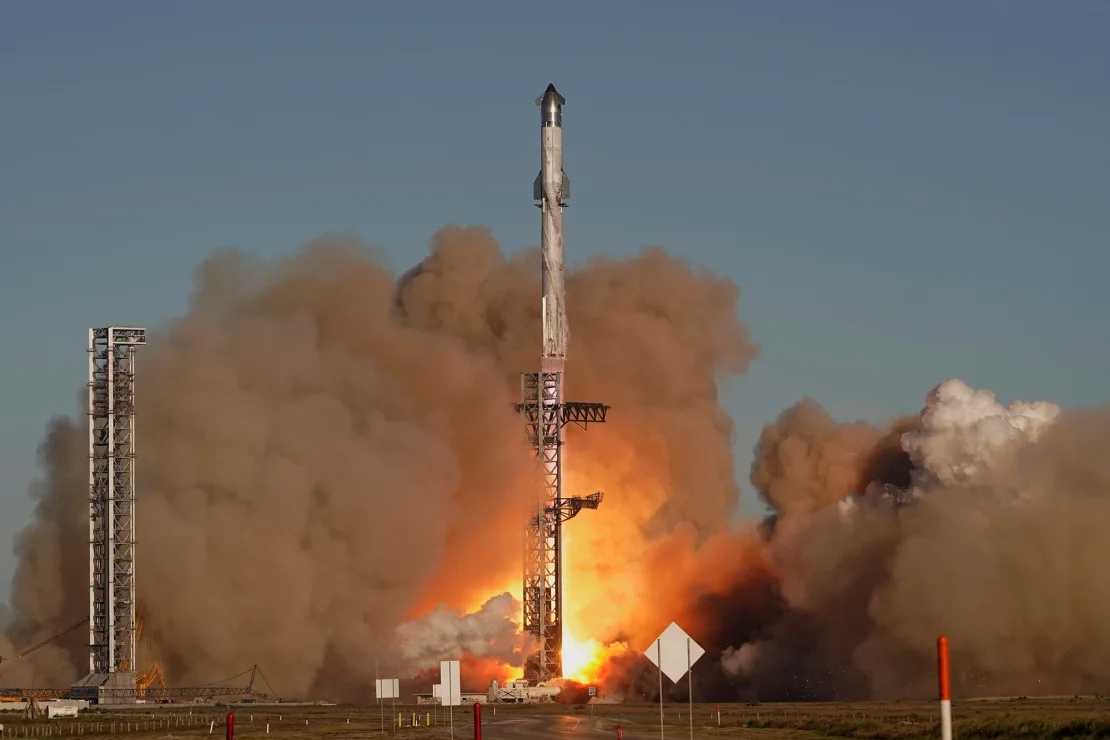
The biggest execution risk? Starship. The reusable rocket that’s supposed to make all of this economically viable is still years behind Musk’s original targets and has yet to prove it can achieve the rapid recovery and reuse capability needed for large-scale deployment.
What Happens Next
Two things are worth watching.
First, Johnsen confirmed that there will be another Starship flight later this month that will be revenue-generating and carry production V3 Starlink satellites. That’s a critical step in proving the launch cadence and reusability that the entire orbital compute plan depends on.
Second, the company is expected to release more financial reports this year following its first earnings report as a public company — which showed significant losses and capital expenditures of $18.4 billion, well above analyst estimates of around $6 billion.
The Bottom Line
SpaceX is betting big that the future of AI computing isn’t on Earth — it’s in orbit. The timeline is aggressive, the technology is largely unproven at scale, and the skeptics are loud. But if SpaceX pulls it off, the company that already dominates commercial launch and satellite broadband will have added an entirely new pillar to its empire.
First satellites next year. Significant scale by 2028. The clock is ticking.
What do you think? Is orbital computing the future, or is this one Musk promise that won’t leave the launchpad? Let us know in the comments.
Leave a Reply