More from our Q&A answering your hantavirus questions now,
Health expert Larry Gostin told health correspondent Ashish Joshi a vaccine being developed against hantavirus is “not a slam dunk”, despite the positive noises we’ve been hearing (see previous post).
In the last hour, researchers at the University of Bath said they were creating a “highly promising” vaccine that has yielded “excellent immune responses” in lab tests.
While he said it was “very good to hear”, Professor Gostin was less optimistic.
“It’s good news, but it’s not, as we say in America, a slam dunk,” said the director of the O’Neill Institute for National and Global Health Law at Georgetown University.
“Sometimes vaccines can be effective in lab conditions or in animal populations, but not when it comes to clinical trials.”
As it stands, there is “no specific antiviral that can cure” hantavirus, he says.
“People need close monitoring because you might start to develop symptoms that might just look like a cold, like nothing, but if it becomes settled in the lungs, it can rapidly become a quite dangerous, quite severe, even lethal disease, and you do need intensive medical support.”
‘Everything is pointing to it being an effective vaccine’
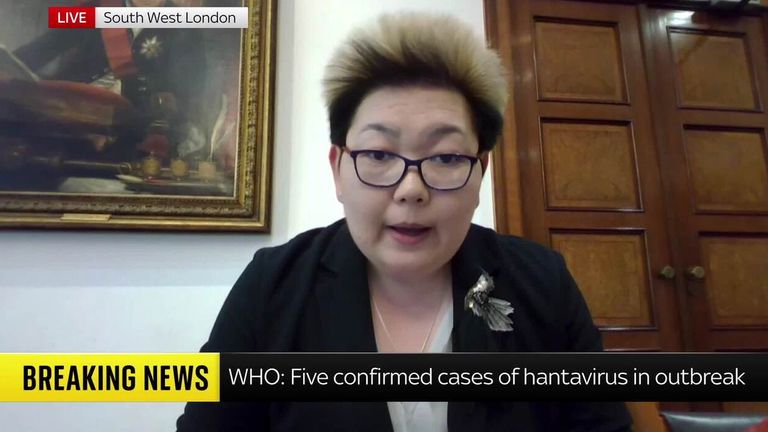
We’ve just heard from Professor Asel Sartbaeva of the University of Bath who has been leading a team trying to develop a vaccine for hantavirus.
Work started on the vaccine two years ago.
“The reason why we chose to work on it is because there isn’t really an effective vaccine against these diseases,” Sartbaeva told Mark Austin (Sky News chief presenter).
“Every year about 200,000 cases happen around the world, it’s a very debilitating disease which needs a vaccine for prevention and that’s why we chose to work on it.
“Everything is pointing to it being an effective vaccine.”
In order for it to be deployed in the future, Sartbaeva said it must go through clinical trials.
“We are currently working with the other three teams to get it to clinical stage and then obviously we will need to run the clinical trials in order to show that it is efficacious in humans and it is safe,” she added.
“Then only after that can it be deployed to the general public. So we’re talking somewhere between three to five years from now.”
Leave a Reply