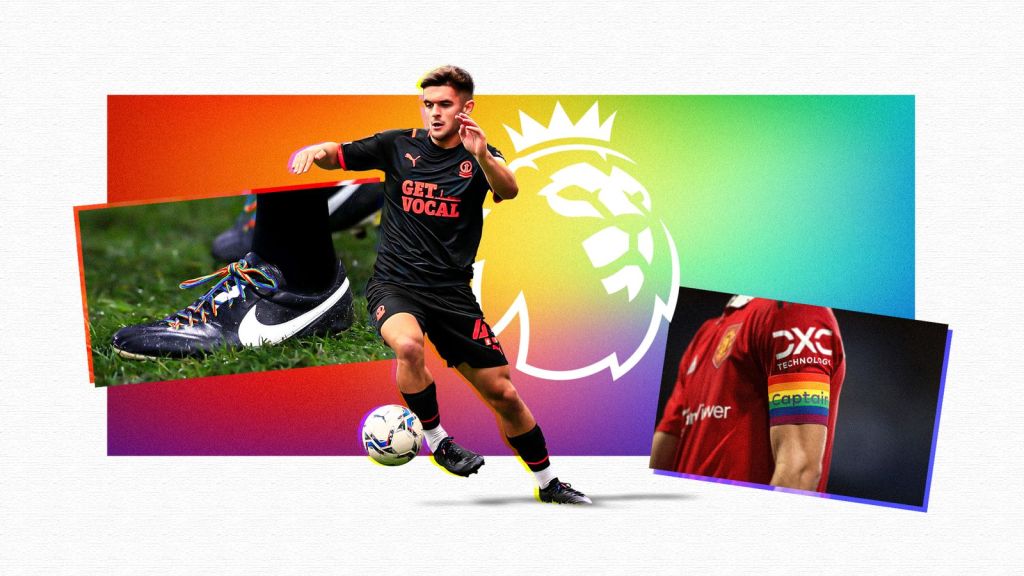
LGBTQ+ rights in the UK have come a long way in a relatively short space of time.
It was only in 1967 that homosexuality was partially decriminalised in England and Wales. Scotland and Northern Ireland followed in 1981 and 1982 – just over 40 years ago.
Since then, we have seen openly lesbian, gay, bi, trans and queer people in most areas of public life.
British sport has a range of LGBTQ+ representation across the overall spectrum. Some of the most visible members of the community include Olympian Tom Daley, boxer Nicola Adams and former Wales international rugby player Gareth Thomas.
But football continues to provide a paradox, as do several other team sports such as rugby and cricket.
In women’s sport, LGBTQ+ people are widely embraced and celebrated. Inclusion is woven into the fabric of what makes these sports special.
In football, for example, there have been close to 100 players taking part in the Women’s World Cup in Australia and New Zealand who are publicly out. That group includes Canada international Quinn, who is the first openly trans non-binary person to play in the tournament.
However, in men’s team sports – and football in particular – there is much less visible LGBTQ+ representation, both on and off the pitch. In recent years, efforts have been stepped up to improve this situation, such as through educational resources and awareness campaigns.
Worldwide, we have seen a smattering of male footballers come out in recent years. Blackpool teenager Jake Daniels came out as gay in 2022 and, as a League One player, he is the highest-level active gay men’s player in British football.
Czech Republic international Jakub Jankto – now with Cagliari in Serie A – is the highest-profile current male footballer to have come out, doing so in February. The other active out pro players are Josh Cavallo and Andy Brennan in Australia, Zander Murray in Scotland, and Collin Martin in the US.
However, as it stands in 2023, there hasn’t yet been an active out gay footballer playing in the Premier League.
‘It’s a very complex situation’
Jon Holmes, founder and lead of Sports Media LGBT+, says there are several factors and nuances to consider.
He explained: “Firstly, we’re not just talking about out gay players, we’re also talking about bisexual footballers.
“For example, Jahmal Howlett-Mundle is a former Crystal Palace scholar who has been playing in non-league for several years. He came out publicly as bi in 2021.
“LGBTQ+ individuals need to navigate their visibility. It’s not a perfect world in the women’s game either – there will be a lot of players there who don’t want to be publicly out, but they may be out within their own dressing-room environments at their clubs.
“I think that will be the case in the men’s game too. There will probably be some players who are out to their team-mates and coaches, but they don’t want the added pressure that comes with public visibility.
“Globally, we have a few out players in the men’s pro game, but it’s very limited. In the UK, there are a few out players and coaches in the non-league game as well, so that’s growing a little bit in terms of visibility.
“But it’s a very complex situation. It’s absolutely up to the individual, and there are so many different pressures that come with being publicly out.
“You’re not just thinking about your team-mates, it’s your friends and family, it’s where you live, it’s where you come from. The pressures that come with faith might play a part in that decision as well.
“Then we’re looking at what it means to be publicly out. It would invite a lot of scrutiny and attention. With social media and the media at large as well, there would be a huge amount of interest. Not everyone wants to open themselves up to that level of scrutiny.
“There hasn’t been any tradition of out gay or bi male players in the game. Men’s football in particular is still wrapped up in traditions that influence the culture of the game, the competitiveness and the rivalries. It’s also a short career for players in which to make their money before moving on to do something else.
“These are a few of the reasons that would make somebody not particularly keen to come out. It would take a strong-minded individual to take that step – someone who doesn’t just want to do it for themselves, but also to benefit other people like them, when that time comes.”

Liz Ward, director of programmes at the LGBTQ+ charity Stonewall, echoes those sentiments.
“In 2023 in football, I guess we stand in the same place as we do in society,” she said. “We’ve seen huge changes and lots more openness.
“But when we talk about openly gay footballers, there are still huge challenges to individuals coming out and wanting to be their true selves.
“At Stonewall, we believe in a world in which everyone can be who they want to be, no matter who you are. We work across football to create that world.
“We work with national governing bodies, leagues, the clubs themselves, and we work with fans and players either through education programmes or our Rainbow Laces campaign.
“As we’ve seen in stadiums, the stakes are very high for any footballer, whether that’s regarding your race, the team you play for, your background – to add sexuality into that increases those stakes even higher.
“In football as a whole, we have seen lots more players come out. There is visibility in grassroots football, where we have some teams that are entirely LGBTQ+. Earlier this year, we saw the first full trans men’s team playing a game of football.
“It’s definitely getting better, but in the Premier League – when the spotlight is on you so intensely and the stakes are so high – a lot of players will want to keep their private lives to themselves. At Stonewall, we support them in doing that in many ways.
“I still think we’ve got a little way to go before these individuals play as their true selves.”
Leave a Reply