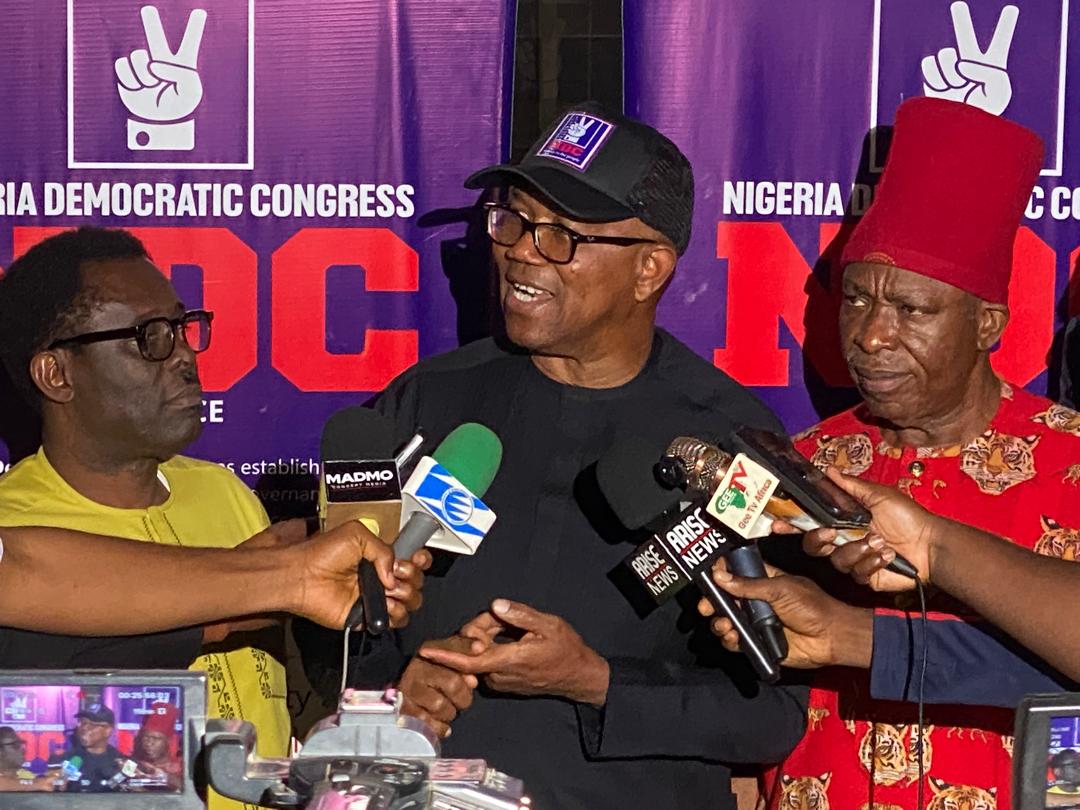
The presidential candidate of the Nigeria Democratic Congress (NDC), Peter Obi, has warned that Nigeria cannot achieve meaningful economic and social development while millions of citizens continue to live in fear because of insecurity, calling on the Federal Government to take urgent measures to protect lives and property.
Obi made the remarks during a courtesy visit to the Plateau State Traditional Council in Jos on Tuesday, November 10, 2026, ahead of a town hall meeting in the state.
The former Anambra State governor said his engagement with traditional rulers and communities across the country was part of efforts to understand the challenges confronting Nigerians before the commencement of formal political campaigns ahead of the 2027 general elections.
He explained that his decision to consult communities was informed by the belief that effective leadership must be based on listening to the people rather than simply making promises during election campaigns.
According to him, political leaders should understand the everyday experiences of citizens and develop policies that directly address their needs.
“When you want to serve, you must listen to the people. When we come for campaigns, we only talk and we don’t listen to the people. We have decided that leadership must be demand-driven,” Obi said.
He maintained that Nigeria needed leadership that prioritised public welfare, security, economic opportunities and human development rather than political interests.
Peter Obi Expresses Concern Over Insecurity in Plateau State
During the visit, Obi recalled his previous engagements with communities affected by violence in Plateau State, including Bokkos, Barkin Ladi and Mangu.
He described the security situation in the affected areas as unacceptable, expressing concern about the experiences of families who had lost relatives, homes and livelihoods because of persistent attacks.
The former governor said his presidential ambition was partly motivated by the need to address the suffering of Nigerians affected by insecurity, particularly displaced persons, widows, orphans and families whose loved ones had been killed.
He questioned how political leaders intended to address the emotional and economic consequences of violence for families who had lost their means of livelihood and security.
Obi emphasised that the suffering of displaced Nigerians should be regarded as a national concern rather than an isolated problem affecting particular communities.
“If I have one person in an IDP camp, it means we are all in an IDP camp. I am competing because I want to know how we talk to that mother whose child was killed, that husband who lost a wife and that woman who lost a husband. Who is going to listen to their cries?” he asked.
His remarks highlighted the humanitarian consequences of insecurity, particularly in communities where recurring attacks have forced residents to abandon their homes and seek refuge in internally displaced persons’ camps.
He argued that government must demonstrate greater commitment to protecting vulnerable populations and restoring confidence among communities affected by violence.
Nigeria Must Address Poverty, Infant Mortality and Out-of-School Children
Beyond insecurity, Obi identified poverty, infant mortality and the increasing number of children outside the formal education system as major challenges requiring urgent government attention.
He argued that Nigeria possesses sufficient human and natural resources to improve living conditions if public resources are properly managed and directed towards essential development priorities.
The NDC presidential candidate identified education, healthcare and agriculture as critical sectors that should receive greater investment to improve national productivity and reduce poverty.
According to him, Nigeria’s development challenges cannot be resolved through political rhetoric without practical policies that improve the lives of ordinary citizens.
He maintained that a country experiencing widespread insecurity cannot effectively develop its agricultural sector, expand businesses or attract the investments required to generate employment.
Obi also stressed that farmers, traders, students and other citizens should be able to carry out their daily activities without fear of kidnapping, attacks or other forms of criminal violence.
He argued that security should be measured not merely by government announcements or military operations but by the ability of ordinary Nigerians to travel, work, attend school and return home safely.
Children, Farmers and Traders Must Be Protected, Obi Says
Obi further emphasised that restoring security should be among the government’s most important responsibilities because insecurity affects virtually every aspect of national development.
He said children should be able to attend school and return home safely, farmers should have unrestricted access to their farms, while traders should conduct business without fear of attacks or abduction.
The former Anambra governor maintained that insecurity discourages productive economic activities and creates additional hardship for families already struggling with rising living costs.
He argued that protecting lives and property would provide the foundation for economic recovery, improved investment and sustainable development.
His position reflects his broader argument that Nigeria’s economic difficulties cannot be separated from governance, security and the effective management of public resources.
Plateau Traditional Ruler Warns Politicians Against Political Violence
Responding to Obi’s visit, the Gbong Gwom Jos, Da Jacob Gyang Buba, urged politicians and Nigerians to ensure that political activities do not worsen the country’s existing security challenges.
The traditional ruler called for peaceful political engagement, mutual respect and peaceful coexistence among citizens, regardless of their political affiliations.
He warned that Nigeria was already confronting serious insecurity and that political competition should not create additional divisions or encourage violence.
“We want to appeal to all politicians and all Nigerians that we should not allow politics to worsen our situation. We already have insecurity, and we must be determined to live with each other in peace and with respect for one another,” the traditional ruler said.
Da Jacob Gyang Buba also prayed for divine guidance in the emergence of a leader capable of governing Nigeria effectively and restoring the country’s greatness.
He urged political actors to conduct their activities peacefully throughout the electioneering period, stressing the importance of national unity and responsible leadership.
The traditional ruler’s remarks underscored concerns that political tensions ahead of the 2027 elections could complicate efforts to address insecurity in Plateau State and other parts of the country.
Peter Obi Begins Wider Consultations Ahead of 2027 Presidential Election
Obi’s visit to the Plateau State Traditional Council forms part of his broader consultations with Nigerians ahead of the 2027 general elections.
The former Labour Party presidential candidate, who is now seeking the presidency under the Nigeria Democratic Congress, has indicated that direct engagement with communities will remain an important component of his political activities.
Rather than relying exclusively on conventional campaign rallies, he has argued that prospective leaders should first understand the concerns and expectations of citizens before presenting their political programmes.
His consultations are expected to cover issues including insecurity, unemployment, poverty, education, healthcare, agricultural development and economic opportunities.
Plateau State is particularly significant in discussions about national security because several communities have experienced recurring violence, displacement and destruction of livelihoods.
Obi’s visit therefore provided an opportunity to engage traditional institutions and affected communities on the need for sustainable solutions to the state’s security challenges.
As political activities gradually intensify ahead of 2027, his comments have again placed insecurity and citizens’ welfare at the centre of the national political debate.
The former governor maintains that Nigeria cannot achieve its development ambitions unless government guarantees the safety and dignity of its people.
For Obi, economic prosperity, national unity and political stability must begin with a country where citizens can live, work, travel, farm and conduct legitimate businesses without fear.
Leave a Reply