Tesla’s strategic decision areas encourage managers to maintain best practices that are capable of improving operational success and efficiency, productivity levels, profitability and competitive advantage (Porter., 2008; Kehoe & Wright., 2010). To achieve these goals against stiff competition with global market contenders like General Motors (GM) and Toyota Motors Corporation, Tesla’s technology innovation—in line with the company’s vision and mission statement—is focused and dependent on the effectiveness of its operational management as discussed below (Holweg et al., 2018).
- Goods and Services: Tesla managers understand the cost implications of providing quality products and services. This challenge is addressed by constant innovative ideas in the various industries such as auto manufacturing, solar panel and battery production etc. For instance, to maintain its forefront position in the car-making business, Tesla built more advanced electric vehicles and has concurrently adapted its products and supply chain systems according to changing consumer needs. Product development and product differentiation are the major factors maximized to achieve business growth and support global business expansion objectives. Tesla’s operations management is not focused on building EVs only but to enhance its organizational competence to design and develop innovative and high-performance electric cars—including car parts and accessories (Swink et al., 2017).
- Quality Management: Another strategic decision area at Tesla Motors is how to satisfy customers’ demand for quality goods and services. To address this issue, the company adopted quality improvement initiatives that include regular quality checks and research on transportation/automotive trends. Tesla’s quality management made it a leading company in energy solutions market since Elon Musk shifted attention to manufacturing car parts rather than sourcing them from suppliers. Tesla’s objective to produce premium products through innovative manufacturing/business processes, however, led to an increase in managers’ workload but quality control remains one of the company’s strengths (Alvesson & Sveningsson., 2015).
Figure 4: Tesla Car Parts Suppliers
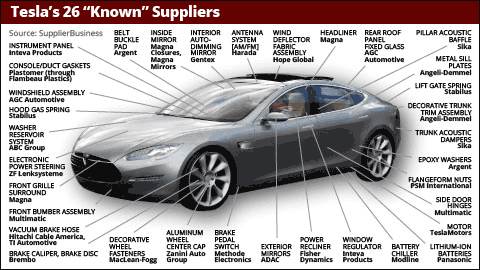
Source: Money Morning (2019)
- Process/Capacity Design: Improved business processes is not Tesla’s only operations management area of interest. To create stakeholder value and maximize benefits from resources, investments and standards, the carmaker adopted automation of manufacturing processes—with inputs from humans—as its growth driver. Combined use of artificial intelligent (AI) has therefore led to organizational efficiency and high productivity in Tesla’s car and energy solutions dealings (Fritsch & Changoluisa., 2017).
Figure 5: Tesla’s Revenue and Losses (2014-2017)
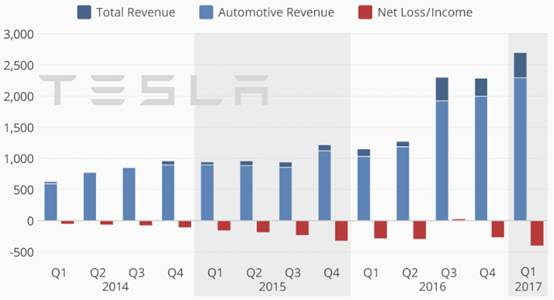
Source: Statistica (2017)
Leave a Reply