There are days on the calendar that pass with little notice, and then there are days that seem to attract history like a magnet. June 20 is one such date.
Across centuries, continents, and industries, this single day has witnessed the birth of revolutions, the death of empires, the dawn of new technologies, and moments of profound cultural transformation. From a tennis court in Versailles to the battlefields of antiquity, from the depths of the ocean to the edges of outer space, June 20 has proven itself a remarkably eventful date in the human story.
The Birth of Modern Democracy: The Tennis Court Oath (1789)
Few moments in history carry the weight of the French Revolution, and fewer still can be traced to a single day with such precision. On June 20, 1789, the deputies of the Third Estate—representing the commoners and lower clergy of France—found themselves locked out of their usual meeting hall by order of King Louis XVI. Refusing to be silenced, they gathered instead in an indoor tennis court at Versailles, the Jeu de Paume.
There, in what would become one of the most iconic scenes of the revolutionary era, they took an oath: they would not disband until a new French constitution had been adopted. The Tennis Court Oath was not merely a symbolic gesture. It was a direct challenge to the divine right of kings and a declaration that sovereignty resided in the people. The Third Estate had already declared itself the National Assembly; now they were daring the monarchy to stop them.
The oath set in motion a chain of events that would culminate just weeks later in the storming of the Bastille on July 14, 1789. The French Revolution had begun in earnest, and the old order of European aristocracy would never be the same. All because a group of determined citizens refused to leave a tennis court.
The Accession of Queen Victoria (1837)
Half a century later, on June 20, 1837, another transformative political moment unfolded across the English Channel. Queen Victoria acceded to the British throne following the death of her uncle, King William IV. She was just eighteen years old.
Few could have predicted that this young woman would go on to reign for sixty-three years—longer than any British monarch before her—and lend her name to an entire era. The Victorian Age would see Britain become the world’s preeminent industrial and imperial power. Victoria’s reign witnessed the expansion of the British Empire to its greatest territorial extent, the flowering of the Industrial Revolution, and profound social and political reforms. Her accession on that June day marked not just a change of monarchs but the beginning of a period that would shape the modern world.
The Telegraph Patented: A Communication Revolution (1840)
Just three years after Victoria’s accession, on June 20, 1840, American inventor Samuel Finley Breese Morse was granted a patent for his electric telegraph. The invention transformed human communication forever.
Before the telegraph, information traveled no faster than a horse could gallop or a ship could sail. Morse’s device changed that, enabling messages to be transmitted over long distances almost instantaneously. The patent—number 1,647—was a milestone not just in American innovation but in global connectivity. The telegraph would shrink the world, linking continents and making possible the modern era of instant communication. Morse’s famous first message, “What hath God wrought?,” sent a year later, might well have been a rhetorical question for the ages.
Ford Signs with the UAW: Labor’s Turning Point (1941)
The relationship between American industry and its workers reached a historic turning point on June 20, 1941. After years of bitter resistance from Henry Ford, who despised labor unions with a passion, the Ford Motor Company signed its first contract with the United Automobile Workers of America (UAW-CIO).
Ford had been the last major automaker to hold out against unionization. General Motors and Chrysler had already made deals with the fledgling UAW by 1937. But Henry Ford, the pioneer of the assembly line and one of the wealthiest men in America, had vowed to shut down his plants rather than sign with the union. He had put his trust in Harry Bennett, head of Ford’s Service Department, who promised to keep the unions at bay—and whose henchmen had brutally beaten UAW organizers in the infamous “Battle of the Overpass” in 1937.
What finally changed Ford’s mind? According to historical accounts, it was his wife, Clara, who threatened to leave him if he did not sign. Whatever the reason, the contract Ford signed on June 20 gave workers more generous terms than either GM or Chrysler had offered—including back wages to more than 4,000 workers who had been wrongfully discharged. The agreement marked the effective end of the auto industry’s resistance to organized labor and established the UAW as a permanent force in American industrial life.
The Detroit Race Riot (1943)
Two years later, on June 20, 1943, America faced one of the most devastating race riots in its history. In Detroit, long-simmering tensions over housing, employment, and racial inequities erupted into violence that would leave more than thirty people dead.
The rioting began with racially charged fighting between Black and white youths on Belle Isle. Police managed to stop the violence there that night, but the unrest spread, with more racist beatings and looting erupting downtown. President Franklin D. Roosevelt sent in federal troops to quell the violence. The final toll was staggering: twenty-five Black people died, seventeen of them at the hands of police. Nine white people died, none at the hands of police. Nearly 700 people were injured, and property damage totaled $2 million.
The Detroit riot was a stark reminder that the wartime rhetoric of democracy and freedom did not extend equally to all Americans. It foreshadowed the civil rights struggles that would convulse the nation in the decades to come.
The First Object in Space: The V-2 Rocket (1944)
Just a year after the Detroit riots, on June 20, 1944, a German V-2 rocket became the first human-made object to reach outer space. The achievement was remarkable, not least because the rocket’s director, Wernher von Braun, had been imprisoned by his own government just months earlier, apparently on suspicion of thinking too much.
The V-2 was a weapon of terror, raining destruction on London and other Allied cities. But it was also a harbinger of the space age. The same technology that carried explosives across the English Channel would, within two decades, carry humans beyond the atmosphere. Von Braun himself would go on to become a central figure in the American space program, helping to put the first Americans into orbit and, eventually, on the Moon. The irony of June 20, 1944—that a weapon of war had inadvertently touched the edge of space—would not be lost on history.
Bugsy Siegel’s Final Act (1947)
On June 20, 1947, one of America’s most notorious gangsters met his end. Benjamin “Bugsy” Siegel, the man who had brought organized crime to the West Coast and was instrumental in developing the Las Vegas Strip, was shot and killed at the Beverly Hills home of his mistress, Virginia Hill.
Siegel, forty-one years old, was sitting in the living room reading a newspaper when an unknown assailant fired multiple shots through the window, striking him in the head. He died instantly. The murder, believed to have been ordered by mob associates who were unhappy with the cost overruns on the Flamingo Hotel in Las Vegas, remains officially unsolved to this day.
Siegel’s death marked the end of an era in American organized crime. The flamboyant, larger-than-life gangster who had helped build the gambling empire of Las Vegas was gone, but the city he helped create would continue to grow, attracting millions of visitors and generating billions of dollars. His life and death became the stuff of Hollywood legend, immortalized in films like Bugsy (1991).
The Washington-Moscow Hotline (1963)
In the tense years of the Cold War, the Cuban Missile Crisis of October 1962 had brought the United States and the Soviet Union to the brink of nuclear war. The world had held its breath, and leaders on both sides had recognized the terrifying possibility that a misunderstanding or a delay in communication could trigger Armageddon.
On June 20, 1963, the two superpowers signed an agreement to establish a direct communications link between Washington and Moscow. The “hotline”—which was actually a teletypewriter system, not a red telephone—was designed to enable immediate, direct communication between the Pentagon and the Kremlin, reducing the risk of war by accident or miscalculation.
The agreement was signed in Geneva and entered into force the same day. The hotline became operational on August 30, 1963. It was a small but vital step toward managing the dangers of the nuclear age—a recognition that even sworn enemies needed a way to talk to each other when the stakes were existential.
Muhammad Ali’s Conviction (1967)
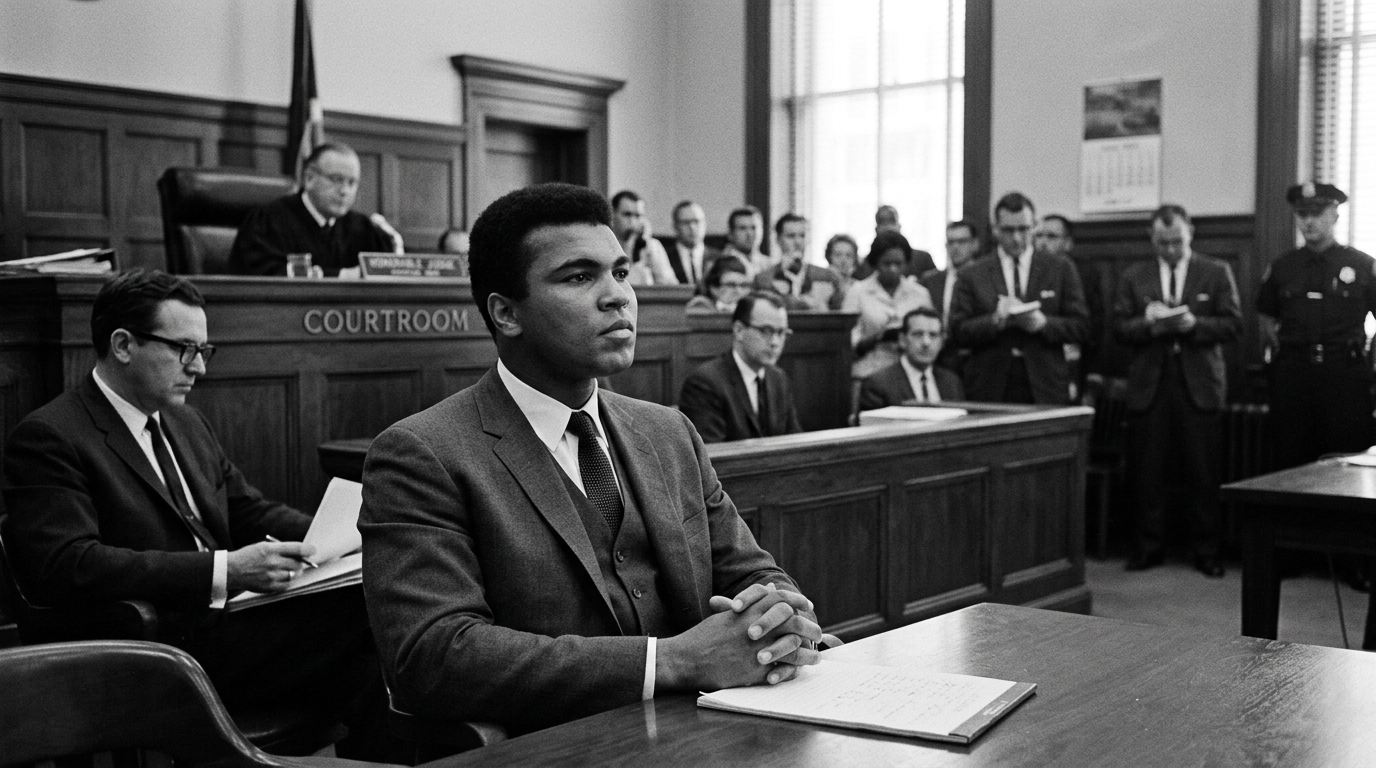
On June 20, 1967, the greatest boxer of his generation was convicted of a crime he believed he had no choice but to commit. Muhammad Ali, the heavyweight champion of the world, was found guilty in Houston of violating Selective Service laws by refusing to be drafted into the U.S. military.
Ali’s refusal was based on his religious beliefs as a Muslim and his opposition to the Vietnam War. “I ain’t got no quarrel with them Viet Cong,” he famously said. The conviction carried a sentence of five years in prison. Ali would not serve time—his appeal kept him free—but he was stripped of his heavyweight title and barred from boxing for more than three years, at the peak of his athletic prime.
The conviction would ultimately be overturned by the U.S. Supreme Court. But on that June day in 1967, Ali stood as a symbol of the conflict between individual conscience and state authority. His stance cost him millions of dollars and years of his career, but it also cemented his legacy as more than just an athlete—he was a man of principle who refused to compromise his beliefs, even at the highest price.
The Newport Pop Festival (1969)
Two years after Ali’s conviction, on June 20, 1969, another kind of revolution was taking place—this one musical. The Newport Pop Festival, billed as “Newport 69,” opened in Northridge, California, at Devonshire Downs. Over three days, an estimated 200,000 people attended what was then the largest pop concert in history.
The headliner was the Jimi Hendrix Experience, which traveled from Los Angeles by helicopter to perform. Hendrix was paid $120,000 for his appearance. The festival would be remembered not just for its size but for its place in the cultural landscape of the late 1960s—a time when rock music, counterculture, and mass gatherings were reshaping American society.
The Newport Pop Festival was a precursor to Woodstock, which would take place just two months later. It demonstrated that the youth culture of the 1960s was not a passing fad but a force that could draw hundreds of thousands of people together in celebration of music and community.
The First Mars Trojan Asteroid (1990)
On June 20, 1990, astronomers David H. Levy and Henry Holt made a discovery at the Palomar Observatory in California that expanded our understanding of the solar system. They found 5261 Eureka, the first known Trojan asteroid of Mars.
Trojan asteroids are objects that share the orbit of a planet, trailing or leading it at stable points known as Lagrange points. Eureka trails Mars at the L5 point. The discovery was significant because it revealed that Mars, like Jupiter, had its own family of Trojan asteroids—a finding that would lead to the discovery of many more Martian Trojans in subsequent years.
The name “Eureka” was fitting, for it was indeed a moment of discovery, of “I have found it.” The asteroid’s path through the solar system, varying in its distance from Mars over centuries, continues to be studied by astronomers today.
Atkins v. Virginia: A Supreme Court Landmark (2002)
On June 20, 2002, the United States Supreme Court issued a ruling that would reshape the application of the death penalty. In Atkins v. Virginia, the Court ruled 6-3 that executing people with intellectual disabilities qualified as cruel and unusual punishment and was therefore unconstitutional under the Eighth Amendment.
The case involved Daryl Atkins, who had been convicted of capital murder and sentenced to death by a Virginia jury. Atkins had an IQ of 59 and was found to have intellectual disabilities. The Supreme Court’s decision effectively barred states from executing individuals with intellectual disabilities, overturning its own 1989 precedent in Penry v. Lynaugh.
The ruling was a significant moment in the ongoing American debate over capital punishment. It reflected a growing recognition that certain categories of defendants—those who, by virtue of intellectual disability, lacked the full capacity to understand their actions or assist in their own defense—should not face the ultimate penalty. The decision has been cited in numerous subsequent cases and remains a cornerstone of Eighth Amendment jurisprudence.
Jack Kilby’s Passing (2005)
On June 20, 2005, the world lost one of the great inventors of the modern age. Jack St. Clair Kilby, the engineer who had invented the integrated circuit while working at Texas Instruments in 1958, died of cancer in Dallas at the age of eighty-one.
Kilby’s invention—a system of interconnected transistors on a single microchip—revolutionized electronics. It made possible the miniaturization of computers, the development of microprocessors, and the entire digital age. Every smartphone, every laptop, every piece of modern electronics owes a debt to Kilby’s breakthrough. For this invention, he shared the 2000 Nobel Prize in Physics.
Kilby’s death on June 20 marked the passing of a titan of innovation. His work had transformed the world in ways he could scarcely have imagined when he first demonstrated the integrated circuit on September 12, 1958.
The Iran Drone Crisis (2019)
In more recent memory, June 20, 2019, brought the world to the brink of military confrontation. Iran’s Revolutionary Guard shot down a U.S. surveillance drone over the Strait of Hormuz, claiming it had violated Iranian airspace. The United States insisted the drone was in international airspace.
It was the first time Iran had directly attacked the American military amid rising tensions over Tehran’s unraveling nuclear deal with world powers. President Donald Trump, in a social media post, said Iran had made a “big mistake”. The U.S. military was “cocked & loaded” to retaliate, Trump later revealed, but he called off the strike minutes before it was to begin after being told that 150 people would die—”not proportionate to shooting down an unmanned drone”.
The incident highlighted the dangers of the volatile Middle East, where miscalculation and misunderstanding can escalate quickly. The fact that a direct military strike was averted—at least on that occasion—was a reminder of the importance of restraint in international affairs.
Leave a Reply