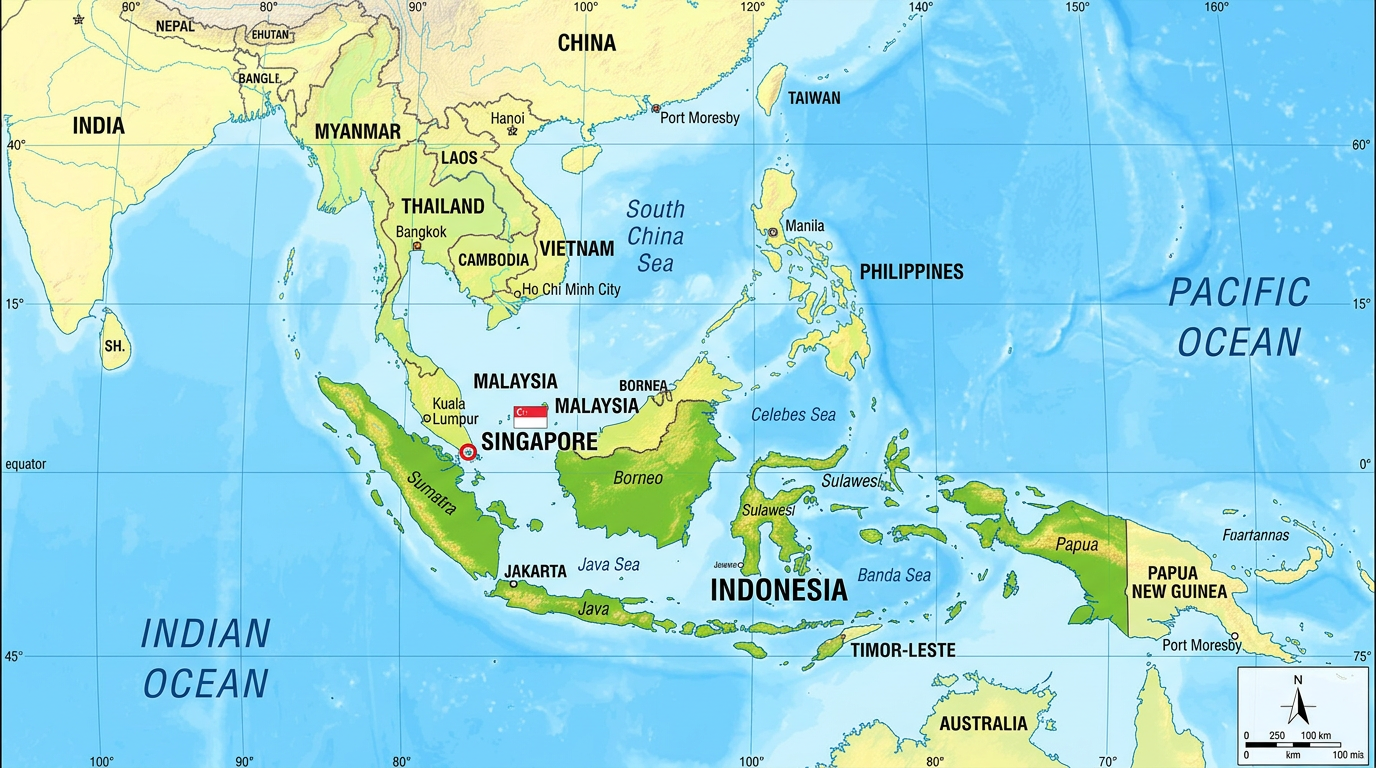
SINGAPORE — November 20, 2026
Indonesia has fully restored its piped natural gas supplies to Singapore following an 18-day reduction in exports that forced the Southeast Asian city-state to monitor its energy supply arrangements more closely.
Singapore’s Ministry of Energy, Trade and Industry (METI) confirmed on Friday, November 20, that natural gas deliveries from Indonesia had returned to normal on November 12.
The restoration ends a temporary disruption that began on October 24, when Indonesia reduced its pipeline gas exports to Singapore to redirect supplies towards domestic electricity generation.
Responding to enquiries about the situation, a METI spokesperson said there had been no further notification of supply reductions since deliveries resumed.
The development provides some relief for Singapore, which relies heavily on natural gas to generate electricity and maintain its industrial and commercial activities.
However, the disruption has raised broader questions about the reliability of regional energy partnerships, particularly as Indonesia increasingly prioritises domestic consumption of its natural resources.
It has also highlighted Singapore’s need to diversify its energy sources and strengthen arrangements that protect the country against unexpected interruptions in imported fuel supplies.
Indonesia redirects gas supplies to meet domestic electricity demand
Indonesia began reducing natural gas exports to Singapore on October 24, diverting supplies from two major production areas to support electricity generation within its own territory.
The reduction involved approximately 31 million standard cubic feet of natural gas daily, comprising 15 million from Natuna and another 16 million from Sumatra.
Indonesia’s upstream oil and gas regulator, SKK Migas, explained that gas from Natuna was being redirected to state-owned electricity company PLN Batam through the WNTS-Pulau Pemping-Batam pipeline.
Meanwhile, supplies from Sumatra were diverted through the TGI pipeline to meet electricity requirements in Batam, Bintan and Sumatra.
The regulator said the decision was intended to “safeguard the reliability of domestic gas supplies for electricity generation”.
The move reflected Indonesia’s growing determination to prioritise domestic energy security as electricity consumption increases and the government seeks to ensure sufficient resources for its population and industrial sector.
Indonesia has considerable natural gas resources and remains an important supplier to neighbouring countries. However, rising domestic demand has created additional pressure on the government to reconsider how much gas should be reserved for local consumption and how much should be made available for export.
The October reduction therefore represented more than a temporary adjustment to pipeline deliveries. It demonstrated the competing demands facing Indonesia as it attempts to balance domestic energy requirements with its commercial commitments to neighbouring economies.
Singapore’s energy regulator says supply reduction had limited impact
Although the reduction attracted considerable attention, Singapore’s Energy Market Authority (EMA) indicated that its overall impact on the country’s energy supply was relatively small.
According to information received from natural gas importers, the reduction amounted to approximately 17 billion British thermal units per day over the 18-day period.
This represented less than 2 per cent of Singapore’s total daily natural gas demand, which exceeds 1,000 billion British thermal units.
Singapore therefore had sufficient alternative arrangements to manage the temporary reduction without experiencing a major disruption to its overall energy supply.
The country’s energy regulator also confirmed that contingency measures were available to address similar interruptions, including the possibility of increasing imports of liquefied natural gas.
A spokesperson for EMA previously explained that Singapore GasCo was operationally prepared to import additional liquefied natural gas whenever necessary.
These arrangements are important because natural gas remains the backbone of Singapore’s electricity generation system.
Approximately 95 per cent of the country’s electricity is generated using natural gas, making the reliability of international supplies a significant national economic and security concern.
Any prolonged interruption could potentially affect electricity generation, industrial operations and businesses that depend on consistent energy supplies.
The temporary Indonesian reduction did not create such a crisis, but it provided an important indication of the risks associated with depending on imported natural resources.
Gas importer reports temporary disruption to customer deliveries
The reduction also affected companies importing natural gas from Indonesia for distribution to Singaporean customers.
Gas Supply, an importer that sources natural gas from Indonesia, previously informed CNA that deliveries to its customers had been affected by temporary reductions from its upstream supplier.
The company acknowledged that the interruption had affected its supply arrangements and said it was communicating directly with customers experiencing the consequences.
The development illustrated how changes in international gas deliveries can affect commercial arrangements even when the overall national energy supply remains stable.
For energy importers, maintaining sufficient supplies requires close coordination with producers, pipeline operators, government regulators and electricity companies.
Temporary reductions can also create uncertainty for businesses that depend on predictable deliveries to meet operational requirements.
The restoration announced by METI should therefore provide greater certainty to importers and customers who were affected by the earlier disruption.
Indonesia insists it did not breach contractual obligations
The October gas reduction generated diplomatic and commercial concerns because Singapore and Indonesia maintain contractual arrangements governing natural gas deliveries.
Singapore Prime Minister Lawrence Wong previously stated that the country expected all parties involved in commercial agreements to honour their contractual commitments.
Indonesia, however, maintained that the reduction did not amount to a breach of its existing agreements.
During a press conference on October 26, Indonesia’s Coordinating Minister for Downstreaming and Energy Transition, Bahlil Lahadalia, defended the government’s decision.
He explained that the reduction remained within the limits permitted under existing contractual arrangements, with deliveries still meeting the minimum agreed supply levels.
“We have only reduced it by about 8 per cent. We would only be in breach of contract if we were to cut by 10 per cent,” said Bahlil, who also serves as Indonesia’s Minister of Energy and Mineral Resources.
He attributed the situation partly to maintenance requirements and growing domestic consumption.
“This situation arose partly due to maintenance requirements, but also because of domestic demand. And that is just for the gas – not even accounting for the (liquefied natural gas) we supply.”
The Indonesian government’s position was that it had fulfilled its contractual responsibilities while making adjustments necessary to protect domestic electricity generation.
The disagreement nevertheless highlighted the sensitivity of energy trade between neighbouring countries, particularly when national governments must balance export commitments against domestic economic and security priorities.
Singapore faces uncertainty as existing gas contracts approach expiration
Although the immediate supply disruption has ended, Singapore faces a longer-term challenge because its existing natural gas import contracts with Indonesia are due to expire at the end of 2028.
Deputy Prime Minister Gan Kim Yong previously addressed the issue in a parliamentary response, warning that Indonesia’s increasing domestic demand for natural gas could influence the quantity available for export.
Gan, who also serves as Minister for Energy, Trade and Industry (Trade), emphasised the importance of securing reliable and diversified energy supplies.
His warning reflects concerns that Indonesia could become more selective about future export commitments as its electricity consumption and industrial requirements increase.
The expiration of the existing agreements could therefore become an important negotiating issue between the two countries.
Singapore will need to secure sufficient supplies for its electricity generation system while considering the possibility that Indonesia may seek revised contractual terms or reduce the volume of gas available for export.
The challenge is particularly significant because natural gas accounts for approximately 95 per cent of Singapore’s electricity generation.
Nevertheless, the country has made efforts to avoid excessive dependence on any single supplier.
In 2024, no individual country accounted for more than 30 per cent of Singapore’s total gas imports.
Singapore obtains natural gas through pipelines from Indonesia and Malaysia, while liquefied natural gas shipments provide another important source of supply.
This diversified approach reduces the risk that a disruption involving one supplier will immediately threaten the country’s entire electricity system.
Singapore accelerates efforts to diversify natural gas imports
Singapore’s response to the Indonesian supply reduction has reinforced the importance of expanding its access to international liquefied natural gas markets.
Unlike piped natural gas, which depends on fixed infrastructure connecting producers and consumers, liquefied natural gas can be transported by specialised vessels from different exporting countries.
This provides Singapore with greater flexibility when securing additional supplies.
The country has also been developing a second liquefied natural gas terminal, expected to become operational towards the end of the decade.
The additional infrastructure is intended to strengthen Singapore’s ability to import natural gas from different international suppliers and improve its energy security.
The investment is particularly important as existing regional pipeline agreements approach expiration and neighbouring countries reassess their domestic energy requirements.
Singapore’s strategy also reflects the need to prepare for unexpected developments in international energy markets, including geopolitical tensions, production interruptions and changing government policies.
Although liquefied natural gas imports may provide additional flexibility, they do not eliminate the need for reliable regional energy partnerships.
Singapore will therefore continue to require cooperation with neighbouring countries to maintain stable and predictable supplies.
Indonesia’s domestic energy priorities could reshape regional gas trade
The temporary reduction in exports reflects a broader policy direction under President Prabowo Subianto’s administration, which has emphasised the importance of securing domestic access to Indonesia’s natural resources.
The government has increasingly highlighted the need to ensure that domestic industries and electricity producers receive adequate supplies before resources are committed to international markets.
Indonesia’s energy officials have also indicated that existing export arrangements could be reviewed as the country’s domestic requirements evolve.
Bahlil previously warned that Jakarta would evaluate energy export relationships and could reconsider arrangements with countries that did not respect Indonesia’s interests.
Although the regulator did not directly link the October supply reduction to those political remarks, the development occurred amid wider discussions about Indonesia’s energy export policies.
Indonesia currently uses a substantial proportion of its natural gas production domestically, while the remainder is exported to international markets.
The government’s challenge is to maintain sufficient supplies for electricity generation, manufacturing and industrial development without undermining the economic benefits associated with energy exports.
For Singapore and other importing economies, these developments demonstrate why long-term energy security cannot depend exclusively on historical export arrangements.
As domestic demand increases across Southeast Asia, energy-producing countries may increasingly seek to retain more of their resources for local consumption.
ASEAN cooperation becomes increasingly important for regional energy security
The Indonesian gas disruption has also renewed attention to regional cooperation as Southeast Asian governments seek more reliable and sustainable energy arrangements.
One important initiative is the ASEAN Power Grid, a regional project designed to connect electricity networks across member countries and facilitate cross-border electricity trading.
The project is intended to allow countries with sufficient electricity generation capacity to supply neighbouring economies experiencing shortages or higher demand.
Singapore has supported the initiative as part of its broader strategy to diversify electricity sources and strengthen regional energy cooperation.
ASEAN members have signed an enhanced memorandum of understanding to advance the regional electricity trading project, which aims to connect participating national grids by 2045.
However, establishing the necessary infrastructure will require considerable investment, regulatory coordination and agreement on the construction, access and maintenance of cross-border transmission facilities.
Singapore’s Minister for Energy and Industry, Tan See Leng, has also advocated closer cooperation between neighbouring countries, arguing that energy trade should benefit participating economies rather than compromise their domestic interests.
His approach has been described as “prosper thy neighbour”.
Singapore is expected to promote stronger regional energy cooperation during its ASEAN chairmanship in 2027.
The initiative could become increasingly important as countries seek to reduce dependence on imported fossil fuels while expanding renewable electricity generation.
Energy security remains a major concern for Singapore
Indonesia’s restoration of natural gas deliveries represents a positive development for Singapore and its energy importers. The end of the 18-day reduction removes an immediate supply concern and restores normal pipeline deliveries.
However, the incident has demonstrated that energy security depends on more than the availability of natural resources.
It also requires reliable commercial agreements, sufficient infrastructure, diversified suppliers and effective cooperation between governments.
Singapore’s heavy dependence on natural gas makes these considerations particularly important as it seeks to maintain economic competitiveness and uninterrupted electricity generation.
The approaching expiration of existing contracts with Indonesia in 2028 adds another dimension to the challenge.
While the current restoration offers temporary reassurance, Singapore must continue preparing for possible changes in regional energy supply arrangements.
For Indonesia, the episode illustrates the government’s determination to protect domestic energy requirements while maintaining its position as an important regional supplier.
The two countries therefore face a shared responsibility to preserve constructive energy relations, particularly as electricity demand continues to increase across Southeast Asia.
The latest development suggests that the immediate disagreement has eased, but the broader questions surrounding regional energy security, domestic consumption and long-term export commitments remain unresolved.
Leave a Reply