Chapter 1: Introduction
1.1 Background of the Study
The rise in non-communicable diseases (e.g., obesity, type 2 diabetes, and various heart diseases) across the world has intensified clamour for healthier food choices. These health concerns in the United Kingdom are prompting health organizations, government agencies, and private-sector stakeholders to support and implement strategies that guide consumers toward making better nutritional decisions. One remarkable consumer-centred tool in this regard is health-focused food labelling (that is, a system designed to provide simple, accessible, and impactful nutritional information at the point of purchase (Osman & Jenkins, 2021).
Health-focused labelling often highlights calorie counts, fat content, sugar levels, and salt measurements with visual cues such as “the traffic light system.” The traffic light system equips consumers with the knowledge necessary to assess the healthiness of a product briefly. is a front-of-pack food labelling designed to help consumers quickly grasp the nutritional content of food and drink products (Iina Ikonen et al, 2023). Retail brands like Tesco often use colour coding such as green (low), amber (medium), and red (high) to indicate levels of key nutrients. This labelling typically covers four main nutrients: fat, saturates (saturated fat), sugars, and salt. A green light means the food is low in that nutrient and this is the healthiest choice. An amber light indicates neither low nor high and this is often the preferred choice. A red light signifies high calorie content. Consumers wrongly assume red light label is a warning sign for “dangerous food or drink,” but it only emphasizes products which people should consume less often or in smaller amounts. The “traffic light system” initiative aligns with public health strategies aimed at reducing diet-related illnesses by influencing shopping behaviour, especially in major retail environments where food choices are abundant (Wakui et al, 2023).
Tesco (one of UK’s largest supermarket chains) explores food labelling as a key part of its customer information strategy in various socio-economic communities. Individual Tesco branches, including its business outlet in Middlesbrough, serve diverse consumer bases with different levels of nutritional awareness, literacy, and economic constraints. According to Middlesbrough health data (2024), Middlesbrough, a fast-growing town with mixed demographics, is currently facing public health challenges that include higher-than-average rates of obesity and diet-related illness. Middlesbrough therefore provides an ideal setting for assessing how effective food labelling drives healthier choices.
Figure 1: Example on a food package
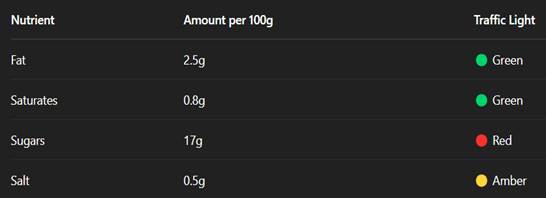
The “traffic light system” is endorsed by the UK government and used voluntarily by major supermarket (e.g., Tesco, Sainsbury’s, and Asda) to support healthier food choices.
Despite efforts to implement clear labelling systems, studies indicate consumers either ignore or misinterpret these labels thereby limiting the intended impact and raising questions about their actual impact on consumers’ purchasing behaviour as highlighted by the Food Standard Agency (FSA, 2023), Osman and Jenkins (2021), however, identified label placement, consumer education, font size, cultural preferences, and even time pressure during shopping as factors that can affect a consumer’s consideration for nutritional information.
Given these complex issues, there is a growing interest in examining current effectiveness of health-focused food labelling as well as identifying strategies to improve its visibility and influence on consumers. Use of secondary data (e.g., consumer feedback, existing sales trends, and previous research findings) in this study therefore offers a robust, cost-effective approach to address a real-world problem.
1.2 Problem Statement
Although health-focused food labelling is designed to simplify health-related decisions at the point of purchase, there is a wide gap between label visibility and consumer response. Shoppers are willing to make healthier dietary choices, but their intention hardly results to actual purchasing behaviour. At Tesco store in Middlesbrough, this discrepancy can be attributed to local factors such as consumers’ health awareness and purchasing power, culture-related food preferences, and ingrained shopping habits that prioritize taste, convenience, or price over nutritional value.
The major challenge is not only about food labelling strategy (that is, presentation of nutritional information), but also how average consumers perceive, interpret, and use the information. Another key area is the technicality of food labels. When labels are too technical, visually unappealing, or poorly placed, consumers may overlook or misunderstand the information. Moreover, consumers may experience information overload or get confused when there are multiple food choices and different labelling formats. These challenges highlight that although current labelling efforts are well-intentioned, the strategies may not achieve expected goals. Thus, there is need for a closer examination of contextual factors at play in Middlesbrough, England. By analysing existing data collated from secondary sources, and understanding consumers’ purchasing habits within this setting, this study can identify practical improvements that can bridge the gap between consumer awareness and healthier decision-making.
1.3 Research Aim
To examine how health-focused food labelling influences consumer choices at Tesco, Middlesbrough, and identify ways of improving the effectiveness of such labels.
1.4 Research Objectives
- To evaluate the current impact of health-focused food labelling on consumer purchasing behaviour at Tesco, Middlesbrough.
- To identify key barriers reducing the influence of health labels on food purchasing decisions.
- To recommend evidence-based strategies for enhancing the visibility, comprehension, and persuasiveness of food labelling systems.
1.5 Research Questions
- How does health-focused food labelling currently affect consumer decision-making at Tesco, Middlesbrough?
- What factors contribute to the limited effectiveness of these labels?
- What practical improvements can enhance the impact of health-focused food labels?
1.6 Scope of the Study
The study focuses exclusively on the Tesco store in Middlesbrough. The location was chosen for its demographic diversity and relevance to public health discussions. However, the research is limited to pre-packaged food items that feature nutritional labels and does not include bakery items, fresh produce, or food sold without standardised labelling. To ensure a data-rich and time-efficient study that is relevant to real-world consumer behaviour, this qualitative study will use only secondary data (e.g., academic publications, customer survey results, supermarket analytics, as well as Middlesbrough and UK government health reports) in the analysis.
1.6.1 Approach and Data Collection Strategy
This study adopts a qualitative research design rooted in secondary data analysis. The rationale for using secondary data stems from its cost-effectiveness, time efficiency, and relevance to real-world consumer behaviour. Therefore, the author will analyse existing datasets and literature, including:
- Customer purchasing trend reports from Tesco, particularly those that reflect responses to front-of-pack nutrition labels.
- Public health records and demographic health profiles published by Middlesbrough government, and Public Health England.
- Findings from previous academic studies and surveys examining food label effectiveness and consumer interpretation behaviour within UK supermarkets.
- Published corporate responsibility reports by Tesco, including health-oriented consumer feedback and strategic initiatives (if available).
To contextualize consumer behaviour, data selection will focus on Middlesbrough. The study will also consider food product categories that are consistently labelled with the traffic light system (e.g., dairy products, snacks, and ready meals), as well as available sales or feedback data related to them.
The analysis will further synthesise data thematically to identify patterns such as:
- Evidence of misinterpretation or disregard of labels.
- Changes in consumer preferences or sales volumes after label implementation.
- Socio-demographic influences on label effectiveness.
This approach allows the researcher to curate generate actionable insights without using primary data and still reflect localised consumer behaviour at Tesco, Middlesbrough.
1.7 Significance of the Study
This research holds practical and academic significance. Firstly, it provides data-based insights for retailers like Tesco seeking to improve customer health engagement through labelling. Secondly, better-designed food labels are more effective in influencing consumer decisions, thus, helping retailers to make significant contributions toward improving public health outcomes and potentially reduce healthcare costs associated with poor diet. Thirdly, results from this study can help policymakers, to make informed decisions about future guidelines and regulations surrounding food labelling and consumer information. Lastly, the study adds to a growing body of knowledge in consumer psychology, behavioural economics, and public health marketing, particularly within the context of health communication and retail settings.
By improving understanding of the successes and failures of the current labelling system at Tesco, this study aims to contribute to the design of more effective interventions that align marketing practices in the food and beverage industry with healthier societal goals.
Leave a Reply