Dutch start-up Elysian is developing a zero-emission aircraft with battery packs integrated into its wings, aiming for operations by 2034 as pilots in the Netherlands begin training on electric planes
Flying without kerosene is no longer just a dream. Pilots are being trained to fly electric planes in the Netherlands, and before long these battery-powered aircraft could be carrying 90 passengers over distances of up to 1,000 kilometres.
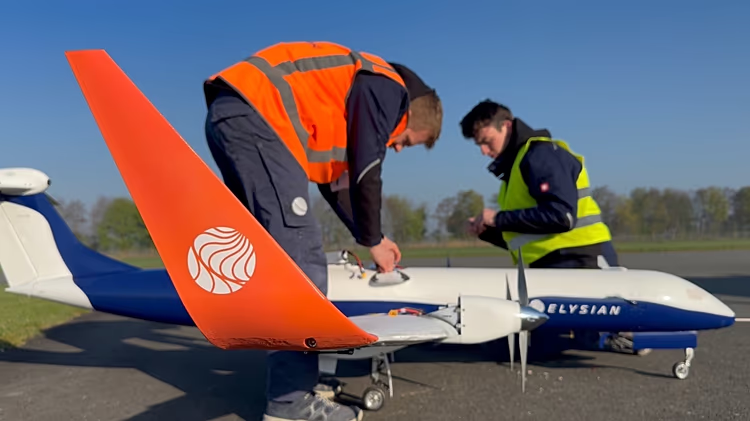
Johannes, Peter and Floris are thrilled. The pilots are carrying out the first test flights for the scaled E9X demonstrator — a world premiere — and if all goes to plan, their electric model plane could soon become a full-size passenger aircraft.
After a soft landing, the aircraft is still in one piece, and now the real adventure can begin: analysing the flight data in the Elysian Aircraft laboratory beside Amsterdam’s Schiphol Airport.
Over the next two decades, the global number of air passengers could double. That is bad news for the climate, which is why the young Dutch start-up Elysian is working on a solution.
The world’s first battery-powered passenger aircraft
Daniel Jacobson is one of the founders of Elysian Aircraft. With ten million euros in start-up capital, his team aims to develop one of the world’s first large, battery-powered passenger aircraft.
“The design pretty much stands,” Jacobson tells Euronews in his workshop. “There will be six engines. And we have folding wingtips, so that we fit into the current gates’ infrastructure of the airports, because the wings are very large. We are talking about more than 50 metres.”
Battery-packed wings
Jacobson shows Euronews the first full-scale model of the innovative wing. The battery packs are integrated into the wing’s structure — roughly 40 packs across the entire wing, each weighing around 1,000 kg.
“Yes, we are an obese plane,” the Elysian manager admits. Yet he smiles confidently: “We are always on a diet, trying to reduce weight. How can you use different materials, how can you combine things, how you do thermo-management. And it’s also IP (intellectual property) that we are generating here.” There are no further details — it is top secret at this stage.
Battery-wings are a revolutionary idea and the key to success. The co-founder and co-CEO of Elysian Aircraft sounds rather proud: “There was really this consensus in the academic world and in the industry that flying electrically with a large aircraft would never be possible. We have disproven that with our research on our design.”
Reducing global aerospace emissions
But what are the benefits? “By being able to transport 90 passengers for initially 800 kilometres and eventually 1,000 kilometres, you can reduce emissions to zero from half the world’s flights,” Jacobson says. “That is a very large amount of flight activity in the world. And you reduce total emissions from aerospace by 20%.”
The E9X is due to be operational by 2034. Europe is doing rather well in the race for the future of aviation, Jacobson believes. “But comparing it to the US or even China, we should fund start-ups and innovation much more aggressively when we want to keep our advantage,” he urges with regard to the EU.
Pilots prepare for electric take-off
At the small regional airport of Teuge, flying on electricity is already a reality. The E-Flight Academy trains pilots from several airlines in an environmentally friendly way at low altitude.
Co-founder Merlijn van Vliet takes Euronews on a ride in a small two-seater: “In this aircraft we have two batteries with 11 kilowatt-hours each. So, in total we have 22 kilowatt-hours on board. We can fly 45 to 50 minutes with them and still have ten minutes of reserve capacity.”
The plane follows the banks of a river through green meadows where Dutch cows graze. “We are now flying towards the old city centre of Deventer. They don’t hear us. So, we can fly wherever we want and they don’t hear us on the ground,” Merlijn beams.
What is his vision for the future? “In ten years, this will grow big and we will fly electric with 40 or 60 passengers — or even more.”
Charging infrastructure
Jurjen de Jong is a pioneer. He is developing a European charging infrastructure for electric aircraft.
“We will expand from the Netherlands to the Nordic States, to France, to Germany and Switzerland,” the co-founder of NRG2fly tells Euronews. “And then we will have a fully-fledged network of low-emission, low-noise electric mobility and that is really what we’re going for.”
Airports are surrounded by huge car parks. Solar panels, tens of thousands of electric cars and stationary energy storage systems could be connected to form a network — “the inter-net of energy,” as Jurjen calls it.
Teuge airport is testing the scaled concept. “We have 500 solar panels on the rooftop,” Jurjen explains, “their energy is stored in a battery. So basically, we have a whole energy hub which is providing energy instead of taking energy from the grid.”
NRG2fly co-founder Jurjen de Jong has a broader vision too: “My dream is to have all regional electric planes powered by the sun. And then we can leave a better world for me, my children and everybody.”
Leave a Reply