
Chapter4: Data Presentation and Analysis
4.1 Introduction
This fourth chapter of the study presents empirical findings from the questionnaires and interviews granted by students and staff members at the University of Sunderland, London. It critically examines the role of university support systems in enhancing students’ mental health and academic performance. To identify key themes: awareness, accessibility, utilisation, perceived effectiveness, and institutional response, the author analysed both quantitative and qualitative data—and used graphical representations (tables and pie charts) to support the analysis.
4.2 Demographics of Respondents
A total of 60 students participated in the questionnaire survey and 6 staff members were interviewed. Here is a statistical distribution of the students:
Table 4.1: Participants’ demographics
| Demographic Indicator | Frequency | Percentage |
| Male | 26 | 43% |
| Female | 34 | 57% |
| International students | 38 | 63% |
| Home students | 22 | 37% |
| Undergraduate students | 40 | 67% |
| Postgraduate students | 20 | 33% |
Source: Questionnaire data (2025)
This demographic breakdown helped contextualise variations in responses about support system awareness and it impact on students’ mental health and academic performance.
4.3 Awareness and Accessibility of Support Systems
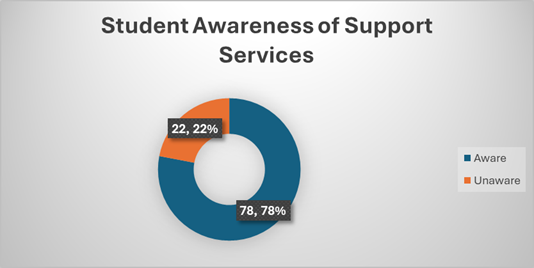
Students who participated in the study answered questions about their awareness of the available university support services, such as mental health counselling, academic tutoring, and wellbeing workshops. As shown in Figure 4.1, 78% of students indicated awareness of at least one support service whereas 22% were either unaware or uncertain about the availability of support services at the University of Sunderland in London.
Diagram 4.1: Student Awareness of University Support Services
Source: The Author (2025)
Despite the high awareness of support services at University of Sunderland, London, accessibility among students remains a concern. Questionnaire data indicates forty-two percent (42%) of students have experienced delays in booking appointments or faced difficulty while navigating the system.
“It took me three weeks to get an appointment, and my anxiety had worsened by then,” said a female international postgraduate student.
4.4 Utilisation of Support Services
When asked whether they had used any support service: at University of Sunderland, London, twenty-one students (35% of the participants) agreed they had used mental health counselling service. Other support services used at the academic institution include academic mentoring (45%), peer support (17%), and wellbeing workshops (23%). However, eighteen students (i.e., 30% of the participants) agreed they have not explored any of the support services available at University of Sunderland, London.
Table 4.2: Students’ usage of support services
| Service Used | No. of Users | Percentage |
| Mental Health Counselling | 21 | 35% |
| Academic Mentoring | 27 | 45% |
| Peer Support or Buddy Scheme | 10 | 17% |
| Wellbeing Workshops | 14 | 23% |
| None | 18 | 30% |
Source: Questionnaire data (2025)
Figure 4.2: Pie Chart showing only students who used one or more support services

Source: The Author (2025)
As shown in Figure 4.2, the author asked students at the University of Sunderland, London campus, to rate the usefulness of support service(s) received. Sixty-one percent (61%) among them reported significant improvement in academic clarity whereas fifty-eight (58%) noted improvement in their mental wellbeing.
4.5 Correlation Between Support Services and Academic Performance
The author asked students about their Grade Point Average (GPA) before and after accessing support services at the university.
Table 4.3: Students’ GPA before and after accessing support services
| Support Use | Average GPA Before | Average GPA After |
| Used Services | 2.7 | 3.3 |
| Did Not Use | 2.6 | 2.8 |
Source: Questionnaire data (2025)
The results in Table 4.3 suggest a positive correlation between the use of support systems and improved academic performance. The average GPA among students who used support services increased from 2.7 to 3.3 (0.6%) whereas participants who did not use support services showed a significantly lower increment from GPA average of 2.6 to 2.8 (0.2%). Therefore, on the average, use of support services has a positive impact on students’ academic performance.
“Students who engage with mentoring and counselling tend to perform better academically. It reflects in their grades and overall wellbeing,” said a Student Support Officer.
4.6 Mental Health Trends Among Students
Mental health challenges were prevalent, especially among international students facing acculturation stress and financial constraints.
Table 4.4: Common mental health challenges among students
| Reported Issues | Frequency | Percentage |
| Anxiety | 26 | 43% |
| Depression | 19 | 32% |
| Stress (academic/work) | 34 | 57% |
| Homesickness | 21 | 35% |
Source: Questionnaire data (2025)
Research data on Table 4.4 identified anxiety, depression, stress from academic activities, and homesick stress as the common indicators and/or stressors of mental health crisis. Twenty-six students (45% of the participants) identified anxiety as the major cause of mental imbalance. Nineteen individuals (32%) agreed to experiencing depression whereas twenty-one (35%) said homesickness triggers mental health challenge. However, the highest stressor of mental health crisis among students is stress from academic work. A total of thirty-four students comprising 57% of the population agreed that stress from academic activities has a more significant negative impact on their wellbeing.
Accordingly, participants agreed that support systems such as cognitive behavioural therapy, group counselling, and stress management webinars have been helpful. A large proportion of students also expressed their desire for more culturally sensitive support.
4.7 Student Testimonials (Qualitative Insights)
Responses from open-ended questionnaire questions and interviews revealed themes (such as frustration with access, gratitude, and emotional relief. Sample quotes include:
“Without counselling, I would have dropped out. It saved me during a mental health crisis.” — Male postgraduate student.
“The academic mentor helped me to structure my dissertation. I went from failing to a merit due to the understanding, student-centred, and humane academic support.” — Female undergraduate student.
4.8 Institutional Response and Areas for Improvement
Interviews with university staff highlighted current initiatives:
- Increased investment in digital mental health platforms.
- Training programmes for culturally aware counselling.
- Feedback mechanisms integrated into service delivery.
However, the identified challenges to improving students’ mental health and academic success at the University of Sunderland in London remain:
- Limited immediate support for crisis situations
- Underrepresentation of certain ethnic groups in service design
4.9 Conclusion
This case study of the University of Sunderland, London campus, demonstrates that student support systems have a direct impact both their mental wellbeing and academic success. Nonetheless, the author identified barriers such as delayed access and lack of cultural responsiveness. These setbacks limit actualization of the full potential of support service systems. Therefore, future improvements should focus on inclusivity, accessibility, and timely intervention to maximise the benefits for a diverse student population.
Leave a Reply