Three Superpowers, One Shenzhen Villa: Inside a Day of Diplomacy, Chip Curbs and Soft Economic Data
Thursday, November 19, 2026
The leaders of the world’s three largest nuclear powers sat down together in China’s southern tech hub today. Outside the villa, a US chip crackdown, a looming mineral-export deadline and a sluggish Chinese economy gave the summit a sharper edge than the handshakes suggested.
A first-of-its-kind meeting
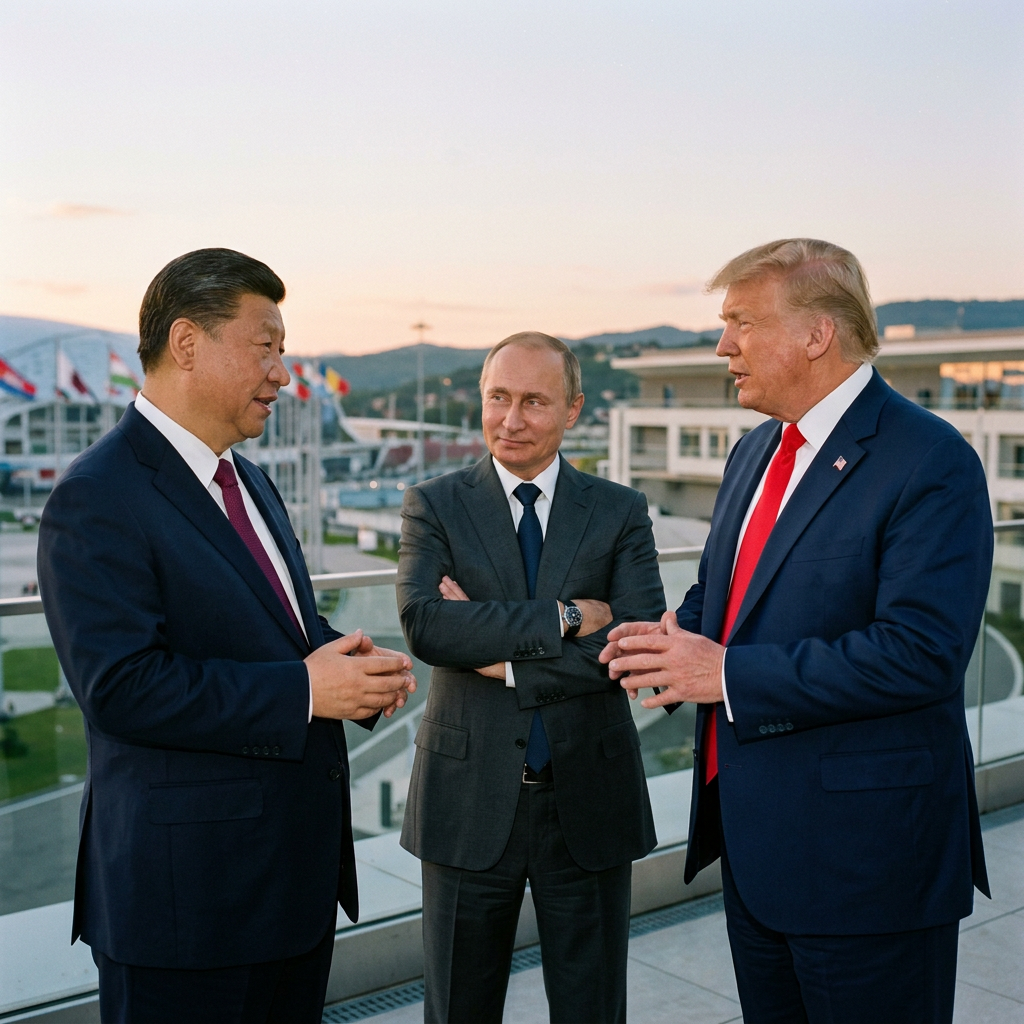
Donald Trump, Xi Jinping and Vladimir Putin held a three-way meeting at Kylin Villa in Shenzhen on the sidelines of the APEC summit. It was unprecedented: the three men lead the world’s three largest nuclear powers. Trump said they were “making history” and pitched the session as a chance to hash out nuclear arms control and start resolving the wars in Ukraine and Iran. The talks wrapped up after a little more than an hour.
Each leader leaned on his own themes. Xi, according to state broadcaster CCTV, called for crisis-communication mechanisms to reduce misjudgments and urged the three nations to drop a “Cold War mentality” and avoid decoupling. He also said the countries must not cross one another’s red lines, and he called for a world free of nuclear weapons. Putin, for his part, said he had covered Ukraine in separate talks with both Xi and Trump, and he invoked the three countries’ shared status as WWII victors and UN founders. Trump, meanwhile, defended the meeting as essential and criticized his predecessors for refusing to talk to rivals.
Not everyone is impressed. France’s foreign minister, Jean-Noël Barrot, said the three leaders disagree on nearly everything, so he expects nothing to come of it. He added that the EU, not Russia, is the third great power alongside the US and China. Others worry about the reverse problem. A Business Standard analysis points to fears in Europe and Asia that the three could negotiate global security arrangements while smaller nations are left out, a modern echo of Yalta.
What Xi and Trump said one-on-one
Earlier in the day Trump and Xi met bilaterally, their third substantial meeting this year. According to the Chinese readout, Xi told Trump the two sides had established a “constructive China-U.S. relationship of strategic stability” and agreed to draw up an action plan to build on it. He credited cooperation on counternarcotics, repatriating illegal immigrants and fighting online fraud, and called for joint work to keep AI under human control.
On Taiwan, the Chinese account says Xi urged Washington to avoid major disruptions to the relationship, and that Trump said the US does not support “Taiwan independence.” That quote comes from a Chinese state-media-derived summary, so it’s worth waiting for independent confirmation of the exact wording.
The chip curbs hanging over the room
The warm language sits uneasily beside what happened on Monday. The Commerce Department issued interim rules under which overseas data centres need US approval to provide large amounts of computing power to Chinese firms, and advanced-chip shipments to Singapore, Malaysia, Thailand, Indonesia and Brazil now require licences. The rules target a growing workaround. A Washington think tank had projected that nearly a third of China’s advanced compute would come from renting overseas data centres by the end of 2027.
Beijing pushed back, saying through its foreign ministry that the move runs counter to the consensus between the two sides and vowing “necessary measures.” Today, Commerce Ministry spokesman He Yadong repeated that China is deeply concerned and firmly opposed to recent US restrictions, and he urged Washington to meet Beijing halfway. A US official, for their part, said Washington does not negotiate American export controls with the Chinese. Markets noticed. Chinese AI stocks slid on Tuesday while chipmaker SMIC jumped by as much as 9%.
Beijing has leverage of its own, and the clock is ticking. After last year’s Busan summit, China suspended its export ban on gallium, germanium and antimony to the US. The suspension expires on November 27, so Beijing could revive the ban simply by letting it lapse. US officials have also complained that rare-earth magnet shipments are arriving too slowly. One Hong Kong-based academic expects a targeted response rather than the end of the trade truce.
There was at least one small step forward on trade. The Commerce Ministry said the two countries will soon hold the first meeting of an agricultural working group, which will discuss market access for farm products. The trade council it belongs to held its first meeting by video link on November 13.
Big business comes to Shenzhen
The corporate world turned out in force. The APEC CEO summit agenda featured the heads of CATL, Baidu, Unitree, BYD and Xiaomi, alongside the CEOs of Visa, Mastercard and UPS. Elon Musk travelled with Trump, and one US official said he could act as an adviser to the president, though he was not part of the three-way meeting. The guest list carries its own tension: CATL, Baidu and Unitree appear on the Pentagon’s list of “Chinese military companies.”
A soft economy and a rough day for stocks
Back on the home front, the economic backdrop is not flattering. October’s data, released Monday, missed expectations across the board. Industrial output grew 4.8% year on year, down from 5.5% in September, while retail sales rose just 0.4% as weak consumer demand and the property crisis weighed on spending. One report concluded that Beijing’s latest stimulus measures have yet to feed through to the economy.
Today’s market close reflected a cautious mood. The Shanghai Composite fell 0.28% to 3,577.62, the Shenzhen Component dropped 0.71%, and the tech-focused STAR Composite lost 0.33%. Hong Kong fared worse: the Hang Seng Index sank 1.95% to 22,841.62, and the Hang Seng Tech Index slid 2.33%. The yuan’s central parity rate edged weaker to 6.7128 per dollar, and benchmark interbank gold fell 17.14 yuan to 815.36 yuan per gram.
Closer ties with South Korea, a freeze with Japan
Away from the superpower spotlight, Beijing notched a regional trade win. China and South Korea concluded the second phase of negotiations to upgrade their free trade agreement, opening investment and services markets through negative-list commitments. The talks began in December 2017 and ran through 17 formal rounds. The ministry also reported bilateral goods trade of $440.9 billion in the first ten months of 2026, up 63.7% year on year. That growth rate looks unusually high, so treat it with caution until it’s corroborated.
Carney of Canada also made the trip. He met Xi in Shenzhen ahead of the summit as he seeks to expand trade in agriculture, energy, financial services and autos.
Japan is the conspicuous holdout. Relations have been frozen since Prime Minister Sanae Takaichi’s remarks on Taiwan a year ago. On November 6, China’s foreign ministry again demanded that Japan correct its “erroneous words and deeds” on the issue. Analysts had hoped the cluster of regional summits might allow some initial rapprochement, but I haven’t seen reporting on any breakthrough today.
What to watch next
The next few weeks will show whether the Shenzhen optics translate into anything concrete. The first test is Beijing’s answer to the chip rules, and whether it lets the November 27 mineral-export deadline pass quietly or uses it as leverage. Beyond that, watch for real substance behind the promised “action plan” for US–China ties and for follow-up on arms control. The December G20 in Florida is the next opportunity for the two sides to convert rhetoric into agreements.
Leave a Reply