Adopting and Implementing Innovation in Healthcare Management
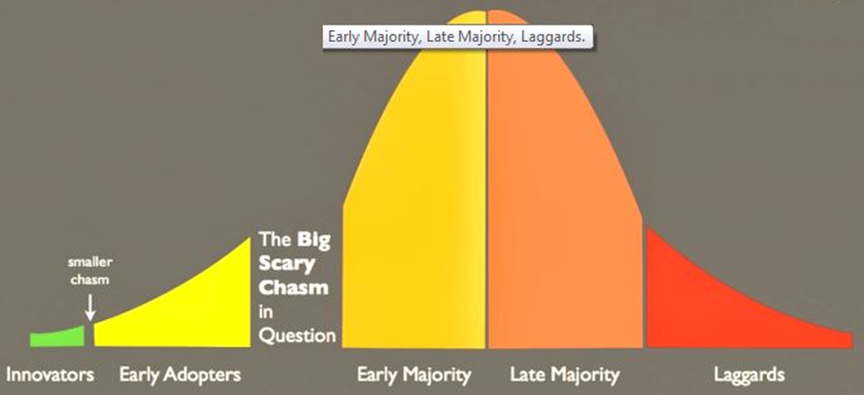
Adopting and implementing health technologies in healthcare organizations—or any other industry—can be a cumbersome activity. The process of adopting or implementing technological advancements in health care also varies among organizations although it occurs along a predictable continuum. Importantly, the launch of a new technology is often met with different reactions from groups among the adopters as well as people whose problems they are trying to solve. This difference in individual or group opinions led to the categorization of health innovation users into: (a) care users who adapt at the earliest stages (commonly known as innovators) (b) those in the early majority (early adopters) (c) early majority (d) those in the late majority, and (d) laggards, who resist the adoption idea and process. The categorization shows that different people try new products at varying speeds.
Figure 2.6: Five (5) Types of Adopters
Source: Adapted from the Diffusion of Innovation Theory (Rogers., 2003)
As shown in Figure 2.6, there are different reasons for the various rates of adapting health innovation. Many adopters emphasise cost as a major determinant factor. Some people’s reaction towards adapting new technologies are controlled by the level of trust they have on the innovation. Thus, they need some time to analyse the circumstances and ask questions before bringing them into their own practice. Others feel quite comfortable with their current technology and work process and are not willing to change. The difference in adoption rate creates inconsistency and disrupts coordination of technology adoption across the healthcare industry. The wide gap between innovators and laggards is a point of reference to the identified theories of innovation in healthcare management—the disruptive and non-disruptive models. Healthcare organizations using innovative management approaches are already exploiting new ways of leveraging technologies like virtual reality to improve patient interactions whereas the conservative organizations disputing the change management process remain in their current form which does not align with patient-centred care philosophy (Pande & Maas., 2013; Larisch et al., 2016).
Challenges to Adapting Innovation in Healthcare Management
A common cause of barriers to adapting and implementing innovation in healthcare organizations is because most systems are not designed to communicate with others. This scenario makes it hard for health providers using different technological platforms to share patient’s health information or transfer data to other systems/people within the healthcare ecosystem. The impact of this barrier to large-scale innovation can be quite expensive and wasteful, especially at a time when the healthcare industry is expanding through mergers and acquisitions at an unprecedented pace (Huang et al., 2021).
Secondly, transition from when creative ideas is first documented to the time of clinical practice is further delayed because healthcare systems with different technological approaches find it hard to collaborate with others in the fast-paced industry. This implies that health managers adapting innovation culture should ensure that unsynchronized systems are standardized. That way, technology transfer process can take place to enable improvement in the efficiency of treatment plans and effectiveness of health care services (Secundo et al., 2019).
Leave a Reply