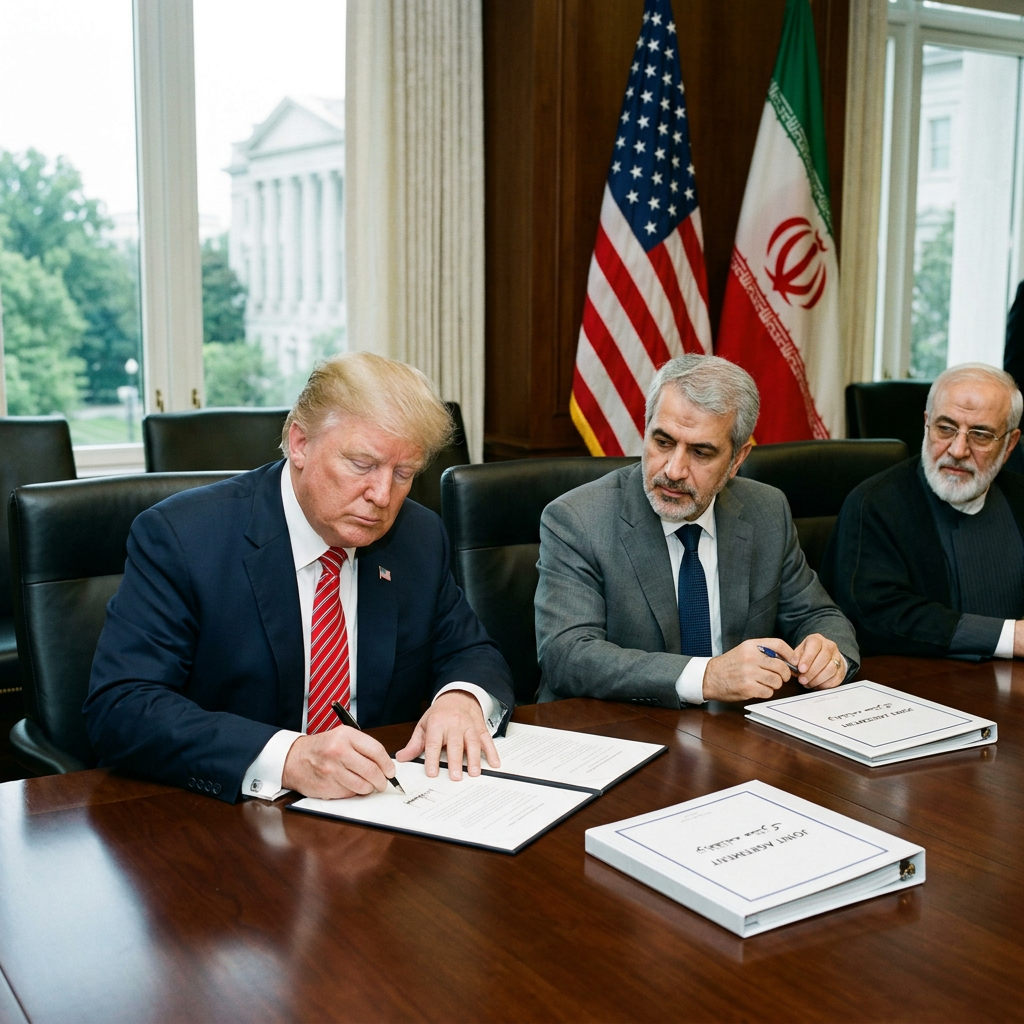
Trump’s Iran Agreement Reshapes Washington Debate
American newspapers today are dominated by coverage of President Donald Trump’s controversial agreement with Iran, which formally ends the 110-day conflict between the two countries while opening a 60-day negotiation period aimed at producing a broader settlement.
According to reports examining the agreement, Iran would retain its existing nuclear infrastructure under a monitoring framework, receive access to frozen assets, and participate in a major reconstruction and investment package. Critics argue that the agreement grants Tehran substantial benefits while obtaining relatively few concrete concessions in return.
The debate has split both political parties. Congressional Democrats have questioned whether the war ultimately achieved its objectives, while several Republicans have expressed concern that the agreement resembles the type of diplomacy many conservatives spent years opposing.
Trump has vigorously defended the agreement. During efforts to preserve a ceasefire between Israel and Hezbollah, he publicly described urging Israeli leaders to de-escalate, saying: “You just gotta calm down.” The comment quickly became one of the most widely quoted lines in today’s coverage.
Interviews with lawmakers reveal uncertainty about whether voters will view the agreement as a diplomatic achievement or as an expensive compromise reached after months of costly conflict.
Middle East Violence Threatens the Peace Process
Even as diplomats celebrate the agreement, newspapers report that the region remains highly unstable.
Israel-Hezbollah fighting in Lebanon disrupted scheduled peace talks between the United States and Iran and raised fears that the broader settlement process could collapse before substantive negotiations begin.
Lebanese President Joseph Aoun emphasized the importance of ending hostilities, stating that a “comprehensive” ceasefire remains essential before meaningful political talks can move forward. His comments were prominently featured in international and American newspaper reports.
Trump has portrayed the ceasefire as evidence that diplomacy remains possible despite regional tensions. However, military analysts interviewed in major publications cautioned that localized clashes could quickly reignite wider conflict if negotiations stall.
Iranian politics are also entering a period of transition. Reporting from Tehran indicates that influential figures inside the government increasingly view economic recovery as a higher priority than continued confrontation with the West. Parliamentary leader Mohammad Bagher Ghalibaf has reportedly advocated reducing hostilities and focusing on domestic reforms.
The evolving situation has led foreign-policy experts to warn that the coming weeks may determine whether the ceasefire becomes a lasting peace or merely a temporary pause in hostilities.
Federal Reserve Sends a Message on Inflation
Economic coverage today centers on the Federal Reserve and its new chairman, Kevin Warsh.
The Fed left interest rates unchanged, but Warsh’s comments signaled a tougher stance on inflation than many investors expected. Markets reacted negatively as traders reassessed the likelihood of future rate increases.
Warsh repeatedly emphasized the central bank’s commitment to restoring price stability. One line that appeared across multiple business reports was his blunt reminder: “The ‘two’ is the left of the decimal point.” The remark referred to the Fed’s long-standing 2% inflation target and underscored his determination to keep inflation under control.
Business leaders interviewed after the announcement expressed concern that higher-for-longer interest rates could slow investment and hiring. Others argued that a firm anti-inflation stance is necessary to restore confidence in monetary policy.
Several economists quoted in today’s newspapers pointed to structural changes in the economy, including artificial intelligence investment, expanded industrial policy and increased defense spending, all of which may complicate traditional monetary policy decisions.
The uncertainty surrounding future rate decisions remains one of the dominant concerns for investors and consumers alike.
Immigration Expansion Becomes a Defining Domestic Issue
Immigration remains one of the most politically charged domestic stories in the country.
New funding measures dramatically expand federal immigration enforcement capabilities, providing additional resources for border security and deportation operations. Supporters argue that the policy fulfills long-standing promises to strengthen immigration controls. Critics contend that it risks creating new humanitarian and legal challenges.
Interviews published across American newspapers reveal anxiety among immigrant communities, employers and legal advocates who are trying to interpret evolving enforcement policies.
An immigration attorney interviewed in coverage of the changes described the current environment as “confusing for families trying to understand their options,” reflecting broader concerns among immigrant communities.
Business groups have also raised alarms about potential labor shortages in industries dependent on immigrant workers, while local officials continue debating how expanded federal enforcement will affect communities across the country.
Political strategists increasingly view immigration as one of the defining issues heading into future elections, particularly in battleground states where public opinion remains sharply divided.
Republican Divisions Become More Visible
Another major theme emerging from today’s coverage is growing tension within the Republican Party.
Several reports describe frustration among lawmakers who feel sidelined by major foreign-policy decisions. While many Republicans continue to support Trump, some privately question the long-term political consequences of the Iran agreement and other recent decisions.
Newspaper accounts portray a White House increasingly driven by presidential authority rather than traditional consensus-building. The result has been occasional friction between the administration and congressional allies.
One phrase repeatedly highlighted in political reporting captured the administration’s governing style. According to accounts from lawmakers and advisers, Trump reminded critics during policy discussions: “I’m the president and you’re not.”
Political analysts interviewed today suggested that disagreements over foreign policy, government spending and executive authority are likely to intensify as the next election cycle approaches.
The divisions are particularly visible on foreign policy, where competing factions disagree over America’s role in global conflicts, military spending and diplomatic engagement.
Intelligence Leadership Changes Spark Questions
Leadership changes within the intelligence community have generated another wave of headlines.
The administration recently replaced senior intelligence officials amid disagreements over policy direction. The reshuffle has prompted debate about the independence of intelligence agencies and their relationship with the White House.
Several lawmakers interviewed in today’s coverage questioned whether the changes could affect oversight and national-security decision-making. Administration officials, meanwhile, argue that the appointments are intended to improve coordination and strengthen accountability.
National-security experts quoted in newspapers described the developments as part of a broader effort to reshape federal institutions according to the administration’s priorities.
Former intelligence officials interviewed by reporters warned that maintaining public confidence in intelligence assessments will remain critical as geopolitical tensions continue to rise.
Ukraine Continues to Compete for Attention
Although Middle East developments dominate headlines, newspapers continue to devote significant coverage to Ukraine.
Military and diplomatic analysts interviewed today noted that the conflict remains unresolved despite shifting international attention. Discussions about military aid, reconstruction and long-term security guarantees continue to shape U.S. policy debates.
One European security analyst told reporters that “strategic attention is finite,” warning that policymakers must avoid neglecting Ukraine while responding to new crises elsewhere.
Foreign-policy specialists also warned against allowing the focus on Iran to overshadow challenges in Eastern Europe. They argue that decisions made in the coming months could have long-term implications for international security and alliances.
The consensus among many experts interviewed today is that the United States is attempting to manage multiple geopolitical crises simultaneously, stretching diplomatic and political resources.
Economic Concerns Continue to Shape Public Opinion
Despite diplomatic developments overseas, domestic economic concerns remain at the center of political discussion.
Interviews with economists, market analysts and business leaders reveal persistent concerns about inflation, borrowing costs and household affordability. Although some indicators suggest economic resilience, many Americans continue to feel financial pressure.
The Federal Reserve’s latest signals reinforced those concerns. Investors interpreted Warsh’s comments as evidence that interest rates may remain elevated longer than previously expected.
A manufacturing executive interviewed by a business newspaper summarized the challenge facing many companies: “We can plan for higher rates. What’s harder is planning for uncertainty.”
Business owners interviewed in regional newspapers reported caution about expansion plans, while consumers expressed concern about housing costs, debt burdens and everyday expenses.
Political consultants from both parties suggested that economic perceptions may ultimately influence voters more than foreign-policy achievements, making inflation and affordability central political issues heading forward.
Congress Questions the Cost of War
One of the most striking themes in today’s reporting involves congressional reflection on the recently concluded Iran conflict.
Lawmakers from both parties are increasingly asking whether the enormous financial and human costs of the war were justified. Congressional interviews reveal concerns about military spending, reconstruction commitments and the challenge of explaining the outcome to voters.
Several members of Congress expressed concern that the final agreement leaves unresolved questions about Iran’s future behavior, regional influence and nuclear ambitions. Others argued that ending the war itself represents a significant achievement regardless of the imperfections of the settlement.
One congressional aide quoted in coverage described the mood on Capitol Hill as “cautiously supportive but deeply skeptical,” a phrase that captures the broader reaction among many lawmakers.
The Pentagon is expected to seek substantial new defense funding, while lawmakers continue debating how much additional money should be devoted to rebuilding military stockpiles depleted during the conflict.
As America’s newspapers assess the day’s events, one message emerges repeatedly from interviews with politicians, economists, diplomats and security experts: the country is entering a period of significant uncertainty in which decisions made over the next several months may determine both the success of the Iran peace process and the broader direction of U.S. politics and economic policy.
Leave a Reply