Tournament Enters Historic New Era
The 2026 FIFA World Cup continues to dominate global sporting headlines as the first edition featuring 48 teams and 104 matches unfolds across the United States, Canada and Mexico. The expanded format has created more storylines, more matches and a larger global audience than any previous World Cup.
Officials estimate that millions of supporters will attend matches across the three host nations, making it the largest World Cup in football history. Host cities continue to report strong attendance figures and significant tourism activity as fans travel across North America.
FIFA Defends Controversial Hydration Breaks
One of the biggest talking points of the tournament has been the introduction of mandatory hydration breaks.
The measure was implemented to help players cope with summer temperatures across North America, but critics argue that the stoppages interrupt the rhythm of matches and create additional commercial opportunities.
FIFA President Gianni Infantino strongly defended the policy this week.
According to reports, Infantino stated that the hydration breaks are based entirely on player welfare rather than commercial considerations. He emphasized that the decision was made for sporting reasons and insisted that no additional revenue is being generated from the stoppages because commercial agreements were already in place before the tournament began.
The issue has divided players and coaches.
England manager Thomas Tuchel and Uruguay coach Marcelo Bielsa have questioned whether the breaks alter the nature of football, while others support the measure during extreme heat conditions.
Spain coach Luis de la Fuente and Netherlands captain Virgil van Dijk have expressed support for player protection in high temperatures while questioning whether the rule is necessary in cooler venues or indoor stadiums.
Goal Explosion Becomes Tournament Trend
The expanded World Cup has also produced a remarkable increase in scoring.
Statistics from the opening phase of the tournament show that goals are arriving at a much faster rate than during the 2022 World Cup in Qatar. Analysts report that scoring is up by approximately 25 percent compared with the same stage four years ago.
Coaches and analysts have pointed to several possible explanations.
Austria coach Ralf Rangnick attracted attention by describing the official match ball as moving “as fast as a cannonball,” suggesting that goalkeepers are finding it harder to react to shots.
Other contributing factors include:
- Longer stoppage times.
- Additional fatigue caused by summer conditions.
- The expanded 48-team field creating larger gaps between elite and emerging nations.
- Increased protection for attacking players from referees.
Football supporters have generally welcomed the attacking style of play, though goalkeepers have faced increased scrutiny as scorelines continue to rise across the tournament.
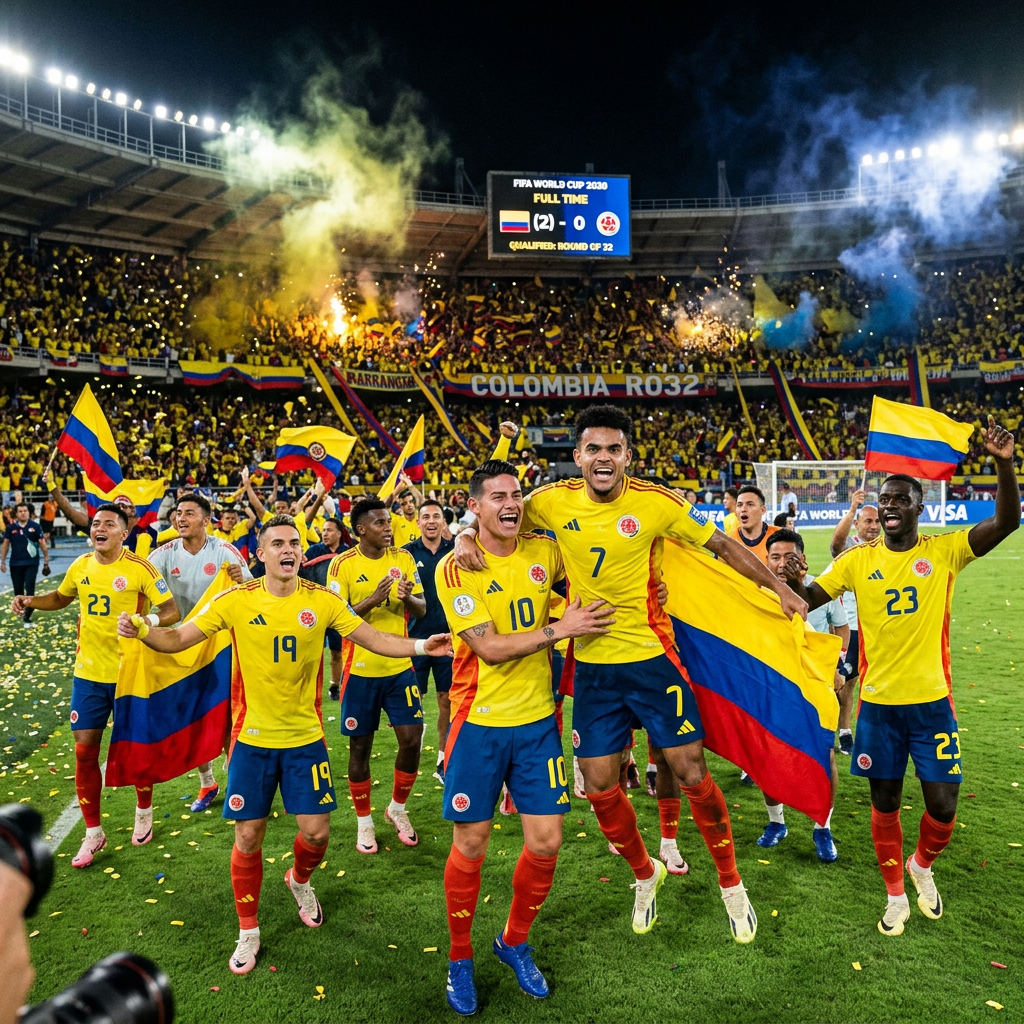
Colombia Among Early Knockout Qualifiers
The race for the Round of 32 continues to develop rapidly.
One of the most notable stories came from Group K, where Colombia secured qualification after defeating DR Congo 1-0.
The victory followed an earlier win against Uzbekistan, leaving Colombia with six points from two matches and guaranteeing progression to the knockout stage regardless of its final group fixture. Defender Daniel Muñoz scored the decisive goal.
The result has increased pressure on several other teams in the group, including Portugal.
Portugal Faces Qualification Pressure
Coverage surrounding Portugal has intensified as the knockout stage approaches.
Led by veteran superstar Cristiano Ronaldo, Portugal entered the tournament among the favorites but now faces a more complicated path following Colombia’s qualification.
Analysts note that Portugal’s advancement scenario depends heavily on remaining group results, creating additional tension for one of Europe’s traditional football powers.
Ronaldo remains one of the biggest attractions of the tournament, with supporters around the world closely following what may be his final World Cup appearance.
France and Spain Continue as Championship Favorites
As the tournament progresses, bookmakers and analysts continue identifying leading contenders for the title.
Current assessments place reigning European champions Spain and perennial contenders France among the strongest favorites.
Defending world champions Argentina also remain firmly in contention as they seek to become only the third nation in history to retain the World Cup trophy.
England continues attracting strong support among analysts and betting markets, with expectations that the team could make a deep run into the knockout rounds.
Golden Boot Race Begins to Take Shape
Attention is increasingly turning toward the competition for the tournament’s top scorer award.
Among the leading names mentioned by analysts are:
- Kylian Mbappé
- Harry Kane
- Lionel Messi
- Erling Haaland
- Lamine Yamal
Messi has once again emerged as a major storyline. Reports indicate that his goals have played a decisive role in keeping Argentina among the tournament favorites.
The high-scoring nature of the competition has made predictions particularly difficult, with several unexpected stars also emerging during the group stage.
Expanded Format Producing Surprise Results
The new 48-team format has created opportunities for nations that previously struggled to qualify for the World Cup.
Analysts have highlighted strong performances from several emerging football countries, contributing to one of the most unpredictable tournaments in recent memory.
The format allows the top two teams from each group, along with the best third-place finishers, to advance to the knockout stage. This structure has kept qualification hopes alive for a larger number of nations deep into the group phase.
Football experts note that the wider field has introduced new styles of play and fresh narratives that were less common in previous editions of the tournament.
Host Cities Report Strong Fan Turnout
Host cities across Canada, Mexico and the United States have reported significant visitor numbers as supporters travel between venues.
The tournament’s unprecedented geographic scale has become one of its defining features. Fans have embraced the opportunity to experience football across multiple countries and cultures during a single World Cup.
The event is being staged across 16 host cities and three countries, making it the largest logistical undertaking in FIFA history.
Local organizers have praised the atmosphere around fan zones, public viewing areas and stadium precincts. Hotels, restaurants and transportation providers in several cities have reported increased activity linked to the tournament.
Commercial Success Exceeds Expectations
Tournament organizers and sponsors are reporting strong commercial results.
Merchandise sales, television audiences and digital engagement figures have all exceeded early projections. Broadcasters across Europe, Africa, Asia and the Americas continue reporting strong viewership as fans follow both traditional football powers and emerging nations.
Corporate sponsors have also increased their activation efforts around stadiums and fan festivals, reflecting the global visibility generated by the expanded competition.
Marketing experts say the three-country hosting model has created new opportunities for sponsors to reach diverse audiences across North America.
Young Stars Capture Global Attention
Beyond established superstars, the tournament has become a showcase for football’s next generation.
Spain’s Lamine Yamal continues attracting worldwide attention with a series of influential performances. Several young players from South America, Africa and Asia have also emerged as breakout stars, earning interest from major European clubs.
Scouts attending matches have described the tournament as one of the deepest collections of young talent seen at a World Cup in decades.
Many coaches have praised the fearlessness displayed by younger players competing on football’s biggest stage.
Refereeing and VAR Continue to Spark Debate
As in previous tournaments, officiating decisions remain a major talking point.
Video Assistant Referee reviews have played important roles in several matches, leading to both praise and criticism from coaches, players and supporters.
Some managers argue that VAR has improved fairness and reduced clear errors, while others believe lengthy reviews disrupt the flow of matches.
FIFA officials maintain that technological assistance remains essential for ensuring accurate decisions in high-pressure situations.
Looking Ahead to the Knockout Stage
With qualification battles intensifying, attention is increasingly shifting toward potential Round of 32 matchups.
The expanded knockout bracket creates new possibilities and increases the importance of final group-stage fixtures. Analysts expect dramatic finishes as teams compete for automatic qualification spots and the remaining places reserved for the best third-place finishers.
Several heavyweight nations remain on course for deep tournament runs, but the early rounds have already demonstrated that surprises are possible in the expanded format.
For now, the major themes of World Cup 2026 remain clear: record crowds, more goals, fierce debates over player welfare, emerging football nations making headlines, and a tournament that continues to redefine the scale of international football.
Leave a Reply