The Ax-3 space mission crew entered the International Space Station (ISS) at 07.16 Eastern Standard Time (ET) (GMT1216) after the docking process on Saturday.
The mission was launched from NASA’s Kennedy Space Center, Florida at 4.49 p.m. ET on Thursday (2149GMT) on a Falcon 9 rocket of private space exploration company SpaceX.
The Dragon capsule, carrying the crew including Türkiye’s first-ever space traveler Alper Gezeravci, docked at the ISS at 05.42 a.m. ET (1042GMT) on Saturday.
The four-person crew will conduct more than 30 scientific researches during their 14-day duty on the ISS.
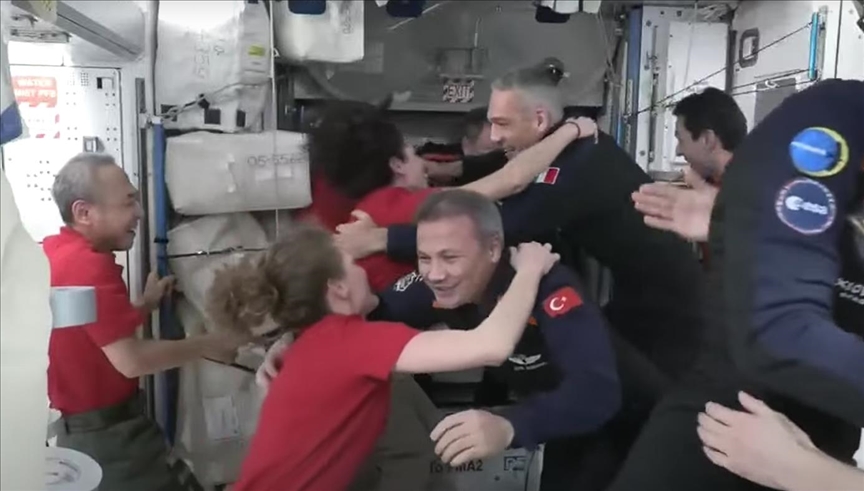
The Ax-3 space mission crew, including Türkiye’s first-ever space traveler Alper Gezeravci, docked at the International Space Station (ISS) at 05.42 a.m. Eastern Standard Time (ET) (1042GMT) on Saturday.
The mission was launched from NASA’s Kennedy Space Center, Florida at 4.49 p.m. ET on Thursday (2149GMT) on a Falcon 9 rocket of private space exploration company SpaceX.
Gezeravci and his three crewmates from Spain, Italy, and Sweden will conduct over 30 scientific experiments and demonstrations on the ISS as part of the Ax-3 mission.
The Ax-3 mission is being led by Michael Lopez-Alegria, representing the US and Spain, while the crew also includes Walter Villadei from the Italian Air Force as the pilot, and Marcus Wandt of Sweden, representing the European Space Agency.
Gezeravci will conduct 13 scientific researches during his 14-day stay on the ISS.
The docking process was planned for Jan. 19 but the liftoff was postponed twice from Jan. 9 to Jan. 17 and Jan. 18.
The 70-meter (230-foot) Falcon 9 rocket, with a diameter of 3.7 meters and weight of roughly 550 tons, has a payload capacity of 22,000 kilograms (over 24 tons) in low Earth orbit, 8,300 kg in geostationary transfer orbit and 4,000 kg on Mars.
The 8.1-meter Dragon capsule, which can carry seven people or an equal amount of cargo in its pressurized area with air flow inside, is capable of carrying cargo in its unpressurized rear section.
As the largest space station, the ISS, built by major space agencies – NASA (US), Roscosmos (Russia), JAXA (Japan), ESA (Europe) and CSA (Canada) – is serving for scientific researches in in low Earth orbit.
Leave a Reply