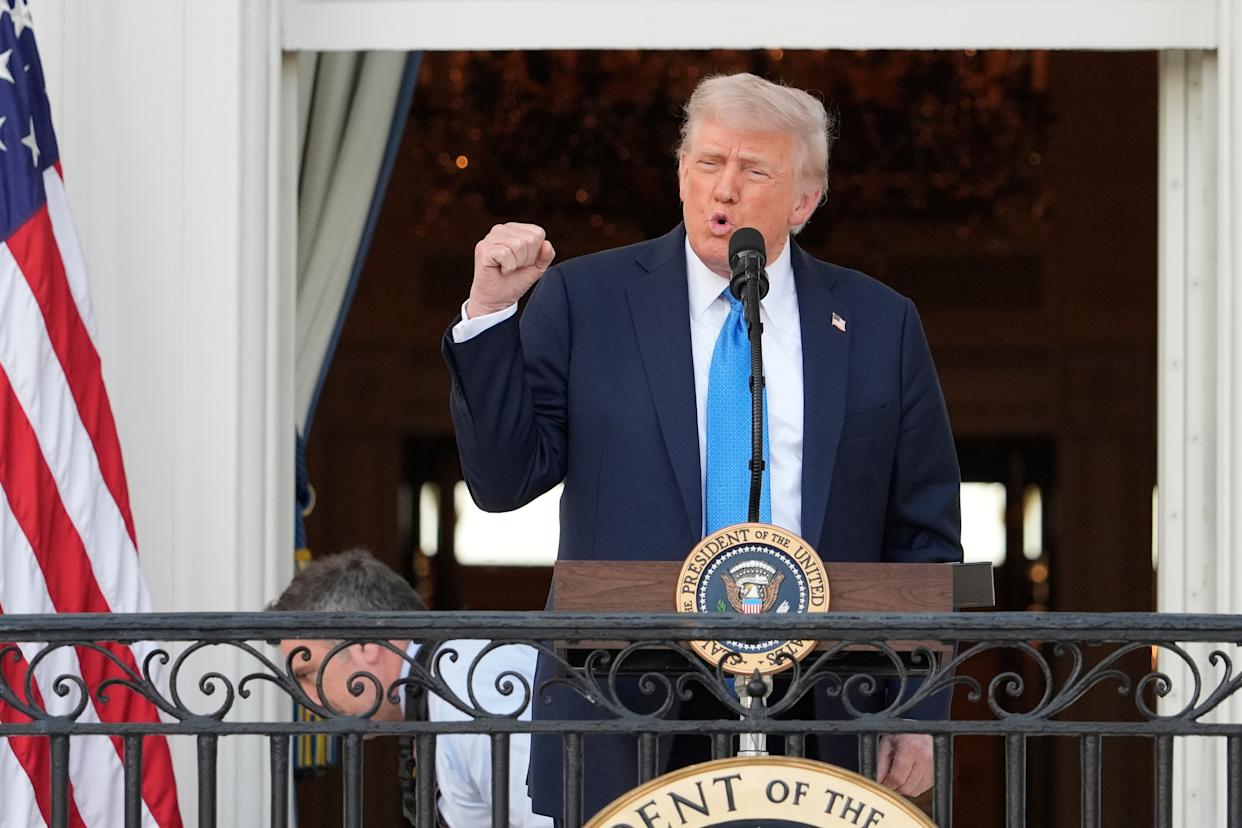
President Donald Trump defended the expansion of data centers in Ohio during a campaign rally on Saturday, arguing that the facilities supporting artificial intelligence projects are important to the United States’ technological and economic future.
Trump made the comments in Vandalia, Ohio, where he campaigned for Republican candidates including Sen. Jon Husted, who is seeking to retain his Senate seat, and Republican gubernatorial candidate Vivek Ramaswamy. The October 3 rally came as Ohio’s 2026 midterm contests have become closely watched races with significant national attention.
Data centers have emerged as a contentious issue in Ohio and other parts of the United States. Supporters point to their role in artificial intelligence development, investment and economic activity, while critics have raised concerns about electricity costs, water consumption, farmland and the potential impact on local communities.
Trump argued that the United States needs to continue developing the infrastructure required to support artificial intelligence rather than allowing other countries, particularly China, to gain an advantage.
He also defended efforts to attract data centers to Ohio, saying the facilities could provide economic benefits to local communities.
The president praised Husted’s work on the issue, particularly his efforts to develop legislation aimed at addressing concerns over the costs associated with large electricity users.
Husted has been closely associated with Ohio’s data-center expansion since his time as lieutenant governor. His supporters have argued that the development can create investment and employment opportunities, while Democrats have criticized the tax incentives and other measures used to attract major technology companies.
The debate intensified after legislation backed by Husted was blocked in the Senate. The proposal sought to require utility regulators to ensure that large power users, including data centers, bear a greater share of the costs associated with the electricity infrastructure they require.
The bill was presented by Husted as an effort to protect ordinary electricity customers from having to absorb costs associated with rapidly expanding data-center operations. However, nearly all Senate Democrats opposed advancing the legislation.
Trump nevertheless continued to defend the broader development of data centers, portraying artificial intelligence infrastructure as an area in which the United States cannot afford to fall behind.
The president’s position has put him at odds with some voters who have become increasingly concerned about the local consequences of data-center construction. Across Ohio, residents and community groups have debated whether the economic benefits of the facilities outweigh concerns about electricity demand, water use and land consumption.
The issue has also become part of the contest between Husted and former Democratic Sen. Sherrod Brown.
Brown and his allies have criticized Husted’s role in attracting data centers to Ohio and have focused on the tax incentives offered to technology companies. Brown has argued that taxpayers and electricity consumers could ultimately bear part of the cost.
In a statement ahead of Trump’s visit, Brown said Husted had “gave billions in tax breaks to Big Tech to make sure they would build their data centers in Ohio.”
Husted’s campaign has presented the issue differently, emphasizing his efforts to ensure that large technology companies contribute more toward the infrastructure they use.
The senator has also argued that his proposed legislation would protect consumers by requiring major power users to shoulder a larger portion of electricity-related costs.
Trump’s intervention gave the data-center debate additional prominence during the Ohio campaign rally. He sought to portray the projects as part of a broader competition over artificial intelligence and technological leadership.
The president has repeatedly argued that the United States needs to expand its energy and computing infrastructure to maintain its position in AI development.
At the Vandalia rally, Trump also sought to portray Ohio’s Republican candidates as closely aligned with his administration and encouraged voters to support them in the November 3 midterm elections.
Husted is facing former Democratic Sen. Sherrod Brown in the Senate race, while Ramaswamy is running against Democrat Amy Acton for governor. Both contests have attracted national political attention.
The Ohio Senate contest has also become one of the most expensive races of the 2026 election cycle, with substantial spending by outside political groups. The outcome could have implications for the balance of power in Washington.
While Trump used the rally to promote Republican candidates, the data-center debate illustrated one of the challenges facing Husted. The senator must defend his record of encouraging technology investment while responding to concerns from voters who fear that new facilities could contribute to higher electricity bills or place pressure on local resources.
The controversy has not been limited to Democrats. Some Ohio Republicans and independent voters have also expressed reservations about data-center development, while others have welcomed the investment and potential economic opportunities.
At the rally, voters expressed differing views about the issue. Some said they were skeptical of large AI facilities, while others supported new development in communities seeking to replace declining industries.
Trump’s defense of the projects therefore comes at a time when data centers have become a significant part of the political debate over Ohio’s economic future.
For Husted, the issue represents both an opportunity to highlight efforts to attract technology investment and a political challenge as opponents continue to question the financial incentives associated with the projects.
Trump’s appearance in Ohio was part of his wider campaign effort ahead of the November midterm elections. His support for Husted and Ramaswamy reflects the importance Republicans place on maintaining their political position in the state, while Democrats are seeking to capitalize on concerns over economic conditions and issues including energy costs.
The data-center debate is likely to remain part of the Ohio campaign as voters weigh competing arguments over technological development, electricity prices, public incentives and the state’s long-term economic priorities.
Leave a Reply