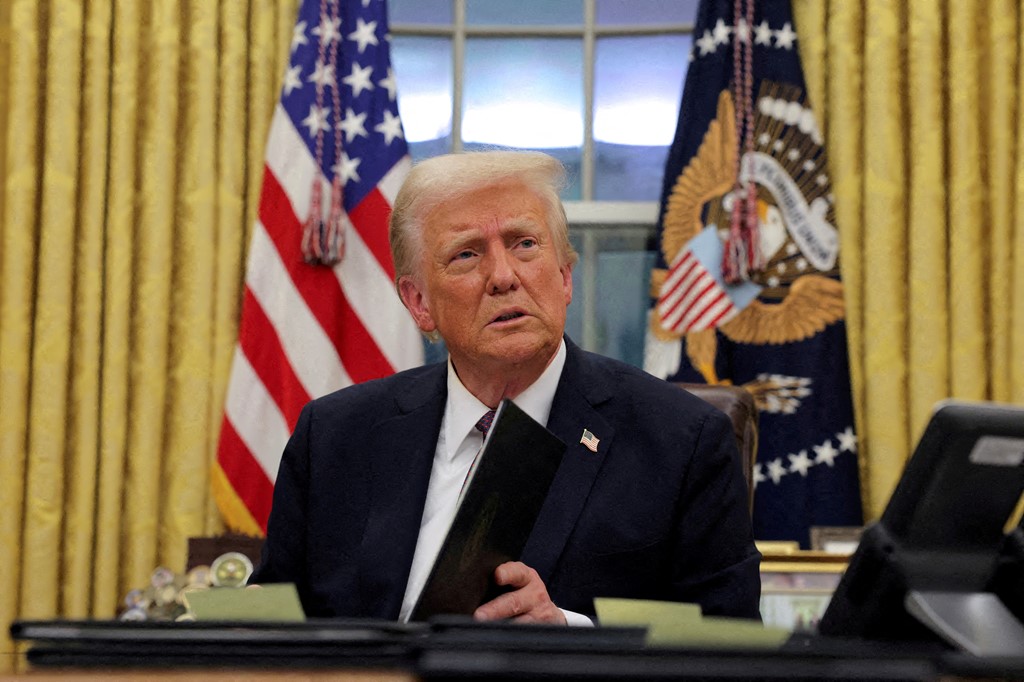
Trump administration faces fresh political battles
President Donald Trump’s administration is facing several major political and legal battles today. Republican Senator Bill Cassidy has backed Todd Blanche’s nomination to become attorney general, giving Blanche the 50th Senate vote needed for confirmation, with Vice President JD Vance expected to cast the tie-breaking vote. Blanche, a former personal lawyer to Trump, has faced opposition from some Republicans concerned about the politicisation of the Justice Department.
Trump is also continuing his efforts to restrict birthright citizenship, despite a Supreme Court ruling concerning the constitutional protection of citizenship under the 14th Amendment. The issue is expected to remain a major legal and political battleground.
Trump moves against Federal Reserve governor
Trump has renewed efforts to remove Federal Reserve Governor Lisa Cook, despite a Supreme Court ruling protecting her position. The dispute is raising fresh questions about presidential authority over the traditionally independent Federal Reserve and the extent to which political pressure can be brought to bear on monetary policy.
The development comes as markets and economists continue to watch the Federal Reserve closely because of persistent inflation pressures and uncertainty surrounding interest rates.
US job market comes under pressure
The American labour market is showing signs of weakness. July employment data have become a major focus of economic discussion after the economy recorded unexpected job losses, raising concerns about whether the labour market is beginning to lose momentum.
At the same time, jobless claims remain relatively low by historical standards, illustrating the mixed picture facing the US economy. Mortgage rates have also risen for five consecutive weeks, reaching about 6.69%, their highest level since July 2025, putting additional pressure on prospective homebuyers.
High fuel prices remain a major concern
American consumers continue to face elevated fuel prices as disruptions linked to the conflict involving Iran affect global energy markets. Although crude oil prices have recently retreated, gasoline and other refined fuels remain expensive because of shortages and constraints affecting refining capacity.
The situation has prompted calls for a windfall tax on oil companies that have benefited from exceptionally high profits. Senators Sheldon Whitehouse and Ro Khanna are among those advocating such a measure, arguing that excess profits could be used to help American families facing higher energy costs.
New tariffs target solar imports
The Trump administration has introduced new trade measures affecting solar energy products. Trump signed an order establishing a 15% tariff on imported polysilicon and solar-related products, alongside minimum pricing requirements intended to protect American manufacturers from cheaper foreign competition.
The measures are part of the administration’s broader effort to use tariffs and trade restrictions to encourage domestic manufacturing. However, the policy could increase costs for companies and consumers involved in the US solar industry.
Senate advances sanctions against Russia
The Senate has passed a sanctions bill targeting Russia and its petroleum trade. The legislation, named after the late Senator Lindsey Graham, is intended to increase economic pressure on Moscow and restrict revenue connected to Russian energy exports.
The measure comes as Washington continues to use sanctions and trade restrictions as part of its broader foreign-policy strategy.
Immigration enforcement remains controversial
Immigration enforcement continues to generate political controversy across the United States. The Trump administration is expanding ICE surveillance and enforcement activities, including intensified operations at airports. Critics have raised concerns about aggressive enforcement practices and the treatment of migrants and protesters.
The future of Temporary Protected Status for Haitian immigrants is another major issue. Thousands of Haitians in the United States face uncertainty following moves to end their protected status, with Springfield, Ohio, among the communities where the issue could have a significant economic and social impact.
Millions of children could face changes to free school meals
Changes to federal food-assistance rules could affect access to free or reduced-price school meals for millions of American children. The changes involve eligibility rules connected to the Supplemental Nutrition Assistance Program, potentially removing an automatic pathway through which some children qualify for school meal assistance.
The issue is attracting attention because it comes at a time when American households are already dealing with higher food, housing and energy costs.
Government spending claims face scrutiny
The Government Accountability Office has found that savings claimed by Elon Musk’s Department of Government Efficiency initiative were overstated. The findings have renewed scrutiny of the administration’s claims about how much money its government-reduction programme has saved taxpayers.
The dispute is part of a larger political argument over federal spending, government efficiency and the scale of reductions being pursued by the administration.
Mining and battery investments receive federal backing
The Trump administration is promoting more than $2 billion in mining and battery investments as part of efforts to strengthen America’s domestic supply chains for strategically important minerals and technologies. The administration views these industries as important to national defence, technological competitiveness and reducing dependence on foreign suppliers.
The investments are part of a broader push to expand domestic production of critical minerals, batteries and other technologies considered important to national security.
Overall picture
The major US stories today centre on Trump’s continuing legal and political battles, pressure on the Federal Reserve, a weakening labour market, high fuel prices, tariffs, immigration enforcement and growing concerns over household costs.
The administration is simultaneously pursuing an aggressive economic and national-security agenda built around tariffs, domestic manufacturing, energy independence and strategic investment. But the combination of expensive fuel, higher mortgage rates, uncertainty over employment and controversial immigration policies is creating significant political pressure heading into the 2026 midterm election season.
Leave a Reply