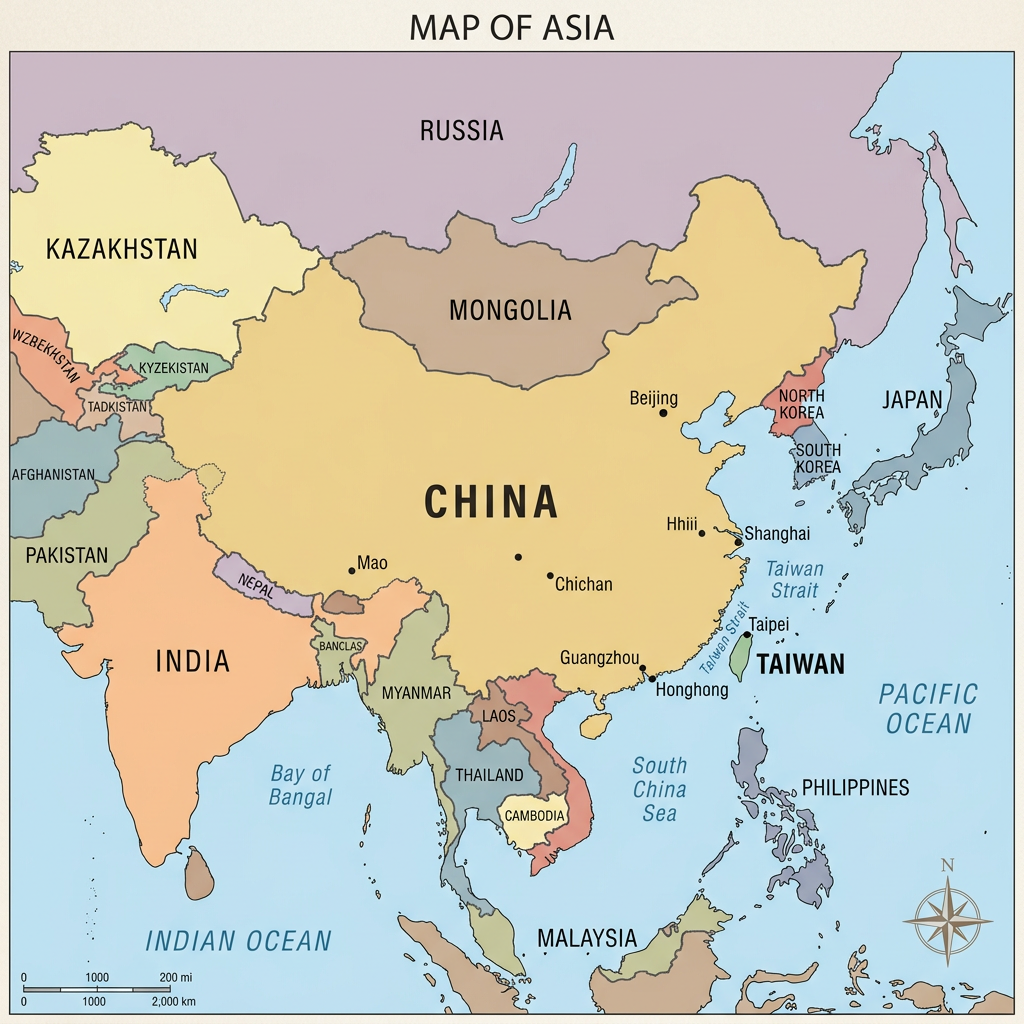
China’s major stories today focus on Communist Party leadership changes, economic investment, clean-energy exports, relations with Germany and the United States, and growing competition in artificial intelligence and advanced technology.
1. China’s Communist Party concludes key meeting amid major anti-corruption shake-up
China’s ruling Communist Party has concluded a major plenary meeting, adopting a resolution focused on strengthening internal discipline and tightening party governance.
The meeting has drawn attention because of the scale of disciplinary action against senior officials. According to Reuters, the gathering formally expelled 33 officials and recorded an unusually high absence rate among Central Committee members, with some absences reportedly linked to anti-corruption investigations and purges.
The military leadership has also experienced significant changes, with several senior figures removed from their positions. The developments highlight President Xi Jinping’s continuing emphasis on political discipline and his campaign against corruption.
The party also set the next Communist Party Congress for the second half of 2027, when a new round of leadership decisions is expected. Reuters+1
2. China issues 800 billion yuan in financial instruments to boost investment
China has completed the issuance of 800 billion yuan in financial instruments intended to expand investment, according to an announcement on the Chinese government’s official news portal.
The move forms part of Beijing’s broader effort to encourage investment and support economic activity. Financial instruments of this kind can help channel funding towards infrastructure, development projects and other areas where policymakers want to stimulate growth.
The announcement comes as China continues to navigate slower economic expansion, domestic demand concerns and international trade pressures. The effectiveness of the investment drive will depend partly on how the funding is deployed and whether it encourages additional private-sector activity. State Council of China+1
3. Germany urges China to pursue fairer economic relations with Europe
German President Frank-Walter Steinmeier has urged China to ensure that its pursuit of economic self-sufficiency does not create excessive dependence on Chinese goods and materials in other countries.
Speaking at Peking University in Beijing on Thursday, Steinmeier raised concerns about the growing trade imbalance between China and Europe. European officials have expressed concern over Chinese exports, state subsidies and restrictions affecting European businesses seeking access to the Chinese market.
Steinmeier said he understood China’s desire to protect its economy from external shocks but warned that greater Chinese independence should not leave other countries more vulnerable.
He stressed that Germany and Europe did not want a new confrontation between economic blocs, arguing that cooperation and dialogue would be better for international security and global economic growth.
The German president is expected to meet Chinese President Xi Jinping on Friday, with trade relations and broader international issues likely to feature in discussions. Reuters+1
4. Chinese clean-energy exports could significantly reduce global emissions
China’s exports of renewable-energy technology are increasing rapidly, potentially delivering substantial reductions in global carbon emissions, according to a report released on Thursday.
The analysis by the Centre for Research on Energy and Clean Air estimates that Chinese solar panels, wind turbines, electric vehicles and batteries exported in 2026 could prevent approximately 450 million metric tonnes of carbon dioxide emissions annually once installed and deployed.
The estimate is roughly equivalent to Brazil’s annual fossil-fuel emissions.
During the first nine months of 2026, Chinese exports increased by 61% for electric vehicles, 45% for wind turbines, 39% for batteries and 22% for solar equipment compared with the same period last year.
Southeast Asia has emerged as a particularly important market, with Chinese clean-energy exports to the region rising sharply. Demand has been encouraged by efforts to reduce dependence on imported fossil fuels and strengthen energy security.
However, China’s dominance in clean technology also creates competitive challenges for manufacturers in other countries. The report’s estimates depend on assumptions about how exported equipment will be used, and independent experts have not independently verified every calculation. Reuters+1
5. China expands investment in artificial intelligence and infrastructure
China’s 800-billion-yuan financial programme is directing substantial funding towards artificial intelligence, the digital economy, green development, urban renewal and other strategic sectors.
According to the government announcement, the funding was fully allocated through three policy banks by October 28. The China Development Bank, Export-Import Bank of China and Agricultural Development Bank of China supported projects intended to attract additional private investment and address financing gaps.
A significant portion of the money is going towards emerging industries, including AI and digital infrastructure. Other projects involve transport, energy systems, urban improvements and the development of advanced industrial capabilities.
The programme reflects Beijing’s strategy of using public financial institutions to stimulate investment in sectors expected to contribute to future economic growth.
The key challenge will be ensuring that the funding produces productive projects, supports private-sector participation and generates sustainable economic returns rather than simply increasing investment volumes. State Council of China+1
6. China’s Belt and Road Initiative faces renewed scrutiny
China’s Belt and Road Initiative, launched by Xi Jinping in 2013, is receiving renewed scrutiny over its economic results, overseas lending and long-term strategic objectives.
An analysis published by Asia Times on Thursday argues that the initiative has shifted away from its original expansive ambitions towards smaller, more commercially focused projects.
The programme was designed to expand international infrastructure through investments in roads, railways, ports, energy facilities and other projects. It also sought to strengthen China’s relationships with developing economies and expand its international influence.
However, some recipient countries have faced difficulties repaying loans, while Chinese financial institutions have also encountered challenges collecting overseas debts. These problems have contributed to criticism of the initiative’s financing model.
China has increasingly emphasised projects involving clean energy, technology, natural resources and commercial returns.
The debate highlights a broader question for Beijing: whether overseas infrastructure investment can continue supporting its global ambitions while limiting financial exposure and addressing concerns among partner countries. The analysis represents a critical assessment rather than a definitive consensus on the initiative’s overall performance. Asia Times+1
7. US moves to restrict Chinese laboratories from testing electronics for American markets
The United States Federal Communications Commission has voted to prohibit Chinese laboratories and certain other foreign testing facilities from certifying electronic devices intended for the US market when their countries deny reciprocal treatment to American testing laboratories.
The decision, reported by Reuters on Thursday, covers products including smartphones, cameras and computers. The restrictions are scheduled to take effect in December 2028.
The FCC said the measure responds to the lack of reciprocal access for US-based testing facilities. The decision represents another development in the broader technological and economic rivalry between Washington and Beijing.
The implications could extend across electronics manufacturing and certification supply chains, given the importance of Chinese laboratories to the testing of consumer devices.
Although implementation remains more than two years away, affected manufacturers and testing organisations may need to assess alternative certification arrangements if the restrictions proceed as planned. Reuters
8. China’s artificial intelligence and semiconductor shares remain under pressure
China’s technology sector continues to face investor uncertainty following a sharp correction in AI and semiconductor stocks.
Reuters reported earlier this week that the STAR 50 index had fallen approximately 40% in less than four months, wiping out hundreds of billions of dollars in market value.
The sell-off reflects concerns about high company valuations, questions surrounding future AI demand and the possibility of additional restrictions on Chinese technology suppliers in international markets.
The downturn has affected investors who had bought into expectations of rapid growth in domestic AI development and semiconductor manufacturing.
Despite the correction, China continues to invest heavily in artificial intelligence, advanced computing and semiconductor capabilities. The government’s latest investment programme also directs funding towards AI and the digital economy.
The central issue for investors is whether future earnings and technological progress will justify the valuations previously assigned to many companies in the sector. Reuters+1
Leave a Reply