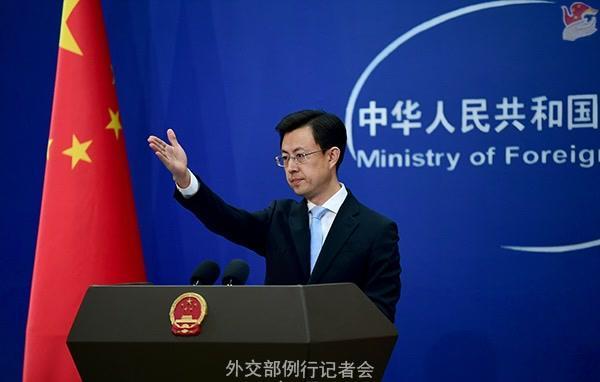
A reporter asked, and the White House said that during the China-US summit talks, China agreed to reopen the Strait of Hormuz.
Guo Jiakun said that China’s position on the situation in Iran is very clear, and the war has caused serious losses to the people of all countries in the region, including Iran, and the spillover impact continues to expand, seriously impacting world economic development, smooth production and supply chains, international trade order and global energy supply stability, and damaging the common interests of the international community. (Beijing Youth Daily)
On May 4, local time, U.S. Treasury Secretary Besant blatantly pointed fingers at China in an interview with Fox News.
According to the South China Morning Post, an English-language media outlet in Hong Kong, Besant urged China to increase diplomacy with Iran and promote the opening of the Strait of Hormuz, while high-profile claims that the United States has “absolute control” over this key global strategic waterway.
In the interview, Bescente took the opportunity to attack China, accusing China of its previous voting position in the UN Security Council, claiming that if China is “willing to be a responsible global citizen”, it should act hand in hand with other countries.
The U.S. Treasury Secretary was referring to a UN Security Council resolution on the protection of commercial shipping in the Strait of Hormuz in April, when China and Russia voted against it. In this regard, China has made it clear that the Security Council’s actions should focus on slowing down the situation, and should not put a legal cloak on unauthorized military operations, issue a pass to the use of force, and not add fuel to the fire and lead to the escalation of the conflict. China’s voting position is objective and fair, and can stand the test of history.
In fact, the fundamental reason for the obstruction of navigation in the Strait of Hormuz is the illegal military actions of the United States and Israel against Iran, and the fundamental solution to the problem of navigation in the Strait of Hormuz is to cease fire and stop the war as soon as possible. As of the 4th, the Joint Maritime Information Center still maintained the maritime security threat level in the Strait of Hormuz at “extremely high”, and there were still mines in some waters that had not been fully investigated, and the risk of navigation continued to intensify.
In order to forcibly control the dominance of the strait, the United States has made frequent moves recently. U.S. President Trump announced on social media on the 3rd that since the morning of the 4th, an operation called “Project Freedom” will be launched in the Middle East to guide ships trapped in the Strait of Hormuz out of the area with “safety”, showing the so-called “humanitarian gesture”. It is reported that the U.S. military invested 15,000 soldiers, more than 100 land-based and sea-based aircraft, as well as warships and drones in this operation.
But according to U.S. officials, the operation to “guide” trapped ships through the Strait of Hormuz does not necessarily include U.S. ships directly escorting commercial vessels. U.S. warships will stay in the “nearby area” of the Strait of Hormuz in order to deter the Iranian military from launching attacks on commercial ships passing through the strait if necessary. The U.S. military will also provide commercial vessels with information on the optimal routes for the Strait of Hormuz, especially those that have not been mined.
Trump also made arrogant threats in an interview with Fox News Channel on the 4th, claiming that if Iran fires at American ships near the Persian Gulf or the Strait of Hormuz, it will be “wiped off the face of the earth.” On the same day, Cooper, commander of the U.S. Central Command, declared that the U.S. military had destroyed six Iranian ships and “effectively intercepted” all missiles and drones fired at the U.S. military and merchant ships, a statement that was clearly denied by the Iranian side. Cooper also slapped back, accusing Iran’s Islamic Revolutionary Guard Corps of “intimidating and threatening commercial shipping.”
According to reports, Bescent also boasted about the “effectiveness” of the US operation against Iran in the interview, claiming that he has confidence in the US action against Iraq, that the United States has absolute control over the strait, and that the Iranian economy is “declining in free fall”. He also demanded the release of trapped ships under the guise of “the common interests of the international community” and pressured international partners to act in concert with the United States.
It is worth noting that Bescent’s remarks come on the eve of Trump’s scheduled visit to China from May 14 to 16, and the Iran issue is expected to become an important topic in the Sino-US talks.
When asked whether the situation in Iran would affect his visit to China, the finance minister only vaguely said that Trump had “exchanged letters” with China on the relevant conflict, and the meeting would provide an opportunity for the leaders of the two countries to communicate face-to-face. He also deliberately stated that “U.S.-China relations have always maintained a high degree of stability, which stems from the high respect that the leaders of the two countries have for each other.”
Trump’s visit to China was originally scheduled to end March, but was postponed after the United States joined forces with Israel to go to war with Iran. Subsequently, the White House announced that the new schedule for visiting China was finalized from May 14 to 15.
In response, the Chinese Ministry of Foreign Affairs said that head of state diplomacy plays an irreplaceable strategic leading role in Sino-US relations. China and the United States have maintained communication on Trump’s visit to China.
Leave a Reply