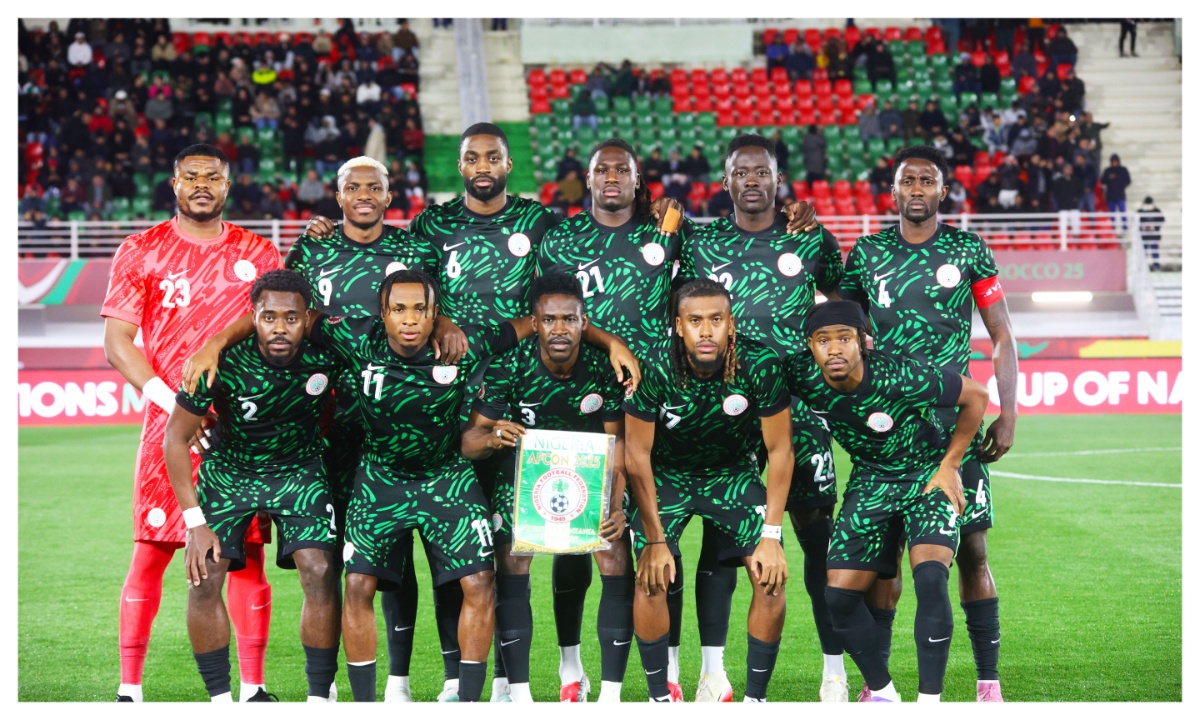
Nigeria’s hopes of qualifying for the 2027 Africa Cup of Nations (AFCON) have suffered a significant setback following a disappointing run of results that has left the Super Eagles three points behind Group L leaders Guinea-Bissau, with only two qualifying matches remaining.
The three-time African champions are now facing a difficult qualification battle after failing to secure a victory against Tanzania in their November fixtures. A 0-0 draw against the Taifa Stars in Zanzibar on November 17 denied Nigeria an opportunity to strengthen its position, while Guinea-Bissau moved further ahead with a 2-0 victory over Madagascar on the same day.
The contrasting results have left Nigeria with seven points from four matches, compared with Guinea-Bissau’s 10 points. Although the Super Eagles remain mathematically capable of qualifying, their fate is no longer entirely in their own hands. They must win their remaining fixtures and potentially rely on favourable results elsewhere to secure a place at the tournament.
The situation has generated considerable concern among Nigerian football supporters, particularly because the country has reached the final of the last two AFCON tournaments. Missing the 2027 competition would represent a major disappointment for a national team that has traditionally been among Africa’s strongest football nations.
Guinea-Bissau Establish Three-Point Advantage Over Nigeria
Guinea-Bissau have emerged as Nigeria’s principal rivals for the available qualification place in Group L after collecting 10 points from their opening four matches.
Their impressive campaign has been built around consistent results, including a convincing 3-0 victory over Nigeria in Bissau on September 29. That defeat remains one of the most damaging results of the Super Eagles’ qualifying campaign because it gave Guinea-Bissau both a three-point advantage and a significant head-to-head goal difference.
Nigeria began its campaign with a 2-1 victory over Madagascar on September 25, raising expectations that the team would establish an early advantage. However, the subsequent defeat to Guinea-Bissau exposed defensive weaknesses and left the Super Eagles needing to recover lost ground.
The team responded with a 3-1 victory over Tanzania in Uyo on November 13. The result appeared to put Eric Chelle’s men back on course, but their inability to reproduce that performance in the return fixture proved costly.
The November 17 encounter in Zanzibar ended without a goal despite Nigeria creating several promising scoring opportunities. Guinea-Bissau subsequently strengthened their position by defeating Madagascar 2-0, leaving Nigeria three points behind the group leaders.
Following the fourth round of matches, the Group L standings were:
| Position | Country | Matches | Points | Goal difference |
|---|---|---|---|---|
| 1 | Guinea-Bissau | 4 | 10 | +7 |
| 2 | Nigeria | 4 | 7 | 0 |
| 3 | Madagascar | 4 | 2 | -3 |
| 4 | Tanzania | 4 | 2 | -4 |
Tanzania have already secured automatic qualification as one of the tournament’s co-hosts alongside Kenya and Uganda. Consequently, only one additional qualification place is available from Group L for the other participating countries.
Madagascar’s maximum possible points total is eight, meaning the country can no longer overtake Guinea-Bissau. The remaining qualification contest is therefore effectively between Nigeria and Guinea-Bissau.
Eric Chelle Admits Nigeria Are in Trouble
Super Eagles coach Eric Chelle has acknowledged the difficult position facing his team following the disappointing draw against Tanzania.
Speaking after the match in Zanzibar, the Franco-Malian coach admitted that Nigeria’s qualification prospects had become more complicated, particularly after Guinea-Bissau defeated Madagascar.
Chelle said:
“We are in trouble because if they (Guinea-Bissau) win, we have to score many goals at home, we have to win in Madagascar… We have to wait until Guinea-Bissau plays to understand our position, this is why we are in trouble.”
He further explained the implications of Guinea-Bissau’s result, saying:
“If they win, we have to win the remaining two games and after both games we’d still be in the same situation.”
The coach’s comments reflect the growing pressure on the Super Eagles as they prepare for the decisive March 2027 fixtures.
Nigeria’s inability to convert opportunities against Tanzania has also raised questions about the team’s attacking efficiency. Although the Super Eagles enjoyed promising attacking spells, they failed to produce the decisive finish required to collect maximum points.
Chelle has defended his tactical approach, pointing to the physical demands of the international schedule and the conditions under which the team played. Nevertheless, the remaining matches will require greater precision, attacking aggression and defensive discipline.
Missed Opportunities Against Tanzania Complicate Qualification
The two November encounters against Tanzania were expected to provide Nigeria with an opportunity to strengthen its position in Group L.
The Super Eagles won the first meeting 3-1 in Uyo on November 13, demonstrating their attacking potential and securing three important points. However, the return fixture in Zanzibar produced a frustrating goalless draw.
Nigeria created opportunities during the second encounter but struggled to find the net against a disciplined Tanzanian defence.
One of the clearest opportunities came when striker Tolu Arokodare was played through by Moses Usor. After beating goalkeeper Aishi Manula, Arokodare’s effort struck the post rather than finding the net.
The missed opportunity illustrated the difference between controlling an attacking situation and converting it into a goal.
Nigeria also encountered difficulties breaking down Tanzania’s defensive organisation as the match progressed. The inability to score was particularly damaging because Tanzania had already secured their place in the tournament as co-hosts.
The result meant Nigeria surrendered an opportunity to put additional pressure on Guinea-Bissau before the latter’s match against Madagascar.
The 2-0 victory subsequently recorded by Guinea-Bissau widened the gap and made the Super Eagles’ qualification calculations considerably more complicated.
Why the 3-0 Defeat to Guinea-Bissau Could Determine Nigeria’s Fate
One of the biggest obstacles confronting Nigeria is the 3-0 defeat suffered against Guinea-Bissau in September.
The result has created a substantial head-to-head disadvantage that could become decisive if both countries finish the group with the same number of points.
Under the Confederation of African Football’s competition regulations, head-to-head results are considered before overall group goal difference when two teams finish level on points.
The relevant tie-breaking considerations include points obtained in matches between the tied teams, goal difference in those encounters and away goals scored in the direct meetings, followed by overall group goal difference and other criteria.
This means Nigeria cannot simply concentrate on winning its remaining matches. The margin of victory against Guinea-Bissau could also become extremely important.
If the Super Eagles defeat Madagascar and Guinea-Bissau, they will finish with 13 points. Guinea-Bissau could also reach 13 points if they defeat Tanzania before losing to Nigeria.
In that situation, the first meeting between the countries would become crucial.
Because Guinea-Bissau won 3-0 in September, Nigeria would need to win the return fixture by at least four clear goals to secure a superior head-to-head goal difference.
For example, a 4-0 victory in Uyo would give Nigeria a 4-3 aggregate advantage over the two meetings.
A 3-0 victory would leave the aggregate score level at 3-3, requiring the competition’s subsequent tie-breaking criteria to be applied.
The challenge is therefore considerably greater than simply defeating Guinea-Bissau. Nigeria may need a convincing performance capable of overturning the damage caused by the September defeat.
Nigeria’s Remaining AFCON 2027 Qualifying Fixtures
The Super Eagles have two decisive matches remaining in their Group L campaign, both scheduled for March 2027.
The first will be an away encounter against Madagascar on March 24, followed by a potentially decisive home meeting with Guinea-Bissau on March 28.
The Madagascar fixture is particularly important because Nigeria cannot afford another disappointing result before facing the group leaders.
Although Madagascar have been eliminated from contention for the available qualification place, they remain capable of affecting the outcome of the campaign by taking points from Nigeria.
The Super Eagles must therefore approach the encounter with maximum concentration rather than assuming that Madagascar will provide an easy opponent.
The subsequent match against Guinea-Bissau will probably determine Nigeria’s qualification fate.
Playing at home in Uyo could provide the Super Eagles with an advantage, particularly with supporters expected to create a strong atmosphere. However, the team must demonstrate considerably better attacking efficiency and defensive organisation than it displayed in the first meeting.
The players will also need to manage the psychological pressure associated with a match that could determine whether Nigeria participates in the continental competition.
Qualification Scenarios: What Nigeria Must Do to Reach AFCON 2027
Nigeria’s qualification possibilities depend on the outcomes of its remaining fixtures and Guinea-Bissau’s encounter with Tanzania.
The most favourable route involves winning both remaining matches and hoping Guinea-Bissau drop points against Tanzania.
A victory in Madagascar followed by a win against Guinea-Bissau would take Nigeria to 13 points. If Guinea-Bissau lose or draw against Tanzania, Nigeria would have a stronger opportunity to finish ahead of them.
However, if Guinea-Bissau defeat Tanzania, both countries could finish with 13 points after Nigeria’s victory in the final meeting. The head-to-head tie-breakers would then become decisive.
The possible outcomes illustrate the pressure facing the Super Eagles:
Two victories: Nigeria would finish with 13 points. This is the strongest available route, although the final result against Guinea-Bissau and the outcome of the Tanzania fixture could determine whether 13 points are sufficient.
One victory and one draw: Nigeria would finish with 11 points. Qualification would become more complicated and would depend on Guinea-Bissau losing to Tanzania before subsequently losing to Nigeria.
One victory and one defeat: Nigeria would finish with 10 points. Their chances would be extremely limited and would depend on a favourable combination of results and tie-breaking calculations.
Two draws or fewer: These outcomes would leave Nigeria with nine points or fewer and make qualification increasingly unlikely.
The safest strategy is therefore to secure all six available points while improving the team’s goal difference and preparing for the possibility of a tie with Guinea-Bissau.
Defensive and Attacking Weaknesses Raise Concerns
Beyond the qualification calculations, the Super Eagles must address several weaknesses that have contributed to their difficult campaign.
The 3-0 defeat against Guinea-Bissau exposed defensive problems that the coaching staff must resolve before the decisive March matches.
Nigeria’s defensive organisation, coordination between the midfield and backline, and ability to manage opposition counterattacks will be important factors in the remaining fixtures.
The goalless draw against Tanzania also exposed concerns about attacking efficiency. Creating opportunities without converting them into goals is particularly costly in a qualification campaign where every point matters.
The Super Eagles possess considerable attacking talent, including players capable of changing matches through individual quality and movement. However, the team must translate that potential into consistent performances.
The coaching staff will also need to make effective decisions concerning player selection, substitutions and tactical adjustments.
The March international window will provide little room for experimentation because both matches could determine the country’s participation in the tournament.
Missing AFCON 2027 Would Be a Major Setback for Nigerian Football
Nigeria’s potential failure to qualify for AFCON 2027 would represent a significant setback for the country’s football ambitions.
The Super Eagles are three-time African champions, having won the competition in 1980, 1994 and 2013. They have also maintained a strong presence in the tournament over several decades.
Their appearance in the finals of the 2023 and 2025 editions reinforced expectations that Nigeria would remain among the leading contenders for the continental title.
Consequently, missing the 2027 competition would be more than an ordinary qualification disappointment. It would raise questions about the effectiveness of the team’s preparation, technical direction and ability to manage competitive pressure.
Participation in AFCON also provides important opportunities for players to demonstrate their abilities on the continental stage, strengthen their international profiles and compete for major honours.
For Nigerian supporters, the tournament represents an important part of the country’s sporting identity.
The pressure on Chelle and his players will therefore extend beyond securing qualification points. They will also be expected to restore confidence in a team that has struggled to deliver consistent performances during the campaign.
Super Eagles Must Deliver in March to Avoid Qualification Disaster
Nigeria still have an opportunity to rescue their AFCON 2027 campaign, but the Super Eagles can no longer afford the mistakes that have placed them in their current position.
The three-point gap behind Guinea-Bissau, the damaging September defeat and the inability to defeat Tanzania away from home have combined to make qualification significantly more difficult.
The immediate priority must be winning against Madagascar before returning to Uyo for the decisive encounter against Guinea-Bissau.
Chelle must also ensure that the team improves its attacking efficiency, strengthens its defensive organisation and approaches the final fixtures with a clear understanding of the qualification calculations.
The Super Eagles have the experience and individual quality to compete for the available ticket, but their performance in March will determine whether those qualities translate into qualification.
For a country with Nigeria’s football history and continental ambitions, missing AFCON 2027 would be a disappointing outcome. The team must now turn its remaining opportunities into results and demonstrate that it can respond effectively when its qualification prospects are under serious pressure.
Leave a Reply