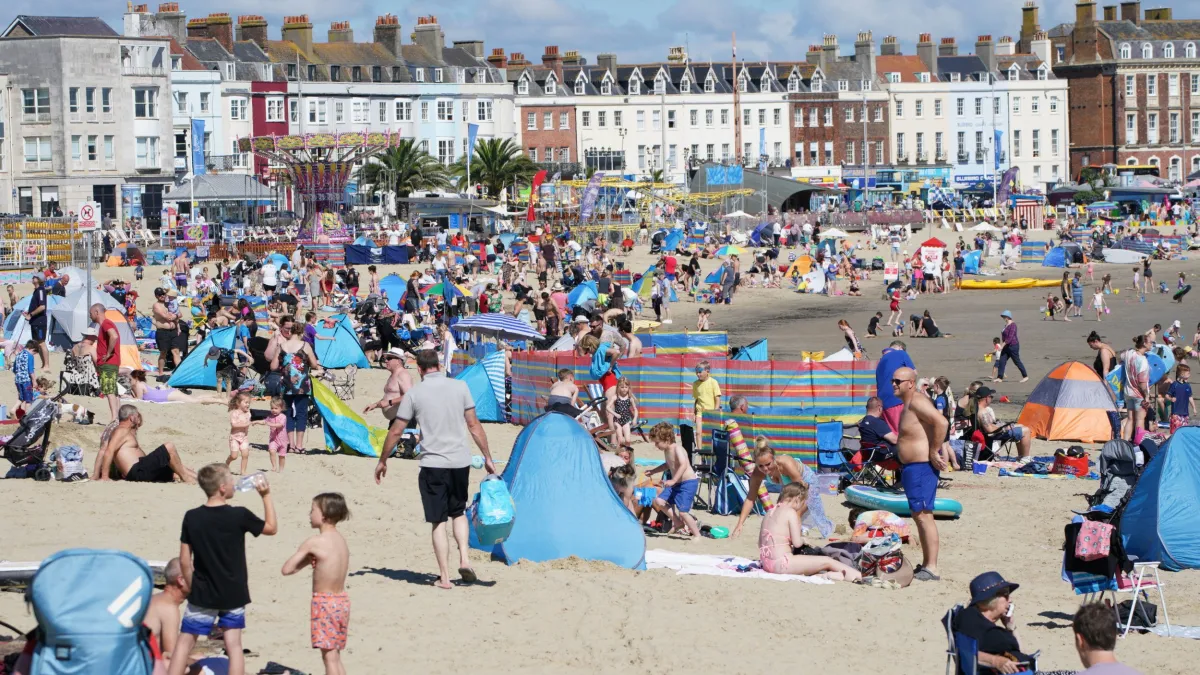
Extreme heat warnings blanketed New York, Boston, and Philadelphia on Wednesday as sweltering conditions pushed eastward, arriving just in time for Fourth of July festivities across a region that takes pride in its historical significance to American independence.
Forecasters are calling for temperatures in the upper 90s across the Northeast, with Philadelphia and Boston potentially breaching the 100-degree mark by Thursday. When combined with oppressive humidity, the heat index could feel even more intense at times, according to the National Weather Service. A stubborn heat dome — a high-pressure system that traps heat and moisture over a region — has been parked over large swaths of the country from the Midwest to the East Coast, threatening to turn anniversary parades, ship flotillas, outdoor concerts, and Boston’s beloved balcony reading of the Declaration of Independence into sweaty affairs.
New York Mayor Zohran Mamdani urged residents to seek shelter indoors and avoid the worst of the heat. “To be breaking into triple digits over the course of these many next days — it is of immense concern given that too often the heat is something that is underestimated,” Mamdani said.
The dangerous conditions have already taken a toll. In Hamptonburgh, New York, an air conditioning failure on a bus carrying Junior ROTC cadets led to multiple heat-related illnesses, with some cadets taken to hospitals as a precaution, Orange County authorities reported.
While humidity is nothing new to the Northeast, Dr. Alexander Azan of NYU Langone Health in New York warned that the combination of high air temperatures and moisture creates a particularly hazardous situation. “Their body doesn’t have that level of acclimatization to respond appropriately to the heat, and so heat stress in the form of what we call heat exhaustion, and in more severe cases, heat stroke, can occur at much lower temperatures than we see in people who live in the South,” Azan explained.
Urban areas face heightened risks, experts say. “The concentration of concrete, asphalt, steel, all of those materials help to retain heat,” said Vijay Limaye, a climate scientist at the Natural Resources Defense Council. “The number on your phone may actually not reflect the true temperature profile that you’re going out into”.
New York City has mobilized more than 200 teams of government workers and volunteers to check on homeless individuals and encourage them to seek refuge indoors. Hundreds of cooling centers have been opened across the city, ranging from the massive Javits Center convention hall to mobile vans and outdoor spots equipped with misting fans.
For some, the heat wave is a business opportunity. At Acme Ice Co. in Cambridge, Massachusetts, the phones have been ringing nonstop as bars and restaurants in the Boston area scramble for supplies. Owner Marc Savenor described the stretch of hot weather as an “ice man’s dream.” “What could an ice man ask for? … I’ve hired a couple extra drivers. I’ve put on an extra couple trucks. I put ice in different freezers so I don’t run out,” Savenor said. “After my ice is depleted here, we go pick up another load, bring it back, and we deliver it everywhere”.
Even the city’s four-legged residents are getting relief. The American Kennel Club’s Museum of the Dog in New York is welcoming visitors to bring their pets inside to cool off through Sunday. Executive Director Christopher Bromson said the idea struck him after watching his own Newfoundland sprawl out on the museum’s cool floor. “I thought every dog should have access to this,” he said.
In Washington, D.C., where temperatures hit 95°F (35°C), thirsty children reached for cold water from U.S. Park Police as they waited in line for the Ferris wheel on the National Mall. Meanwhile, heat risks persist across the Midwest. Taylor Harnist, a Cincinnati business owner who installs and repairs air conditioners, said he is struggling to keep his employees safe with frequent breaks, water, and electrolyte drinks. “You get an attic job when it’s this hot, we do them but it’s strenuous,” Harnist said. “It’s so hot the attics will reach temperatures of 145 degrees”.
Jeff Schlegelmilch, associate professor at Columbia University’s Climate School, said extreme heat is among the clearest indicators of climate change. “We have seen a continued increase in longer summers, hotter temperatures, hotter temperatures earlier on, more evaporation of moisture, higher humidity — effects like that,” he said.
Leave a Reply