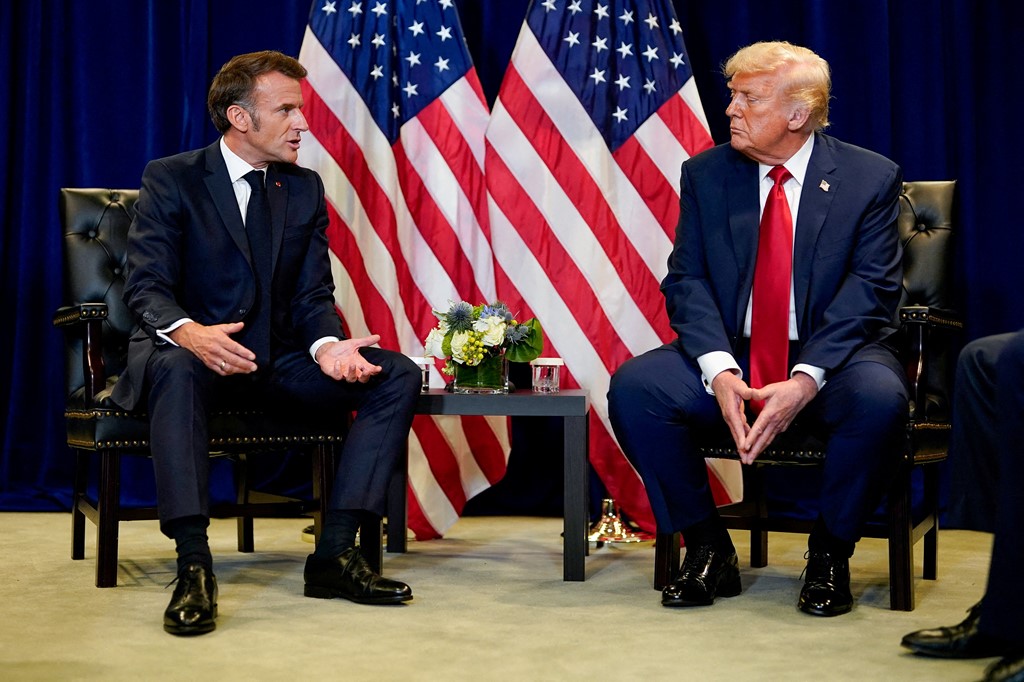
French President Emmanuel Macron on Wednesday called on the U.S. and Iran to coordinate reopening the Strait of Hormuz as they negotiate an end to the conflict.
Iran has effectively stalled traffic through the strait, a vital artery for global oil and energy trade, since the U.S.-Israeli military operation against Iran began Feb. 28 with airstrikes on the regime’s political leadership and military infrastructure.
Iran retaliated after Operation Epic Fury began, targeting Gulf neighbors including the United Arab Emirates, as well as vessels in the strait. The U.S. has since blocked ships from entering or leaving Iranian ports, crippling the regime’s ability to profit from oil production.
Macron, in a post on X, said he spoke with Iranian President Masoud Pezeshkian and expressed “deep concern over the ongoing escalation” while condemning “the unjustified strikes against Emirati civilian infrastructure and several ships.”
“All parties must lift the blockade of the strait, without delay and without conditions,” Macron wrote. “We must durably return to the regime of full freedom of navigation that prevailed before the conflict.”
France earlier Wednesday deployed the Charles de Gaulle carrier strike group to the Red Sea as part of preparations for a potential mission to secure the strait.
France and the United Kingdom have been working on a proposal for several weeks that seeks to lay the groundwork for safe transit through the waterway once the situation stabilizes or the conflict is resolved.
“The multinational mission that France and the United Kingdom have set up can help restore confidence among shipowners and insurers,” Macron wrote. “It will, by its very nature, be distinct from the warring parties.
“The pre-positioning of the aircraft carrier Charles de Gaulle fits within this context.
“Recent events clearly demonstrate the usefulness that such a mission would have. I have invited the Iranian president to seize this opportunity, and I intend to discuss this matter with President [Donald] Trump.
“The return of calm in the strait will help advance negotiations on the nuclear issue, the ballistic issue, and the regional situation. The Europeans, on whom the lifting of sanctions depends, will take their place in this process.”
European nations have been largely onlookers in the conflict, but with Middle East shipping lanes disrupted and oil prices fluctuating around $100 a barrel, European powers are grappling with how to defend their interests.
Their refusal to support Trump’s blockade has drawn sharp criticism from the president, who accused allied nations of failing to align with U.S.-led efforts. The deployment of European assets to the region could help ease those tensions.
Trump on Tuesday paused a U.S. military operation to escort commercial ships through the strait, citing “great progress” in negotiations to end the conflict. Iran reportedly is reviewing a U.S. proposal to end the conflict and is expected to respond through Pakistani mediators.
The proposal’s details remain largely undisclosed, and Iranian state-linked media are downplaying outside accounts, fueling doubts about whether Tehran is negotiating in earnest.
Leave a Reply