It’s Monday, so before we start another week of our coverage, here’s everything you need to know as tensions continue to rise in the Middle East…
Week of escalation
Fears of a wider regional conflict increased over the last week, as cross-border attacks between Israel and Lebanon-based Hezbollah reached new heights.
On Tuesday and Wednesday, pagers and walkie-talkies, widely used by Hezbollah officials, exploded across Lebanon, killing at least 37 people and wounding more than 3,000 others.
Israel’s president denied his country was involved in the coordinated attack, but Hezbollah’s secretary-general blamed Israel and said they had “crossed all the red lines”.
Friday’s airstrike on Beirut, which Lebanese officials said killed 45 people, was claimed by Israel, with the attack demolishing two apartment blocks in the south of the capital.
The Israel Defence Forces (IDF) said it had “almost completely dismantled” Hezbollah’s leadership.
Hezbollah confirmed that Ibrahim Akil, who was in charge of its elite Radwan Force, and Ahmed Wahbi, another senior commander in the group’s military wing, had both died.
Over the weekend, Hezbollah launched rockets into Israel, which it said was in response to “repeated” attacks.
The IDF said it had struck more than 100 Hezbollah targets with its own strikes on Saturday night, hitting launchers and “terrorist infrastructure”.
These exchanges continued into Sunday, with reports that Hezbollah’s rockets reached deeper into Israel’s territory than ever before.
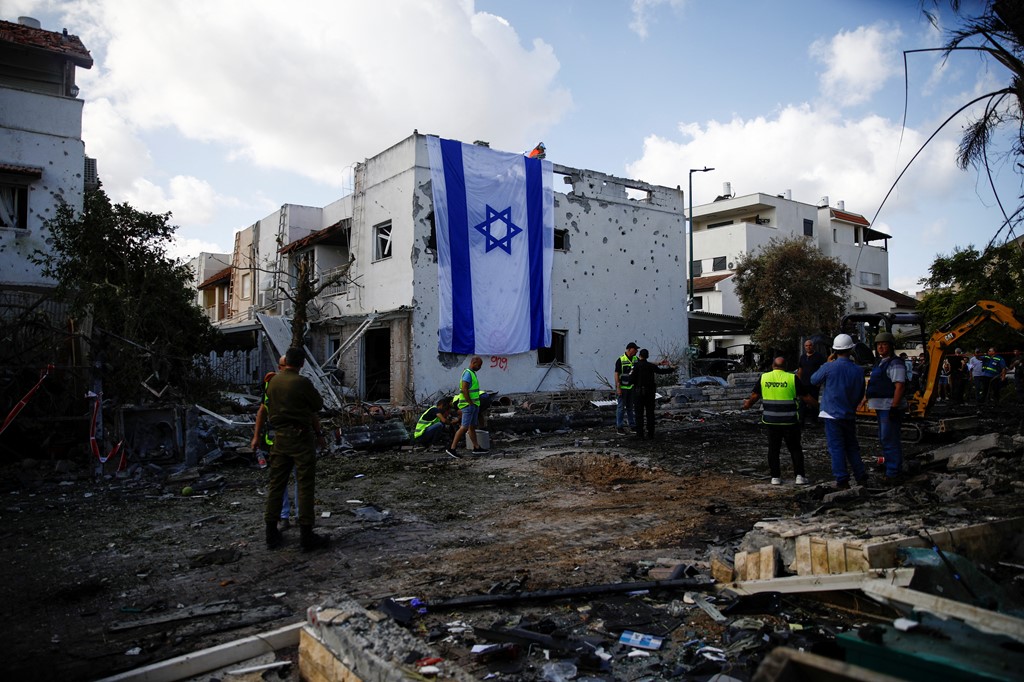
When Benjamin Netanyahu addressed Israelis from his office on Sunday, he said that if Hezbollah hadn’t already understood the message being sent by Israel, it soon would.
Lebanese ambassador to the UK Rami Mortada told Sky News that Israeli “war crimes” have put the region on “the brink of an all-out war”.
Hezbollah’s deputy secretary-general, Naim Qassem, has said that the group had entered a new phase of its battle with Israel, which he described as an “open-ended battle of reckoning”.
Pressure grows on Netanyahu over hostages
There has been mounting anger on the streets of Israel over the government’s approach to bringing hostages home from Gaza.
Protest organisers said hundreds of thousands of people had turned out in Tel Aviv, though there were no official figures.
Protests have been held every Saturday in the city since the first weeks of the war. For months, they were held separately from anti-government protests, but the two joined together after the bodies of six hostages were recovered.
“The people of Israel are voting with their feet in favour of the return of the hostages by way of a deal — the living hostages to rehabilitation and the dead to an appropriate burial in their land,” the Hostages and Missing Families Forum said on Saturday evening.
While some captives have been freed, Hamas is still holding around 100 hostages. Approximately a third of them are believed to be dead.
Israel condemned over Al Jazeera raid
Israeli forces raided the West Bank office of news network Al Jazeera yesterday and ordered it to shut down, the network said.
The early morning raid in the city of Ramallah sparked condemnation, with the Foreign Press Association urging Israel to reconsider and saying the action “threatens press freedom”.
Al Jazeera, a Qatar-funded broadcaster, aired footage of Israeli troops live on its Arabic-language channel ordering the office to be shut for 45 days.
The broadcaster says it “vehemently condemns and denounces the criminal act”.
Leave a Reply