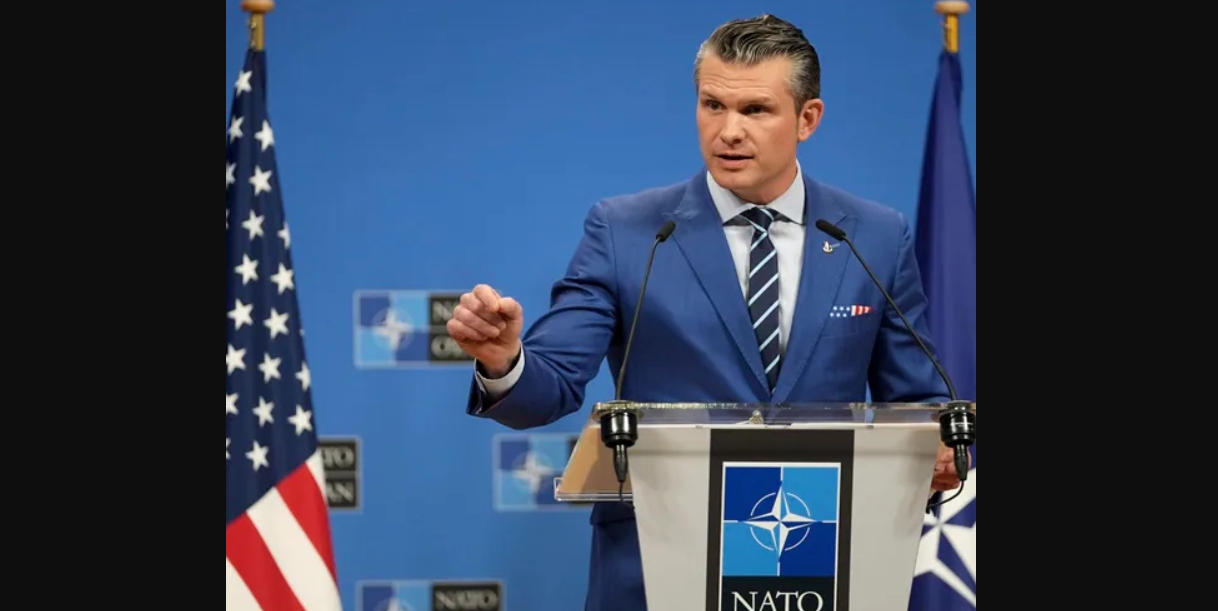
America’s top uniformed and civilian military leaders made their case in the Senate on Tuesday for an emergency funding package of nearly $80 billion to help replenish stockpiles spent during the Iran war and fund other Trump administration priorities.
Democrats were highly skeptical of the request, asking why U.S. taxpayers should continue footing the bill for a war they don’t support — particularly with the Pentagon sitting on billions of unspent funding from the One Big Beautiful Bill Act passed last year. Defense Secretary Pete Hegseth repeatedly pinned the blame on the Biden administration for underinvesting in the military and prioritizing weapons for Ukraine, while admitting the military was facing immediate funding shortfalls as the price tag on the Iran war rises.
While Hegseth and Democrats exchanged pointed barbs throughout the hearing, tensions didn’t boil over until the final minutes, when Sens. Jon Ossoff (D-Ga.) and Gary Peters (D-Mich.) pressed the Pentagon chief on his dubious claims of victory in Iran and “failure” as a leader.
Here are key takeaways from the Senate Appropriations Committee hearing.
1. Hegseth warns of training cuts without immediate funding
The Defense secretary said the first casualty of dwindling Pentagon funding would be training.
“There is training — training right now and training in the future — that would have to be curtailed if we do not get our budget needs met and met urgently,” Hegseth told Appropriations Committee Chair Susan Collins (R-Maine).
Both Hegseth and Gen. Dan Caine, chair of the Joint Chiefs of Staff, argued the supplemental funding request was also crucial to maintaining healthy weapons stockpiles, both now and into the future.
Sen. Deb Fischer (R-Neb.) asked Caine what would happen if Congress failed to pass the $21 billion in the supplemental request set aside for munitions.
“If we don’t, as a team, figure out how to properly fund the department, and you know, we’re not going to get the munitions, and there’s going to be a lack of shared risk between the federal government and the private sector,” Caine said.
Fischer asked Caine what his “Plan B” would be if the supplemental funding isn’t approved.
“We will always figure things out. We will always have contingencies. We will always determine a way to create multiple simultaneous dilemmas for adversaries around the world,” Caine said.
Sen. Shelley Moore Capito (R-W.Va.) asked Caine where the military would be hit hardest should the funding request fail.
“It’ll be in military personnel-related matters. We’ll figure out how to pay soldiers and sailors, but that would be a strain,” Caine said, also listing operations and maintenance costs and “future combat capability” in areas such as AI, drones and space.
2. Democrats eye unspent Pentagon funding
Democratic senators repeatedly returned to what they said was $75 billion in unspent funds allocated to the Pentagon under the GOP’s reconciliation bill passed last year.
“Well, you’ve told this committee that you’ve barely spent half of the $150 billion in reconciliation funding, and if you still have $75 billion available, why are you asking the American people to absorb the cost of a war they don’t support instead of asking for transfer authority for [the unspent funds]?” one senator pressed.
3. Hegseth reveals the war’s staggering cost
As part of his testimony, Hegseth — who is requesting roughly $70 billion in additional funds for the war — said that the deadly conflict had already cost a staggering $37.5 billion.
“This request is an urgent, necessary injection of resources to address the immediate needs of our department,” Hegseth argued in opening remarks, which were interrupted by protesters expressing their opposition to the conflict.
4. Republicans demand ‘straight answers’ on military capabilities
President Donald Trump’s decision to ramp up strikes against Iran has prompted concerns about the administration’s long-term strategy for the war and the possibility that the U.S. could become mired in the conflict. Sens. John Kennedy (R-La.) and Lisa Murkowski (R-Alaska) both grilled Hegseth on issues such as the U.S. military’s ability to undermine Iran’s nuclear capabilities and Trump’s compliance with the War Powers Resolution.
“Guys! We need straight answers. We need straight answers. Do we have the ability to destroy whatever is underneath Pickaxe Mountain?” Kennedy asked in apparent exasperation at one point.
“A lot of our capabilities are classified, but if anybody in the world can reach anything on God’s green Earth, it’s the United States military, the most powerful military in the world,” Hegseth claimed.
5. A widening conflict threatens global oil supplies
After a ceasefire between Washington and Tehran collapsed earlier this month, the conflict is threatening to widen. On Monday, the Iranian-backed Houthis in Yemen announced a blockade against Saudi Arabia’s oil shipments in the Red Sea. The Trump administration has launched more than a week of consecutive strikes on Iran, pledging to retaliate for the recent deaths of American service members.
“As long as American hostilities in the region continue, the Strait of Hormuz will remain closed,” Iran’s Islamic Revolutionary Guard Corps said in remarks carried by the semiofficial Tasnim News Agency.
If successful, the Houthis’ move targeting the Bab el-Mandeb Strait could choke off one of the few viable alternatives for oil exports and reduce global supply by an estimated 7 percent. Already, 10 percent of global oil shipments are halted by disruptions in the Strait of Hormuz, which has been largely shut by Iranian threats and mines since the U.S. and Israel launched the war five months ago.
In the United States, the national average gas price rose above $4 per gallon this week, following an average of $3.85 one week ago.
Leave a Reply